

Solana Meme Coin Volume Hits 2-Year Low as Investors Turn to PEPENODE’s $2.2M Presale
Quick Facts:
 Solana meme coin volume falling to a two-year low suggests traders are moving away from pure degen churn and toward narratives with more durable engagement.
- Next‑cycle meme plays increasingly blend game mechanics, rewards, or social layers to keep communities active between major catalysts and exchange listings.
- PEPENODE ($PEPENODE) targets this shift with a virtual mine‑to‑earn system, aiming to replace hardware mining complexity with gamified nodes and progressive in‑app rewards.
- $PEPENODE has raised $2.2M in presale so far and positions itself for a potential 513% ROI by end-2026.
Solana meme coin volume sliding to a two-year low is more than a blip on a chart.
$SOL itself is already down 7% in the market after a 31.45% dip over the past 30 days.
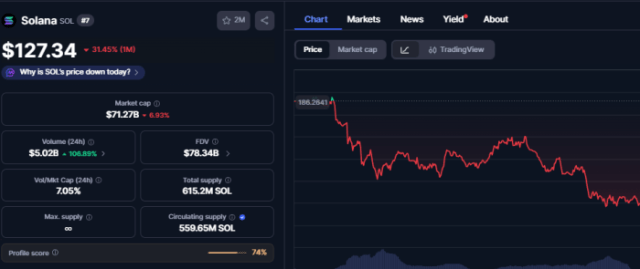
It’s a sign that traders are getting tired of pure degen rotations where tokens moon and then die within days. Liquidity is thinning on short-lived hype, and the market is quietly asking for something stickier than the next dog mascot.
You’re seeing it in sentiment: traders want meme coins that still deliver the dopamine hit, but with a storyline or mechanic that gives people a reason to come back tomorrow. Simple ‘buy, wait, pray for a CEX listing’ models feel dated when everyone has lived through multiple meme coin cycles already.
That’s why capital rotation away from hyperactive Solana meme coin churn matters.
 In that context, PEPENODE ($PEPENODE) positions itself as a different way to play the next meme coin cycle: a mine-to-earn ERC‑20 token on Ethereum that wraps meme coin culture around a virtual mining game.
Instead of needing ASICs or GPUs, users operate gamified mining nodes through a dashboard, turning what’s usually a back-end infrastructure process into front-end entertainment.
Visit the official $PEPENODE presale website for more project details.
Why Meme Coin Capital Is Rotating Toward Mechanics, Not Just Mascots
The last two years of Solana meme coin mania have shown how quickly pure narrative trades can exhaust themselves. High-frequency launches, thin liquidity, and rapid rug cycles have trained traders to treat most new tokens as intraday lottery tickets, not communities to actually stick with beyond a few volatile sessions.
 As that playbook gets crowded, there is growing interest in meme coin projects that bolt on real mechanics: gamification, social farming layers, NFT-based perks, or yield-style reward systems.
These don’t turn meme coins into blue-chip fundamentals, but they do offer repeatable actions and progression systems that survive beyond initial hype.
Competing efforts span across chains: gaming-infused memes on BNB Chain, social-fi memes on Base, and experimental ‘work-to-earn’ or ‘engage-to-earn’ designs on Ethereum and Solana.
In this mix, $PEPENODE is one of several projects that aims to capture rotating capital by making the meme coin itself the front end of a simplified mining and rewards economy, rather than just a ticker symbol.
Buy your $PEPENODE today.
Inside PEPENODE’s Virtual Mine-to-Earn Narrative
Where most mining-related projects lean into hardware jargon and hash power charts, PEPENODE ($PEPENODE) flips the script with a virtual mining system.
You’ll be able to buy and customize mining nodes, upgrade in‑game facilities to boost performance, and earn meme coin rewards like $PEPE and $FARTCOIN, all without using a single watt of real electricity or configuring actual rigs.
The project’s core pitch is solving recurring pain points at once: mining that feels boring or opaque and technical hurdles that keep non‑miners on the sidelines.
Early adopters in PEPENODE’s ecosystem can secure more powerful nodes with higher reward potential, effectively front‑loading upside for those willing to join before the full gameplay loop goes live.
On the token side, $PEPENODE runs as an ERC‑20 on Ethereum’s proof‑of‑stake network, with smart contracts handling staking logic, rewards, and governance hooks.
 The presale has raised over $2.2M so far, with tokens currently priced at $0.0011731. As for staking, the $PEPENODE presale offers an impressive 578% APY.
As is the nature of presales, though, the price will increase in stages, while staking APY will drop as more $PEPENODE holders join the staking pool.
That makes now the the perfect time to join the $PEPENODE presale. If you’re planning to do just that, take a look at our guide to buying $PEPENODE.
Our price prediction for $PEPENODE puts the token at a potential $0.0072 by end-2026 and $0.0244 or higher by 2030. In terms of ROI, these numbers translate to 513% and 1,979% respectively.
 Ready to jump in? Join the $PEPENODE presale before the next price increase.
Disclaimer: This isn’t financial advice. Always do your own research before making any investment decision.
Authored by Bogdan Patru, Bitcoinist – https://bitcoinist.com/solana-meme-coin-volume-hits-2-year-low-investors-turn-to-pepenode
You May Also Like

The Channel Factories We’ve Been Waiting For


SUI Ecosystem Sees Strong Revival as TVL Surpasses $1 Billion Again
