NEAR Foundation introduces AI Cloud and Private Chat solutions with hardware-backed privacy. Brave Nightly, OpenMind AGI, and Phala Network have implemented these tools. The post NEAR Foundation Launches AI Cloud, Private Chat for Over 100M Users appeared first on Coinspeaker.NEAR Foundation introduces AI Cloud and Private Chat solutions with hardware-backed privacy. Brave Nightly, OpenMind AGI, and Phala Network have implemented these tools. The post NEAR Foundation Launches AI Cloud, Private Chat for Over 100M Users appeared first on Coinspeaker.

NEAR Foundation Launches AI Cloud, Private Chat for Over 100M Users

2025/12/04 04:47

The NEAR Foundation announced the launch of two new and interconnected projects: NEAR AI Cloud and Private Chat. These solutions are already implemented by Brave Nightly, OpenMind AGI, and Phala Network, reaching over 100 million users.

According to the announcement via an X thread on Dec. 3, these products are built around the principle that “users should own their AI” by offering “hardware-backed, verifiable privacy.”

For NEAR AI Cloud, every request is processed by Intel TDX and NVIDIA Confidential Computing hardware—two industry-respected trusted execution environment (TEE) solutions. This is important to keep every piece of data sealed and isolated from external participants, securing data privacy.

Users can also verify that their data was really protected by accessing “a cryptographic attestation proving the model ran the expected code” in the expected privacy environment.

The Privacy Chat leverages NEAR AI Cloud, running on top of it, and “introduces verifiable privacy to your everyday questions and research.” Essentially, it is an application similar to OpenAI’s ChatGPT, Google’s Gemini, or xAI’s Grok, but without the data-harvesting part by the controlling company.

Brave announced NEAR AI Cloud integration to its test implementation, Brave Nightly, on Nov. 20. Together with the leading privacy-enhancing browser integration, NEAR Protocol communicated that OpenMind AGI and Phala Network are also using its solutions for verifiable privacy, reaching more than 100 million users.

“NEAR AI’s confidential computing has been validated under real operational conditions: high-volume traffic, deterministic latency, strict compliance requirements,” the NEAR Foundation account posted. “NEAR AI is proven at launch, stress-tested with partners handling sensitive workloads at scale.”

NEAR Price Analysis

NEAR NEAR $1.84 24h volatility: 2.1% Market cap: $2.35 B Vol. 24h: $229.97 M is currently changing hands between $1.81 and $1.82, testing a reentry to a year-long support zone that the asset briefly lost during Bitcoin’s crash down to $84,000 on Dec. 1. This area has seen significant buying pressure since early 2025.
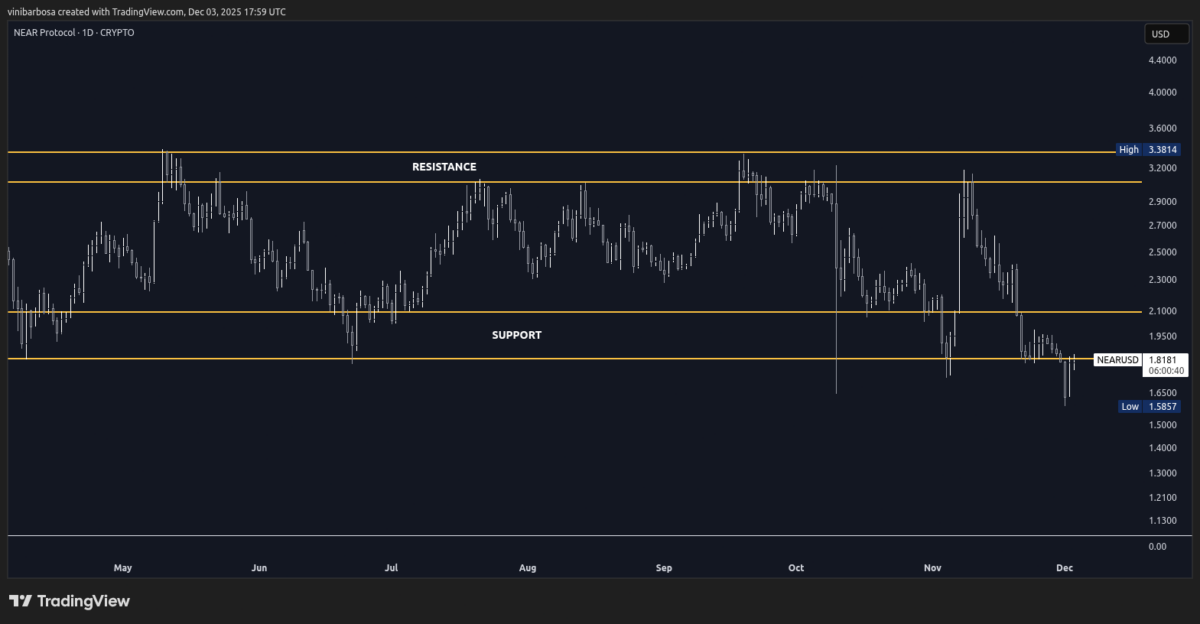
NEAR 1D price chart, as of Dec. 3, 2025 | Source: TradingView

NEAR 1D price chart, as of Dec. 3, 2025 | Source: TradingView

Retrieving the price levels within the historical support is an important step for price recovery, while keeping trading below that zone could indicate NEAR has entered bear territory and could trend downward in the following days.

Michaël van de Poppe, CIO and founder of MN Fund and MN Capital, is looking at similar levels. NEAR needs to break through the $1.80 and $1.95 price levels for it to “be good to go upward from here,” according to his analysis.

From a fundamental perspective, the project is accumulating relevant momentum with NEAR Intents metrics ramping up exponentially—now with over $7 billion in all-time volume and $11.68 million in total generated fees across 12 million cross-chain swaps and with over 800,000 unique addresses in the last 30 days, per Dune Analytics data. The all-time volume was at $3 billion when Coinspeaker covered this data on Oct. 30.
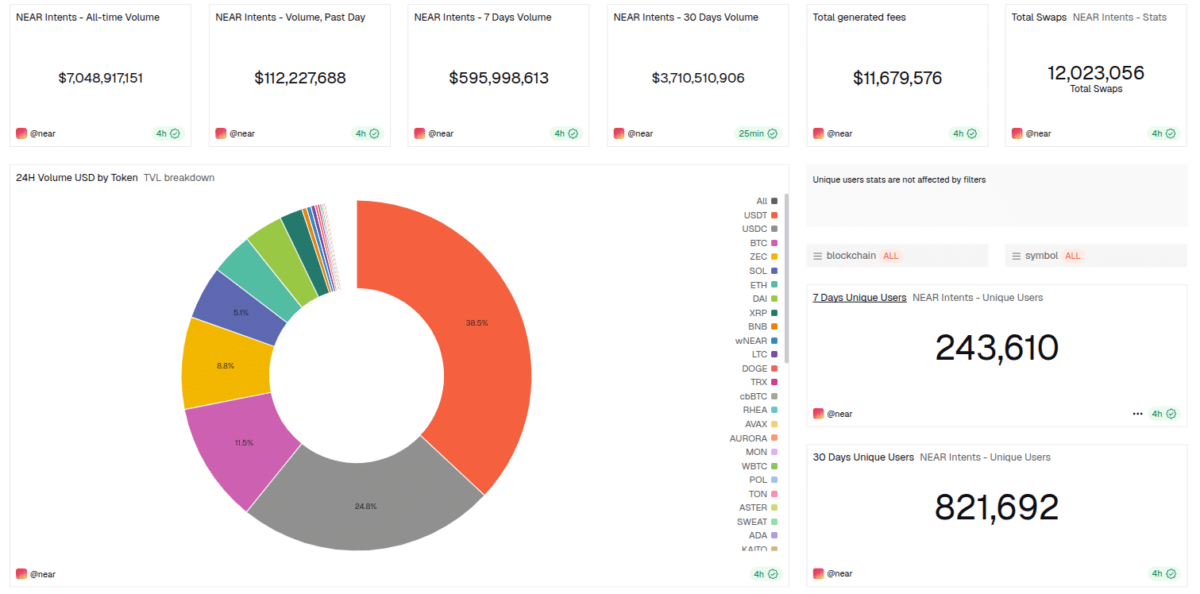
NEAR Intents dashboard as of Dec. 3, 2025 | Source: Dune Analytics

NEAR Intents dashboard as of Dec. 3, 2025 | Source: Dune Analytics

The leading US-based prediction market, Kalshi, has added support for the NEAR token on Nov. 25, as Coinspeaker reported, making another relevant development for the project. Moreover, the NEAR validator’s community approved an inflation halving on Oct. 28 that reduced the NEAR token’s annual tail emission from 5% to 2.5%, which can have a future economic impact by diminishing the available supply pressure for token sales.

next

The post NEAR Foundation Launches AI Cloud, Private Chat for Over 100M Users appeared first on Coinspeaker.

Disclaimer: The articles reposted on this site are sourced from public platforms and are provided for informational purposes only. They do not necessarily reflect the views of MEXC. All rights remain with the original authors. If you believe any content infringes on third-party rights, please contact [email protected] for removal. MEXC makes no guarantees regarding the accuracy, completeness, or timeliness of the content and is not responsible for any actions taken based on the information provided. The content does not constitute financial, legal, or other professional advice, nor should it be considered a recommendation or endorsement by MEXC.

You May Also Like

The Channel Factories We’ve Been Waiting For

The Channel Factories We’ve Been Waiting For

The post The Channel Factories We’ve Been Waiting For appeared on BitcoinEthereumNews.com. Visions of future technology are often prescient about the broad strokes while flubbing the details. The tablets in “2001: A Space Odyssey” do indeed look like iPads, but you never see the astronauts paying for subscriptions or wasting hours on Candy Crush.  Channel factories are one vision that arose early in the history of the Lightning Network to address some challenges that Lightning has faced from the beginning. Despite having grown to become Bitcoin’s most successful layer-2 scaling solution, with instant and low-fee payments, Lightning’s scale is limited by its reliance on payment channels. Although Lightning shifts most transactions off-chain, each payment channel still requires an on-chain transaction to open and (usually) another to close. As adoption grows, pressure on the blockchain grows with it. The need for a more scalable approach to managing channels is clear. Channel factories were supposed to meet this need, but where are they? In 2025, subnetworks are emerging that revive the impetus of channel factories with some new details that vastly increase their potential. They are natively interoperable with Lightning and achieve greater scale by allowing a group of participants to open a shared multisig UTXO and create multiple bilateral channels, which reduces the number of on-chain transactions and improves capital efficiency. Achieving greater scale by reducing complexity, Ark and Spark perform the same function as traditional channel factories with new designs and additional capabilities based on shared UTXOs.  Channel Factories 101 Channel factories have been around since the inception of Lightning. A factory is a multiparty contract where multiple users (not just two, as in a Dryja-Poon channel) cooperatively lock funds in a single multisig UTXO. They can open, close and update channels off-chain without updating the blockchain for each operation. Only when participants leave or the factory dissolves is an on-chain transaction…
Share
BitcoinEthereumNews2025/09/18 00:09
CME Group to launch Solana and XRP futures options in October

CME Group to launch Solana and XRP futures options in October

The post CME Group to launch Solana and XRP futures options in October appeared on BitcoinEthereumNews.com. CME Group is preparing to launch options on SOL and XRP futures next month, giving traders new ways to manage exposure to the two assets.  The contracts are set to go live on October 13, pending regulatory approval, and will come in both standard and micro sizes with expiries offered daily, monthly and quarterly. The new listings mark a major step for CME, which first brought bitcoin futures to market in 2017 and added ether contracts in 2021. Solana and XRP futures have quickly gained traction since their debut earlier this year. CME says more than 540,000 Solana contracts (worth about $22.3 billion), and 370,000 XRP contracts (worth $16.2 billion), have already been traded. Both products hit record trading activity and open interest in August. Market makers including Cumberland and FalconX plan to support the new contracts, arguing that institutional investors want hedging tools beyond bitcoin and ether. CME’s move also highlights the growing demand for regulated ways to access a broader set of digital assets. The launch, which still needs the green light from regulators, follows the end of XRP’s years-long legal fight with the US Securities and Exchange Commission. A federal court ruling in 2023 found that institutional sales of XRP violated securities laws, but programmatic exchange sales did not. The case officially closed in August 2025 after Ripple agreed to pay a $125 million fine, removing one of the biggest uncertainties hanging over the token. This is a developing story. This article was generated with the assistance of AI and reviewed by editor Jeffrey Albus before publication. Get the news in your inbox. Explore Blockworks newsletters: Source: https://blockworks.co/news/cme-group-solana-xrp-futures
Share
BitcoinEthereumNews2025/09/17 23:55
