The post Solana Builders Question Base Bridge’s Bidirectionality in Escalating Rivalry appeared on BitcoinEthereumNews.com. The Base Solana bridge, launched on December 4, enables seamless asset transfers between the two ecosystems using Chainlink CCIP and Coinbase infrastructure. This move has sparked controversy, with Solana developers accusing Base of prioritizing its own growth over true interoperability, while Base insists on mutual benefits for developers and users. Launch Details: The bridge supports bidirectional asset movement, integrating early with Base-native apps like Aerodrome and Zora to facilitate liquidity across chains. Escalating Tensions: Solana’s key figures, including CEO Mert Mumtaz and co-founder Anatoly Yakovenko, have criticized the initiative as a potential vampire attack disguised as collaboration. Potential Impacts: Data from on-chain activity shows Solana’s meme coin and NFT markets could funnel value to Base, raising concerns about net export for Solana’s economy. Discover the Base Solana bridge controversy: How interoperability claims clash with competition in crypto. Explore key debates, benefits, and risks for developers—read now for insights on blockchain rivalries. What is the Base Solana Bridge and Why Has It Caused Controversy? The Base Solana bridge is a cross-chain infrastructure connecting the Base network, built on Ethereum Layer 2 by Coinbase, with the high-speed Solana blockchain, allowing users to transfer assets like SOL and SPL tokens bidirectionally. Launched on December 4, it leverages Chainlink’s Cross-Chain Interoperability Protocol (CCIP) and Coinbase’s secure framework for reliable transfers. The controversy stems from Solana community’s accusations that Base’s rollout favors its own ecosystem, potentially extracting value from Solana without reciprocal benefits, as highlighted in public debates involving leaders like Jesse Pollak and Anatoly Yakovenko. How Does the Base Solana Bridge Impact Ecosystem Competition? The bridge’s design enables Base applications, such as Aerodrome for decentralized exchanges and Zora for NFTs, to import Solana assets, instantly exposing Base to Solana’s vibrant meme coin trading and retail user base, which has driven over $10 billion in… The post Solana Builders Question Base Bridge’s Bidirectionality in Escalating Rivalry appeared on BitcoinEthereumNews.com. The Base Solana bridge, launched on December 4, enables seamless asset transfers between the two ecosystems using Chainlink CCIP and Coinbase infrastructure. This move has sparked controversy, with Solana developers accusing Base of prioritizing its own growth over true interoperability, while Base insists on mutual benefits for developers and users. Launch Details: The bridge supports bidirectional asset movement, integrating early with Base-native apps like Aerodrome and Zora to facilitate liquidity across chains. Escalating Tensions: Solana’s key figures, including CEO Mert Mumtaz and co-founder Anatoly Yakovenko, have criticized the initiative as a potential vampire attack disguised as collaboration. Potential Impacts: Data from on-chain activity shows Solana’s meme coin and NFT markets could funnel value to Base, raising concerns about net export for Solana’s economy. Discover the Base Solana bridge controversy: How interoperability claims clash with competition in crypto. Explore key debates, benefits, and risks for developers—read now for insights on blockchain rivalries. What is the Base Solana Bridge and Why Has It Caused Controversy? The Base Solana bridge is a cross-chain infrastructure connecting the Base network, built on Ethereum Layer 2 by Coinbase, with the high-speed Solana blockchain, allowing users to transfer assets like SOL and SPL tokens bidirectionally. Launched on December 4, it leverages Chainlink’s Cross-Chain Interoperability Protocol (CCIP) and Coinbase’s secure framework for reliable transfers. The controversy stems from Solana community’s accusations that Base’s rollout favors its own ecosystem, potentially extracting value from Solana without reciprocal benefits, as highlighted in public debates involving leaders like Jesse Pollak and Anatoly Yakovenko. How Does the Base Solana Bridge Impact Ecosystem Competition? The bridge’s design enables Base applications, such as Aerodrome for decentralized exchanges and Zora for NFTs, to import Solana assets, instantly exposing Base to Solana’s vibrant meme coin trading and retail user base, which has driven over $10 billion in…

Solana Builders Question Base Bridge’s Bidirectionality in Escalating Rivalry

2025/12/07 01:44
  • Launch Details: The bridge supports bidirectional asset movement, integrating early with Base-native apps like Aerodrome and Zora to facilitate liquidity across chains.

  • Escalating Tensions: Solana’s key figures, including CEO Mert Mumtaz and co-founder Anatoly Yakovenko, have criticized the initiative as a potential vampire attack disguised as collaboration.

  • Potential Impacts: Data from on-chain activity shows Solana’s meme coin and NFT markets could funnel value to Base, raising concerns about net export for Solana’s economy.

Discover the Base Solana bridge controversy: How interoperability claims clash with competition in crypto. Explore key debates, benefits, and risks for developers—read now for insights on blockchain rivalries.

What is the Base Solana Bridge and Why Has It Caused Controversy?

The Base Solana bridge is a cross-chain infrastructure connecting the Base network, built on Ethereum Layer 2 by Coinbase, with the high-speed Solana blockchain, allowing users to transfer assets like SOL and SPL tokens bidirectionally. Launched on December 4, it leverages Chainlink’s Cross-Chain Interoperability Protocol (CCIP) and Coinbase’s secure framework for reliable transfers. The controversy stems from Solana community’s accusations that Base’s rollout favors its own ecosystem, potentially extracting value from Solana without reciprocal benefits, as highlighted in public debates involving leaders like Jesse Pollak and Anatoly Yakovenko.

How Does the Base Solana Bridge Impact Ecosystem Competition?

The bridge’s design enables Base applications, such as Aerodrome for decentralized exchanges and Zora for NFTs, to import Solana assets, instantly exposing Base to Solana’s vibrant meme coin trading and retail user base, which has driven over $10 billion in annual transaction volume according to blockchain analytics from Dune. Solana advocates, including DRiP founder Vibhu Norby, argue this setup risks turning Solana into a liquidity feeder for Base, where fees and executions remain on Base, potentially siphoning up to 20-30% of cross-chain value based on similar past integrations. In contrast, Base’s creator Jesse Pollak emphasizes developer outreach over nine months, noting collaborations with meme projects like Trencher, and positions it as essential for broader Web3 accessibility. Expert analysis from Chainlink reports underscores that true interoperability requires balanced governance to prevent such imbalances, quoting protocol engineers on the need for neutral fee structures. This rivalry, rooted in September’s Basecamp boasts of overtaking Solana, illustrates how competition can fuel innovation while testing collaboration boundaries in the blockchain space.

Frequently Asked Questions

What Are the Main Criticisms of the Base Solana Bridge Launch?

Solana builders criticize the Base Solana bridge for lacking coordination with the Solana Foundation and excluding Solana-native apps from initial integrations, viewing it as a strategic move to import liquidity without enabling Solana executions. Figures like Akshay BD from Superteam highlight the dishonest framing of bidirectionality, supported by on-chain data showing early flows favoring Base’s DeFi pools. Despite this, Base reports genuine developer interest in cross-ecosystem access.

Is the Base Solana Bridge Truly Bidirectional for Users?

Yes, the Base Solana bridge supports bidirectional transfers of assets between the chains, allowing Solana users to access Base’s Ethereum-compatible liquidity and vice versa, which can enhance trading opportunities across meme coins and NFTs. This setup, powered by secure oracles, aims to connect Solana’s speed with Base’s cost efficiency, making it easier for everyday traders to move funds without centralized intermediaries.

Key Takeaways

  • Interoperability vs. Competition: The Base Solana bridge highlights the tension between collaborative tools and aggressive growth strategies in crypto, where bridges can boost liquidity but also spark value extraction debates.
  • Developer Benefits: Early integrations with apps like Virtuals and Flaunch demonstrate potential for shared economies, though Solana experts call for more inclusive launches to ensure mutual gains.
  • Future Outlook: Monitor on-chain metrics for net flows; if balanced, this could set a model for L2-blockchain partnerships, urging developers to explore hybrid dApps.

Conclusion

The Base Solana bridge represents a pivotal step in cross-chain interoperability, yet its launch has intensified the Base Solana rivalry by raising questions about genuine collaboration versus competitive extraction. With voices from Helius Labs CEO Mert Mumtaz to Solana co-founder Anatoly Yakovenko emphasizing fair value capture, this development underscores the evolving dynamics of blockchain ecosystems. As adoption grows, stakeholders should watch for policy adjustments to foster sustainable partnerships—stay informed on these shifts to navigate the crypto landscape effectively.

Source: https://en.coinotag.com/solana-builders-question-base-bridges-bidirectionality-in-escalating-rivalry


Disclaimer: The articles reposted on this site are sourced from public platforms and are provided for informational purposes only. They do not necessarily reflect the views of MEXC. All rights remain with the original authors. If you believe any content infringes on third-party rights, please contact [email protected] for removal. MEXC makes no guarantees regarding the accuracy, completeness, or timeliness of the content and is not responsible for any actions taken based on the information provided. The content does not constitute financial, legal, or other professional advice, nor should it be considered a recommendation or endorsement by MEXC.

You May Also Like

IP Hits $11.75, HYPE Climbs to $55, BlockDAG Surpasses Both with $407M Presale Surge!

IP Hits $11.75, HYPE Climbs to $55, BlockDAG Surpasses Both with $407M Presale Surge!

The post IP Hits $11.75, HYPE Climbs to $55, BlockDAG Surpasses Both with $407M Presale Surge! appeared on BitcoinEthereumNews.com. Crypto News 17 September 2025 | 18:00 Discover why BlockDAG’s upcoming Awakening Testnet launch makes it the best crypto to buy today as Story (IP) price jumps to $11.75 and Hyperliquid hits new highs. Recent crypto market numbers show strength but also some limits. The Story (IP) price jump has been sharp, fueled by big buybacks and speculation, yet critics point out that revenue still lags far behind its valuation. The Hyperliquid (HYPE) price looks solid around the mid-$50s after a new all-time high, but questions remain about sustainability once the hype around USDH proposals cools down. So the obvious question is: why chase coins that are either stretched thin or at risk of retracing when you could back a network that’s already proving itself on the ground? That’s where BlockDAG comes in. While other chains are stuck dealing with validator congestion or outages, BlockDAG’s upcoming Awakening Testnet will be stress-testing its EVM-compatible smart chain with real miners before listing. For anyone looking for the best crypto coin to buy, the choice between waiting on fixes or joining live progress feels like an easy one. BlockDAG: Smart Chain Running Before Launch Ethereum continues to wrestle with gas congestion, and Solana is still known for network freezes, yet BlockDAG is already showing a different picture. Its upcoming Awakening Testnet, set to launch on September 25, isn’t just a demo; it’s a live rollout where the chain’s base protocols are being stress-tested with miners connected globally. EVM compatibility is active, account abstraction is built in, and tools like updated vesting contracts and Stratum integration are already functional. Instead of waiting for fixes like other networks, BlockDAG is proving its infrastructure in real time. What makes this even more important is that the technology is operational before the coin even hits exchanges. That…
Share
BitcoinEthereumNews2025/09/18 00:32
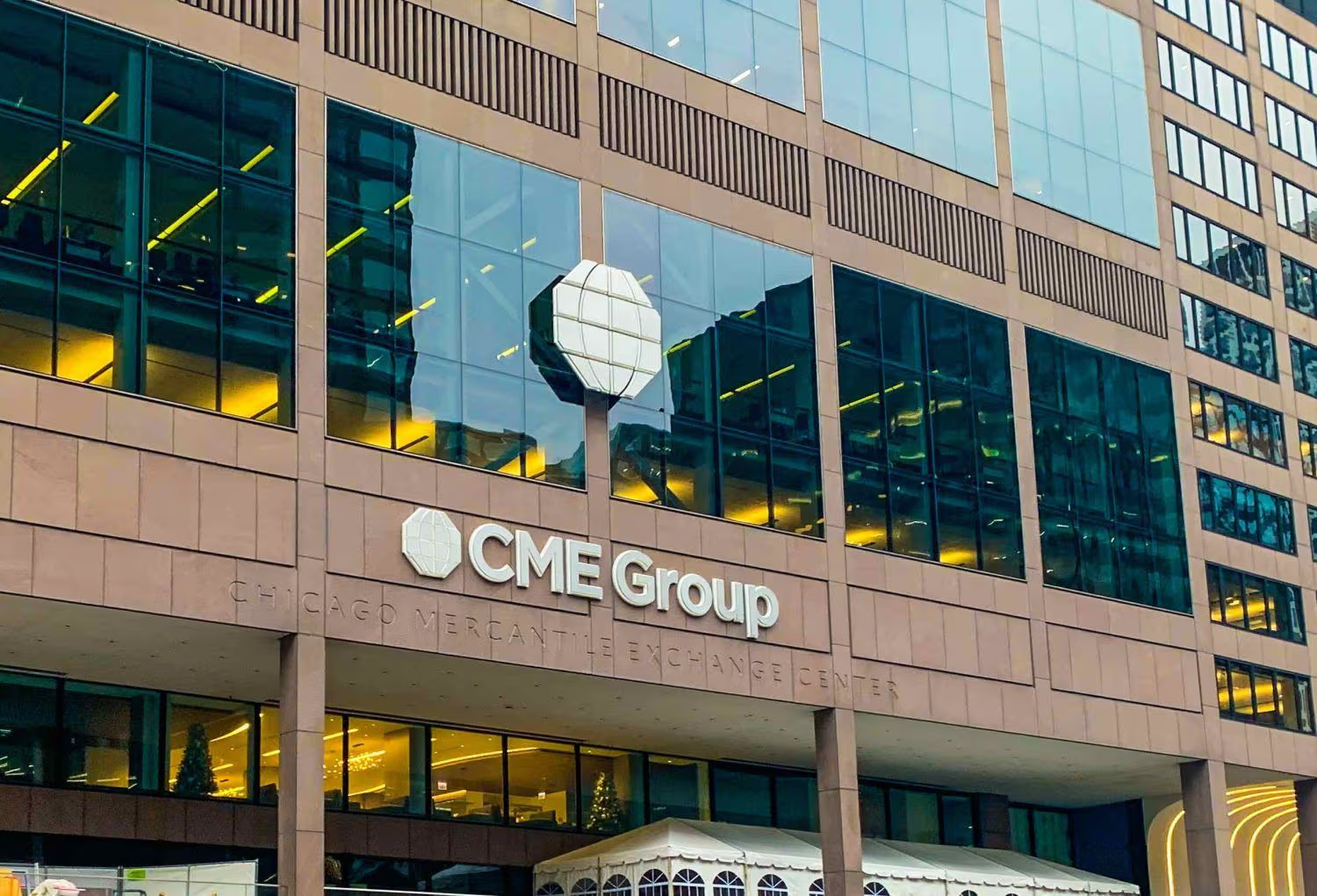
Breaking: CME Group Unveils Solana and XRP Options

Breaking: CME Group Unveils Solana and XRP Options

CME Group launches Solana and XRP options, expanding crypto offerings. SEC delays Solana and XRP ETF approvals, market awaits clarity. Strong institutional demand drives CME’s launch of crypto options contracts. In a bold move to broaden its cryptocurrency offerings, CME Group has officially launched options on Solana (SOL) and XRP futures. Available since October 13, 2025, these options will allow traders to hedge and manage exposure to two of the most widely traded digital assets in the market. The new contracts come in both full-size and micro-size formats, with expiration options available daily, monthly, and quarterly, providing flexibility for a diverse range of market participants. This expansion aligns with the rising demand for innovative products in the crypto space. Giovanni Vicioso, CME Group’s Global Head of Cryptocurrency Products, noted that the new options offer increased flexibility for traders, from institutions to active individual investors. The growing liquidity in Solana and XRP futures has made the introduction of these options a timely move to meet the needs of an expanding market. Also Read: Vitalik Buterin Reveals Ethereum’s Bold Plan to Stay Quantum-Secure and Simple! Rapid Growth in Solana and XRP Futures Trading CME Group’s decision to roll out options on Solana and XRP futures follows the substantial growth in these futures products. Since the launch of Solana futures in March 2025, more than 540,000 contracts, totaling $22.3 billion in notional value, have been traded. In August 2025, Solana futures set new records, with an average daily volume (ADV) of 9,000 contracts valued at $437.4 million. The average daily open interest (ADOI) hit 12,500 contracts, worth $895 million. Similarly, XRP futures, which launched in May 2025, have seen significant adoption, with over 370,000 contracts traded, totaling $16.2 billion. XRP futures also set records in August 2025, with an ADV of 6,600 contracts valued at $385 million and a record ADOI of 9,300 contracts, worth $942 million. Institutional Demand for Advanced Hedging Tools CME Group’s expansion into options is a direct response to growing institutional interest in sophisticated cryptocurrency products. Roman Makarov from Cumberland Options Trading at DRW highlighted the market demand for more varied crypto products, enabling more advanced risk management strategies. Joshua Lim from FalconX also noted that the new options products meet the increasing need for institutional hedging tools for assets like Solana and XRP, further cementing their role in the digital asset space. The launch of options on Solana and XRP futures marks another step toward the maturation of the cryptocurrency market, providing a broader range of tools for managing digital asset exposure. SEC’s Delay on Solana and XRP ETF Approvals While CME Group expands its offerings, the broader market is also watching the progress of Solana and XRP exchange-traded funds (ETFs). The U.S. Securities and Exchange Commission (SEC) has delayed its decisions on multiple crypto-related ETF filings, including those for Solana and XRP. Despite the delay, analysts anticipate approval may be on the horizon. This week, REX Shares and Osprey Funds are expected to launch an XRP ETF that will hold XRP directly and allocate at least 40% of its assets to other XRP-related ETFs. Despite the delays, some analysts believe that approval could come soon, fueling further interest in these assets. The delay by the SEC has left many crypto investors awaiting clarity, but approval of these ETFs could fuel further momentum in the Solana and XRP futures markets. Also Read: Tether CEO Breaks Silence on $117,000 Bitcoin Price – Market Reacts! The post Breaking: CME Group Unveils Solana and XRP Options appeared first on 36Crypto.
Share
Coinstats2025/09/18 02:35