TLDR Target shares dip to $96.65 as of Aug. 21, 2025, reflecting investor concerns after Q2 earnings. Comparable sales declined 1.9%, though results showed slight improvement from Q1. Digital sales rose 4.3%, with Target Circle 360 same-day delivery up more than 25%. CEO Brian Cornell steps down, with Michael Fiddelke set to lead the retailer [...] The post Target Corp. ($TGT) Stock: Shares Fall Below $100 on Q2 Earnings, CEO Transition appeared first on CoinCentral.TLDR Target shares dip to $96.65 as of Aug. 21, 2025, reflecting investor concerns after Q2 earnings. Comparable sales declined 1.9%, though results showed slight improvement from Q1. Digital sales rose 4.3%, with Target Circle 360 same-day delivery up more than 25%. CEO Brian Cornell steps down, with Michael Fiddelke set to lead the retailer [...] The post Target Corp. ($TGT) Stock: Shares Fall Below $100 on Q2 Earnings, CEO Transition appeared first on CoinCentral.

Target Corp. ($TGT) Stock: Shares Fall Below $100 on Q2 Earnings, CEO Transition

2025/08/22 04:08

TLDR

  • Target shares dip to $96.65 as of Aug. 21, 2025, reflecting investor concerns after Q2 earnings.
  • Comparable sales declined 1.9%, though results showed slight improvement from Q1.
  • Digital sales rose 4.3%, with Target Circle 360 same-day delivery up more than 25%.
  • CEO Brian Cornell steps down, with Michael Fiddelke set to lead the retailer forward.
  • Net income dropped 21.5% YoY to $935 million, while EPS fell to $2.05 from $2.57.

On August 21, 2025, Target Corporation (NYSE: TGT) reported Q2 results that sent its stock down 2.07% to $96.65 in midday trading.
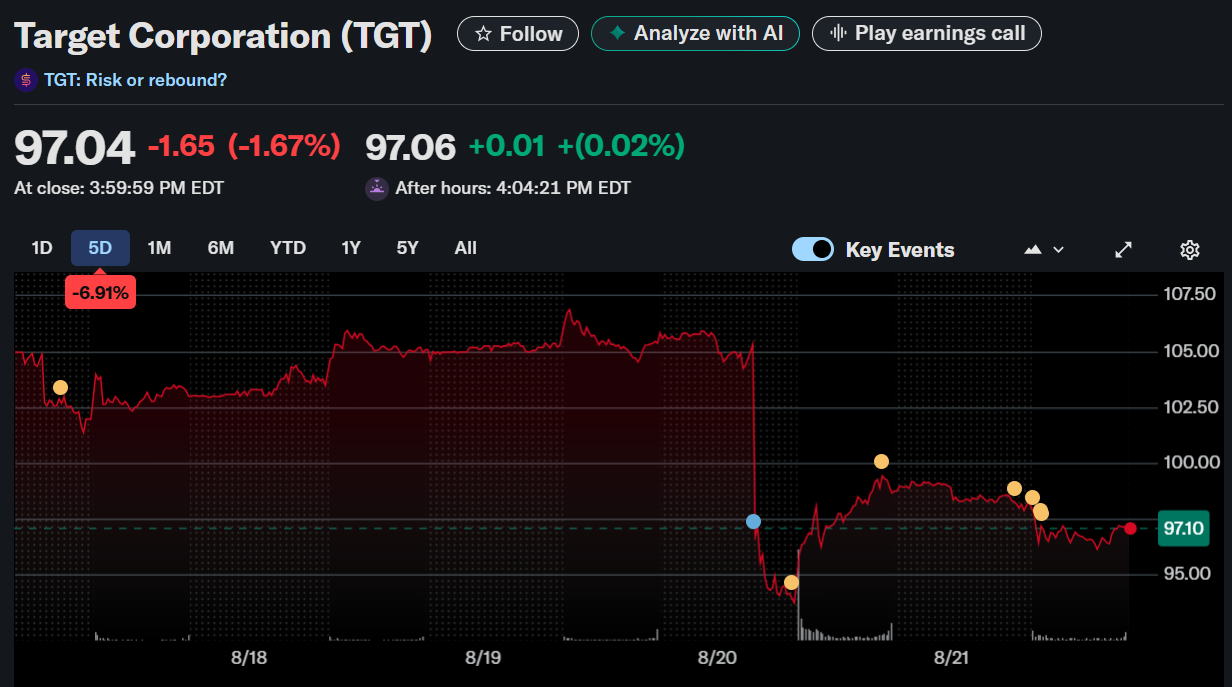
Target Corporation (TGT)

At the close of the previous session, shares had already slipped to $98.69, pushing the company below the symbolic $100 mark. Investors reacted negatively to weaker sales, margin pressure, and the announcement of a CEO transition.

Q2 2025 Performance Highlights

Target posted net sales of $25.2 billion, down 0.9% year-over-year, while comparable sales dropped 1.9%. This was a nearly two-point improvement compared to Q1, but still marked the ninth decline in comps out of the last eleven quarters.

Digital channels provided a bright spot, rising 4.3%, driven by same-day delivery through Target Circle 360, which surged more than 25%. Categories like “Fun 101,” covering toys, entertainment, and impulse buys, grew more than 5%, while trading card sales climbed nearly 70% year-to-date, positioning the segment to surpass $1 billion in sales this year.

Profitability and Margins Under Pressure

The retailer’s gross margin rate contracted by one percentage point from last year, weighed down by inventory adjustment costs and tariffs. Net income fell 21.5% to $935 million, compared with $1.19 billion in Q2 2024. Both GAAP and adjusted EPS came in at $2.05, down from $2.57 a year earlier.

While Target kept SG&A expenses 0.1% lower year-over-year through strict cost controls, profitability remains under stress as consumer caution and higher tariffs cut into earnings.

Leadership Transition: Cornell to Fiddelke

The most significant corporate update came with CEO Brian Cornell announcing his departure. Michael Fiddelke, the current CFO, will take over as CEO and board chair. While Cornell was credited with steering Target through growth phases and digital transformation, analysts expressed concerns that an internal hire may not break from entrenched strategies.

Fiddelke outlined his priorities: revitalizing Target’s merchandising authority, improving in-store customer experiences, and accelerating technology investments. He acknowledged the company’s missteps, noting overemphasis on basic goods during the pandemic and supply chain struggles that left store experiences inconsistent.

Outlook and Market Challenges

Target reaffirmed its outlook for fiscal 2025, expecting GAAP EPS between $8 and $10 and adjusted EPS in the $7 to $9 range, alongside a low single-digit decline in sales. Capital expenditures remain on track to reach $4 billion for the year, with $1.9 billion already invested.

Still, the retailer faces a difficult path forward. From margin pressures to consumer boycotts and competition from Walmart and off-price chains, Target’s challenges remain steep. Analysts argue the company must rediscover its balance of style and affordability that once made it stand out in U.S. retail.


The post Target Corp. ($TGT) Stock: Shares Fall Below $100 on Q2 Earnings, CEO Transition appeared first on CoinCentral.

Disclaimer: The articles reposted on this site are sourced from public platforms and are provided for informational purposes only. They do not necessarily reflect the views of MEXC. All rights remain with the original authors. If you believe any content infringes on third-party rights, please contact [email protected] for removal. MEXC makes no guarantees regarding the accuracy, completeness, or timeliness of the content and is not responsible for any actions taken based on the information provided. The content does not constitute financial, legal, or other professional advice, nor should it be considered a recommendation or endorsement by MEXC.

You May Also Like

The Channel Factories We’ve Been Waiting For

The Channel Factories We’ve Been Waiting For

The post The Channel Factories We’ve Been Waiting For appeared on BitcoinEthereumNews.com. Visions of future technology are often prescient about the broad strokes while flubbing the details. The tablets in “2001: A Space Odyssey” do indeed look like iPads, but you never see the astronauts paying for subscriptions or wasting hours on Candy Crush.  Channel factories are one vision that arose early in the history of the Lightning Network to address some challenges that Lightning has faced from the beginning. Despite having grown to become Bitcoin’s most successful layer-2 scaling solution, with instant and low-fee payments, Lightning’s scale is limited by its reliance on payment channels. Although Lightning shifts most transactions off-chain, each payment channel still requires an on-chain transaction to open and (usually) another to close. As adoption grows, pressure on the blockchain grows with it. The need for a more scalable approach to managing channels is clear. Channel factories were supposed to meet this need, but where are they? In 2025, subnetworks are emerging that revive the impetus of channel factories with some new details that vastly increase their potential. They are natively interoperable with Lightning and achieve greater scale by allowing a group of participants to open a shared multisig UTXO and create multiple bilateral channels, which reduces the number of on-chain transactions and improves capital efficiency. Achieving greater scale by reducing complexity, Ark and Spark perform the same function as traditional channel factories with new designs and additional capabilities based on shared UTXOs.  Channel Factories 101 Channel factories have been around since the inception of Lightning. A factory is a multiparty contract where multiple users (not just two, as in a Dryja-Poon channel) cooperatively lock funds in a single multisig UTXO. They can open, close and update channels off-chain without updating the blockchain for each operation. Only when participants leave or the factory dissolves is an on-chain transaction…
Share
BitcoinEthereumNews2025/09/18 00:09
CME Group to launch Solana and XRP futures options in October

CME Group to launch Solana and XRP futures options in October

The post CME Group to launch Solana and XRP futures options in October appeared on BitcoinEthereumNews.com. CME Group is preparing to launch options on SOL and XRP futures next month, giving traders new ways to manage exposure to the two assets.  The contracts are set to go live on October 13, pending regulatory approval, and will come in both standard and micro sizes with expiries offered daily, monthly and quarterly. The new listings mark a major step for CME, which first brought bitcoin futures to market in 2017 and added ether contracts in 2021. Solana and XRP futures have quickly gained traction since their debut earlier this year. CME says more than 540,000 Solana contracts (worth about $22.3 billion), and 370,000 XRP contracts (worth $16.2 billion), have already been traded. Both products hit record trading activity and open interest in August. Market makers including Cumberland and FalconX plan to support the new contracts, arguing that institutional investors want hedging tools beyond bitcoin and ether. CME’s move also highlights the growing demand for regulated ways to access a broader set of digital assets. The launch, which still needs the green light from regulators, follows the end of XRP’s years-long legal fight with the US Securities and Exchange Commission. A federal court ruling in 2023 found that institutional sales of XRP violated securities laws, but programmatic exchange sales did not. The case officially closed in August 2025 after Ripple agreed to pay a $125 million fine, removing one of the biggest uncertainties hanging over the token. This is a developing story. This article was generated with the assistance of AI and reviewed by editor Jeffrey Albus before publication. Get the news in your inbox. Explore Blockworks newsletters: Source: https://blockworks.co/news/cme-group-solana-xrp-futures
Share
BitcoinEthereumNews2025/09/17 23:55
