BitcoinWorld US Stocks Close Lower: What Sparked the Sudden Sell-Off? If you watched the markets today, you saw a sea of red. The major US stock indices couldn’t hold their ground, closing the session in negative territory. For investors and traders, especially those with exposure to crypto assets which often correlate with broader risk sentiment, understanding why US stocks close lower is crucial. Let’s break […] This post US Stocks Close Lower: What Sparked the Sudden Sell-Off? first appeared on BitcoinWorld.BitcoinWorld US Stocks Close Lower: What Sparked the Sudden Sell-Off? If you watched the markets today, you saw a sea of red. The major US stock indices couldn’t hold their ground, closing the session in negative territory. For investors and traders, especially those with exposure to crypto assets which often correlate with broader risk sentiment, understanding why US stocks close lower is crucial. Let’s break […] This post US Stocks Close Lower: What Sparked the Sudden Sell-Off? first appeared on BitcoinWorld.

US Stocks Close Lower: What Sparked the Sudden Sell-Off?

2025/12/09 05:25
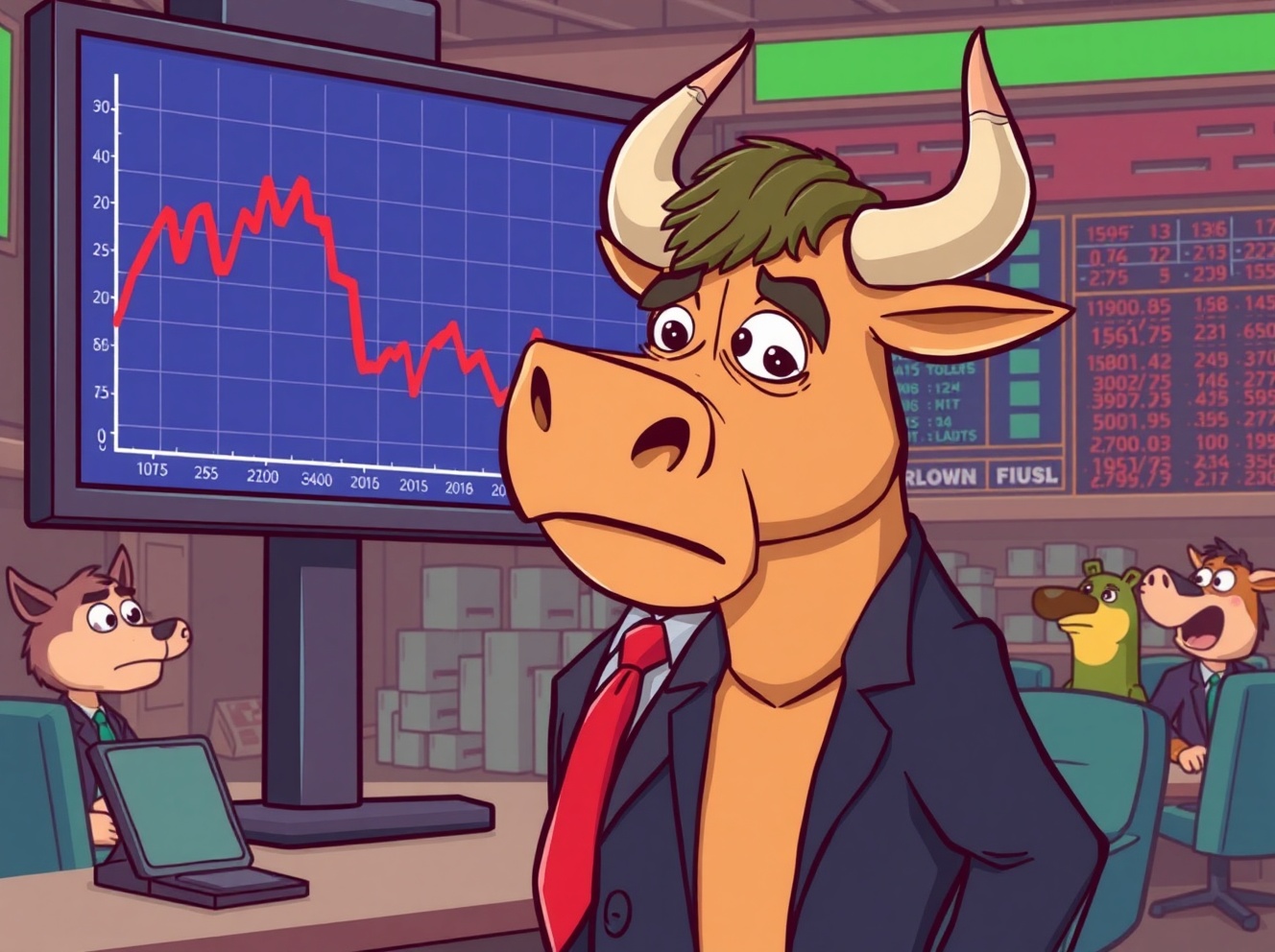
Cartoon illustration of a worried bull watching US stocks close lower on a vibrant trading floor.

BitcoinWorld

US Stocks Close Lower: What Sparked the Sudden Sell-Off?

If you watched the markets today, you saw a sea of red. The major US stock indices couldn’t hold their ground, closing the session in negative territory. For investors and traders, especially those with exposure to crypto assets which often correlate with broader risk sentiment, understanding why US stocks close lower is crucial. Let’s break down the numbers and the narrative behind today’s pullback.

Why Did US Stocks Close Lower Today?

The trading session ended with all three major benchmarks down. The Dow Jones Industrial Average fell 0.45%, the S&P 500 dropped 0.35%, and the tech-heavy Nasdaq Composite declined a more modest 0.14%. This wasn’t a market crash, but a broad-based retreat that suggests investors are hitting the pause button. The primary question on everyone’s mind is simple: what triggered this shift in sentiment?

Several factors likely contributed to the pressure. First, renewed concerns about the pace of interest rate cuts from the Federal Reserve can spook the market. Second, mixed earnings reports from key sectors create uncertainty. Finally, geopolitical tensions often lead to a ‘risk-off’ environment, where money flows out of stocks. When US stocks close lower, it’s rarely due to a single event, but a combination of these headwinds.

Breaking Down the Index Moves

Not all declines are created equal. The varied performance of the indices tells a deeper story about sector rotation and investor focus.

  • The Dow’s Drop (0.45%): This 30-stock blue-chip index, heavy with industrial and financial companies, is often sensitive to economic growth fears. Its larger decline suggests worries about the traditional economy.
  • The S&P 500’s Slide (0.35%): As the broadest benchmark, its move indicates a widespread, though not panicked, sell-off across large-cap America.
  • The Nasdaq’s Relative Resilience (0.14%): The smaller decline here hints that mega-cap tech stocks, which have driven much of the recent rally, showed some defensive strength.

This pattern shows that while selling was broad, it wasn’t a uniform stampede. The fact that US stocks close lower across the board, however, is a clear signal of caution.

What Does This Mean for Your Portfolio?

A single down day is not a trend. However, it serves as a powerful reminder of market volatility. For long-term investors, days like these are normal fluctuations. For active traders, they present both risk and opportunity. The key is to avoid making emotional decisions.

Consider these actionable insights:

  • Review Your Asset Allocation: Ensure your portfolio is diversified across different asset classes to weather downturns.
  • Look for Quality: Market pullbacks can be a chance to invest in strong companies at better prices.
  • Monitor Correlation: Remember, when traditional US stocks close lower, crypto markets can sometimes follow suit as investors reduce overall risk.

Therefore, staying informed and sticking to your strategy is more important than reacting to daily noise.

The Final Tally: A Day of Healthy Caution

In conclusion, the session where US stocks close lower reflects a market digesting complex information. It was a day of measured profit-taking and repositioning rather than outright fear. The underlying economic data and corporate earnings will determine if this is a brief stumble or the start of a deeper correction. For now, investors should view it as a reminder that markets don’t move in a straight line. Staying disciplined and focused on fundamentals is the best response to these inevitable down days.

Frequently Asked Questions (FAQs)

Q: Is it time to sell my stocks because they closed lower?
A> Not necessarily. A one-day decline is normal volatility. Base selling decisions on your long-term investment goals and the fundamentals of your holdings, not daily price movements.

Q: Do crypto prices always drop when US stocks close lower?
A> While not always, there is often a correlation. Both are considered ‘risk-on’ assets. When investors become risk-averse, they may sell both stocks and cryptocurrencies.

Q: Which sectors were hit the hardest today?
A> While specific data varies daily, on days of broad declines, cyclical sectors like industrials, financials, and materials often underperform more defensive sectors like utilities or consumer staples.

Q: Should I “buy the dip” when stocks close lower?
A> “Buying the dip” can be a strategy, but it requires research. Ensure you are investing in fundamentally sound companies or ETFs, and avoid trying to catch a falling knife without a clear plan.

Q: How can I stay updated on market movements?
A> Follow reputable financial news sources, monitor key economic calendars for data releases, and consider setting up alerts for your major holdings.

Found this breakdown of why US stocks close lower helpful? Market knowledge is power. Share this article on your social media to help your network navigate these volatile times with more insight!

To learn more about the latest financial market trends and their impact on digital assets, explore our article on key developments shaping cryptocurrency price action amid traditional market fluctuations.

This post US Stocks Close Lower: What Sparked the Sudden Sell-Off? first appeared on BitcoinWorld.

Disclaimer: The articles reposted on this site are sourced from public platforms and are provided for informational purposes only. They do not necessarily reflect the views of MEXC. All rights remain with the original authors. If you believe any content infringes on third-party rights, please contact [email protected] for removal. MEXC makes no guarantees regarding the accuracy, completeness, or timeliness of the content and is not responsible for any actions taken based on the information provided. The content does not constitute financial, legal, or other professional advice, nor should it be considered a recommendation or endorsement by MEXC.

You May Also Like

Tether invests $81.6M in Italian Humanoid-Robotics firm as AI push accelerates
Tether invests $81.6M in Italian Humanoid-Robotics firm as AI push accelerates

The post Tether invests $81.6M in Italian Humanoid-Robotics firm as AI push accelerates appeared on BitcoinEthereumNews.com. Tether, known as the issuer of the stablecoin USDT, has made a major foray into robotics and physical AI by backing Europe’s up‑and‑coming humanoid robotics firm Generative Bionics with a contribution to a €70 million (approx. $81.6 million) funding round. Notably, this startup develops industrial robots utilizing research from the Italian Institute of Technology. This funding round was led by CDP Venture Capital, a company supported by the Italian government and operating through its Artificial Intelligence Fund. This information was made public following the release of Generative Bionics’s statement, shared by a reliable source. Some of the firms that participated in this round, apart from Tether, included AMD Ventures, the investment arm of the American chipmaker Advanced Micro Devices, and other industry investors. Tether aims to solidify its position as a leader with major investments in AI  Tether’s investment marks another significant milestone in the company’s ongoing series of deals. Concerning its role in issuing the USDT stablecoin, sources acknowledged that stablecoins, cryptocurrencies that are typically connected to traditional currencies such as the dollar, have recently gained popularity, preferred by many as a suitable alternative method of payment. These sources also elaborated that this type of cryptocurrency usually relies on cash reserves and US government bonds issued on a short-term basis to maintain its value.  Following this finding, Tether shared its forecast that the reserves supporting USDT will help it in attaining its target of generating approximately $15 billion in profit this year. The company made this prediction after noting high interest rates in the sector. Based in El Salvador, Tether has been utilizing these profits to expand its presence in various fields, including commodities, artificial intelligence, and sports. The firm also disclosed its growing interest in fields of AI and data. According to the Chief Executive Officer (CEO) of Tether, Paolo…
Share
BitcoinEthereumNews2025/12/09 13:51
Why Washington now eyes BTC miners

Why Washington now eyes BTC miners

The post Why Washington now eyes BTC miners appeared on BitcoinEthereumNews.com. Homepage > News > Business > The shadow over Bitmain: Why Washington now eyes BTC miners For years, most BTC holders didn’t think twice about where their mining equipment came from. Bitmain—this massive Beijing-based manufacturer—just kept shipping Antminers to warehouses in Texas, Kazakhstan, Paraguay, wherever. As long as the rigs worked and the hash rate kept climbing, nobody really cared. That casual attitude died this month when the U.S. government launched a national-security investigation into Bitmain and its stranglehold on global mining hardware. They’re calling it Operation Red Sunset, which should tell you how seriously they’re taking this. Here’s what has Washington spooked: Bitmain controls approximately 80% of the world’s Bitcoin mining equipment. And basically every modern Antminer can be accessed remotely through firmware updates. Theoretically, one command pushed from their headquarters in China could throttle, redirect, or completely brick a huge chunk of the BTC network’s processing power. Intelligence officials worry that Beijing could exploit that access directly, or force Bitmain to do it during some future crisis—Taiwan keeps coming up in these conversations. Making things messier, one of Bitmain’s biggest recent customers is American Bitcoin, a mining operation backed by Donald Trump Jr. and Eric Trump. So yeah, that’s added some urgency to the whole thing. American Bitcoin ordered 16,000 high-end rigs earlier this year for a new facility somewhere in the Midwest. The irony isn’t subtle: a company connected to the incoming first family is now at the center of an investigation designed to reduce foreign control over critical U.S. infrastructure. From what I’m hearing, investigators are especially interested in whether those machines have hidden backdoors or telemetry channels that Beijing could flip on without anyone knowing. Bitmain claims that its remote-management tools are solely for customer support and monitoring efficiency. They insist that no government has…
Share
BitcoinEthereumNews2025/12/09 14:02