

Must Read
A country that gradually abandons industrial capability grows more reliant on imports, external supply chains, and foreign manufacturing ecosystemsA country that gradually abandons industrial capability grows more reliant on imports, external supply chains, and foreign manufacturing ecosystems
[Vantage Point] Does JG Summit’s petrochem exit signal the end of PH industrialization?
Per feedback o dubbi su questo contenuto, contattateci all'indirizzo [email protected].
When JG Summit president and CEO Lance Gokongwei announced his company’s exit from the petrochemical business, many took the line as a sobering assessment of economic reality.
His statement that the country might possibly only be globally competitive in services could be interpreted as a surrender. It signals that one of the country’s major conglomerates no longer thinks Philippine manufacturing can sustainably compete at scale.
That makes JG Summit Holdings Inc.’s decision more than just another step in its portfolio. It turns the sale into a referendum on the country’s industrial strategy itself. For decades, petrochemicals were the sort of industry that the government said it wanted to make — capital-intensive, job-creating, strategically integrated, capable of creating a whole series of downstream manufacturing environments. Plastics, packaging, automotive parts, consumer products, building materials, and industrial chemicals all rely on the back-end of a working petrochemical network. Countries that industrialized successfully rarely skipped this stage. South Korea did not. Taiwan did not. China certainly did not.
But the Philippines seems to be pushing back against it. The irony is hard to lose sight of. The Gokongwei group was one of only a few Philippine conglomerates prepared to make the massive long-term bets needed to develop industrial capability.
 PETROCHEM. JG Summit Petrochemical Corporation and JG Summit Olefins Corporation’s industrial facility in Batangas province. Courtesy of JG Summit website
Under the JG Summit Olefins Corporation, the group created the nation’s first and only naphtha cracker complex — an industrial platform capable of producing polyethylene, polypropylene, aromatics, butadiene, ethylene, and propylene. It was the sort of project governments routinely celebrate as strategic national infrastructure. Instead, it became a financial drag.
Balance sheet under pressure
The numbers show the strain.
In 2024, JG Summit turned around P378.6 billion in revenue and P21.3 billion in net income. But underneath those consolidated numbers sat a balance sheet under pressure. By the first quarter of 2026, the conglomerate still harbored about P303.5 billion of financial debt and about P230.2 billion of net debt. Equity attributable to the parent company declined sharply to around P287.8 billion from roughly P364.4 billion at the end of 2024.
That deterioration matters because conglomerates do not abandon strategic assets merely because margins soften temporarily. They exit when the capital structure no longer justifies continued exposure. The petrochemical segment increasingly looked like such an exposure.
JG Summit’s disclosures illustrated the divergence. Excluding the petrochemical operations, revenues of the rest of the group continued growing. But including them diluted performance. The company itself acknowledged that part of its earnings recovery stemmed from a “significant loss reduction” from halted petrochemical operations. In corporate finance language, that often indicates the beginning of the end.
Why? The explanation, which involves in part the structural economics of the Philippines, goes beyond JG Summit itself. Petrochemicals are hard-nosed enterprises. They need gigantic scale, cheap and steady power, good ports, integrated logistics, sturdy shipping links, and stable industrial policy consistency. Unfortunately, the Philippines has trouble in virtually all those variables at the same time.
Industrial ecosystems survive because factories feed other factories. Petrochemicals become viable when downstream industries — automotive manufacturing, heavy industrial fabrication, export manufacturing, electronics assembly, packaging, chemicals, and consumer-goods manufacturing — grow around them.
Service-driven market
Without that density, upstream producers become hostage to import competition and volatile global pricing. The Philippine economy has instead evolved in another direction. The country increasingly became a services-driven economy powered by consumption, remittances, business-process outsourcing, banking, retail, aviation, and property development.
Recent economic data reflect that imbalance clearly. Services continue to dominate GDP growth, while industry contributes comparatively little. Relative to regional peers, the manufacturing’ sector’s share of national output has steadily weakened over the years. In effect, the Philippines skipped much of the industrial deepening phase that historically transformed middle-income economies into manufacturing powers.
That may explain why Gokongwei’s comments resonated uncomfortably across corporate circles. They reflected not merely the frustration of one conglomerate, but perhaps the emerging consensus of Philippine capital itself: that deploying large-scale industrial capital domestically may no longer generate risk-adjusted returns comparable to services, finance, real estate, infrastructure, or digital platforms.
From a purely shareholder perspective, the pivot is understandable. JG Summit’s strongest franchises today are no longer heavy industry. They are consumer-facing and service-oriented businesses — asset-light relative to petrochemicals, generate faster capital turnover, and they align more naturally with the consumption-heavy structure of the Philippine economy.
But what is sensible for one conglomerate may be deeply disconcerting for national progress. A country that gradually abandons industrial capability grows more reliant on imports, external supply chains, and foreign manufacturing ecosystems. It discards technological upgrading, higher-value exports, industrial employment multipliers, and ultimately even strategic economic resilience.
That is why JG Summit’s petrochemical exit is worth more than just the immediate financial write-off.
Ultimately, the deal may come to be described not as the closure of a specific business segment, but as the quiet consensus among Philippine conglomerates that their deep-seated fear — which many economists seem to have overlooked — has become real: the country’s industrial environment no longer makes large-scale manufacturing a worthwhile risk.
At stake is the future of Philippine industrialization itself.– Rappler.com
I welcome your views on these and other issues where decisions made in power shape the country’s economic future.
Below are Vantage Point pieces you might have missed:
Click here for more Vantage Point articles.


Disclaimer: gli articoli ripubblicati su questo sito provengono da piattaforme pubbliche e sono forniti esclusivamente a scopo informativo. Non riflettono necessariamente le opinioni di MEXC. Tutti i diritti rimangono agli autori originali. Se ritieni che un contenuto violi i diritti di terze parti, contatta [email protected] per la rimozione. MEXC non fornisce alcuna garanzia in merito all'accuratezza, completezza o tempestività del contenuto e non è responsabile per eventuali azioni intraprese sulla base delle informazioni fornite. Il contenuto non costituisce consulenza finanziaria, legale o professionale di altro tipo, né deve essere considerato una raccomandazione o un'approvazione da parte di MEXC.
Potrebbe anche piacerti

Phemex Publishes April 2026 Proof of Reserves, Reporting 131% Total Reserve Ratio
Phemex Publishes April 2026 Proof of Reserves, Reporting 131% Total Reserve Ratio
Condividi
Cryptodaily2026/04/02 19:35
The End of Anonymous Gambling: How 2026’s Global Privacy Crackdown Is Reshaping Crypto Casinos
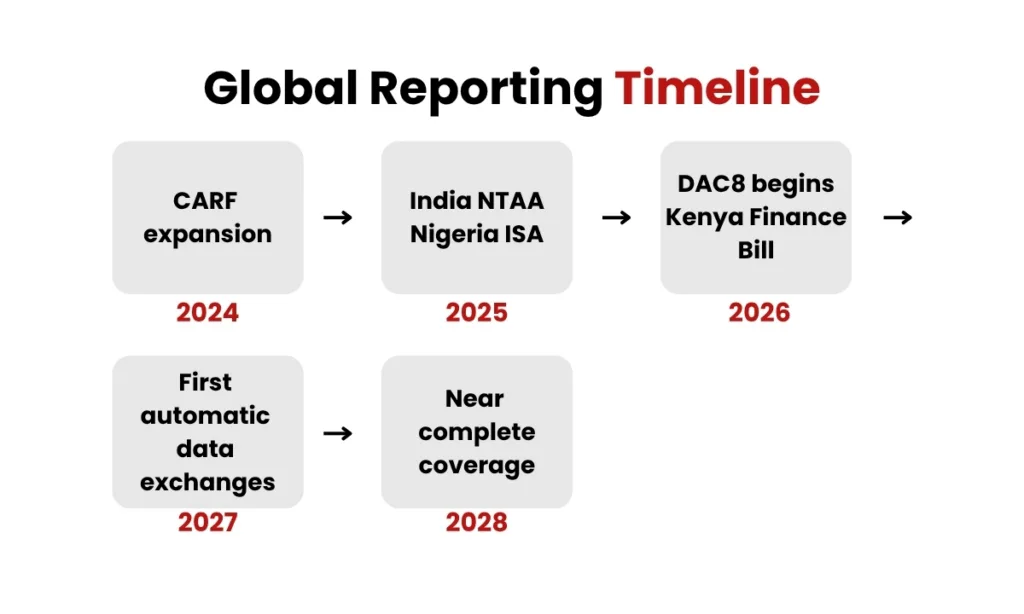
The promise of anonymous crypto gambling is collapsing under new 2026 tax rules, exchange reporting systems, and international data sharing. The post The End of
Condividi
Bitcoinchaser2026/06/09 14:14

China Nabs Another Huione Group Core Member in Cambodia Extradition
The post China Nabs Another Huione Group Core Member in Cambodia Extradition appeared on BitcoinEthereumNews.com. Li Xiong, a senior figure at Huione Group, an
Condividi
BitcoinEthereumNews2026/04/02 17:54


Notizie di tendenza
Altro
