Hackers are now exploiting vulnerabilities in widely-used NPM coding libraries to inject malware into Ethereum smart contracts, according to cybersecurity research by blockchain compliance firm Reversing Labs(RL). In a September 3 blog post detailing the discovery, researcher Lucija Valentić revealed that threat actors bypass security scans by exploiting new open-source malware present in the Node Package Manager (NPM) package repository, which contains extensive JavaScript packages and libraries. The most destructive malware discovered was “colortoolsv2” and “mimelib2“, both published in July, which were found to abuse smart contracts to conceal malicious commands that install downloader malware on infected systems.Source: ReversingLabs How Ethereum Smart Contracts Turn Into Malware Command Centers These packages are part of broader open-source libraries affecting both NPM and GitHub, where malicious supply chain actors use advanced social engineering and deception tactics to trick developers into incorporating harmful code into their projects. According to ReversingLabs, 2025 has witnessed a diverse range of malicious campaigns targeting NPM, the leading online repository for JavaScript packages. In March, RL documented the discovery of NPM packages ethers-provider2 and ethers-providerz Since discovering the ethers campaign, researchers have detected numerous additional infostealers, downloaders, and droppers found on NPM. At the beginning of July, RL researcher Karlo Zanki discovered and reported a new NPM campaign involving a basic package that deployed blockchain in a novel way to deliver a malicious second stage. The exact package colortoolsv2 is being used to infiltrate Ethereum smart contracts. According to RL researchers, the malware is a basic NPM package containing just two files. The major file is a script named index.js, which contains a hidden malicious payload. Once installed in a project, the script would run to fetch blockchain data and execute a harmful command by loading the URL for a command and control (C2) server that would then download second-stage malware to the requesting system. Although “downloader” malware is a common method hackers use in NPM repositories to target victims, this specific malware is unusual as it uses Ethereum smart contracts to host the URLs where malicious commands are located for downloading the second-stage malware. Notably, the cybersecurity researchers acknowledge that they haven’t encountered this approach previously. Two-File Malware Hides a $2.5M Bridge Exploit Method The researchers uncovered a Solana-trading-bot infected by the malicious colortoolsv2 package called solana-trading-bot-v2, which appears to be a trustworthy GitHub project to the average observer.Source: ReversingLabs It has thousands of commits, several active contributors, and a decent number of stars and watchers, all characteristics of legitimate open-source repositories. However, all these details were fabricated, and any developer who installs it risks having user wallets that interact with the bot drained of funds. Software supply chain attacks targeting smart contracts and blockchain infrastructure are now on the rise. In July, hackers exploited a vulnerability in Arcadia Finance’s Rebalancer contract, draining approximately $2.5 million in cryptocurrency from the decentralized finance platform operating on Base blockchain. The attackers manipulated arbitrary swapData parameters to execute unauthorized swaps that emptied user vaults. A recent report by blockchain analytics firm Global Ledger revealed that hackers have now stolen $3 billion worth of crypto in 119 separate incidents during the first half of 2025, which is 150% more than all of 2024.Source: Global Ledger Slava Demchuk, CEO of analytics firm AMLBot, said access-control flaws and smart contract vulnerabilities, especially in bridges, continue to be dominant attack methods. Demchuk told Cryptonews that these hackers are exploiting the interconnected and composable nature of decentralized finance (DeFi) protocols to amplify the impact. Blockchain auditors advised that it is critical for developers to assess each library they are considering implementing before deciding to include it in their development cycleHackers are now exploiting vulnerabilities in widely-used NPM coding libraries to inject malware into Ethereum smart contracts, according to cybersecurity research by blockchain compliance firm Reversing Labs(RL). In a September 3 blog post detailing the discovery, researcher Lucija Valentić revealed that threat actors bypass security scans by exploiting new open-source malware present in the Node Package Manager (NPM) package repository, which contains extensive JavaScript packages and libraries. The most destructive malware discovered was “colortoolsv2” and “mimelib2“, both published in July, which were found to abuse smart contracts to conceal malicious commands that install downloader malware on infected systems.Source: ReversingLabs How Ethereum Smart Contracts Turn Into Malware Command Centers These packages are part of broader open-source libraries affecting both NPM and GitHub, where malicious supply chain actors use advanced social engineering and deception tactics to trick developers into incorporating harmful code into their projects. According to ReversingLabs, 2025 has witnessed a diverse range of malicious campaigns targeting NPM, the leading online repository for JavaScript packages. In March, RL documented the discovery of NPM packages ethers-provider2 and ethers-providerz Since discovering the ethers campaign, researchers have detected numerous additional infostealers, downloaders, and droppers found on NPM. At the beginning of July, RL researcher Karlo Zanki discovered and reported a new NPM campaign involving a basic package that deployed blockchain in a novel way to deliver a malicious second stage. The exact package colortoolsv2 is being used to infiltrate Ethereum smart contracts. According to RL researchers, the malware is a basic NPM package containing just two files. The major file is a script named index.js, which contains a hidden malicious payload. Once installed in a project, the script would run to fetch blockchain data and execute a harmful command by loading the URL for a command and control (C2) server that would then download second-stage malware to the requesting system. Although “downloader” malware is a common method hackers use in NPM repositories to target victims, this specific malware is unusual as it uses Ethereum smart contracts to host the URLs where malicious commands are located for downloading the second-stage malware. Notably, the cybersecurity researchers acknowledge that they haven’t encountered this approach previously. Two-File Malware Hides a $2.5M Bridge Exploit Method The researchers uncovered a Solana-trading-bot infected by the malicious colortoolsv2 package called solana-trading-bot-v2, which appears to be a trustworthy GitHub project to the average observer.Source: ReversingLabs It has thousands of commits, several active contributors, and a decent number of stars and watchers, all characteristics of legitimate open-source repositories. However, all these details were fabricated, and any developer who installs it risks having user wallets that interact with the bot drained of funds. Software supply chain attacks targeting smart contracts and blockchain infrastructure are now on the rise. In July, hackers exploited a vulnerability in Arcadia Finance’s Rebalancer contract, draining approximately $2.5 million in cryptocurrency from the decentralized finance platform operating on Base blockchain. The attackers manipulated arbitrary swapData parameters to execute unauthorized swaps that emptied user vaults. A recent report by blockchain analytics firm Global Ledger revealed that hackers have now stolen $3 billion worth of crypto in 119 separate incidents during the first half of 2025, which is 150% more than all of 2024.Source: Global Ledger Slava Demchuk, CEO of analytics firm AMLBot, said access-control flaws and smart contract vulnerabilities, especially in bridges, continue to be dominant attack methods. Demchuk told Cryptonews that these hackers are exploiting the interconnected and composable nature of decentralized finance (DeFi) protocols to amplify the impact. Blockchain auditors advised that it is critical for developers to assess each library they are considering implementing before deciding to include it in their development cycle

Hackers Exploit Ethereum to Inject Malware in Popular Coding Libraries

2025/09/04 20:39
4분 읽기
이 콘텐츠에 대한 의견이나 우려 사항이 있으시면 [email protected]으로 연락주시기 바랍니다

Hackers are now exploiting vulnerabilities in widely-used NPM coding libraries to inject malware into Ethereum smart contracts, according to cybersecurity research by blockchain compliance firm Reversing Labs(RL).

In a September 3 blog post detailing the discovery, researcher Lucija Valentić revealed that threat actors bypass security scans by exploiting new open-source malware present in the Node Package Manager (NPM) package repository, which contains extensive JavaScript packages and libraries.

The most destructive malware discovered was “colortoolsv2” and “mimelib2“, both published in July, which were found to abuse smart contracts to conceal malicious commands that install downloader malware on infected systems.
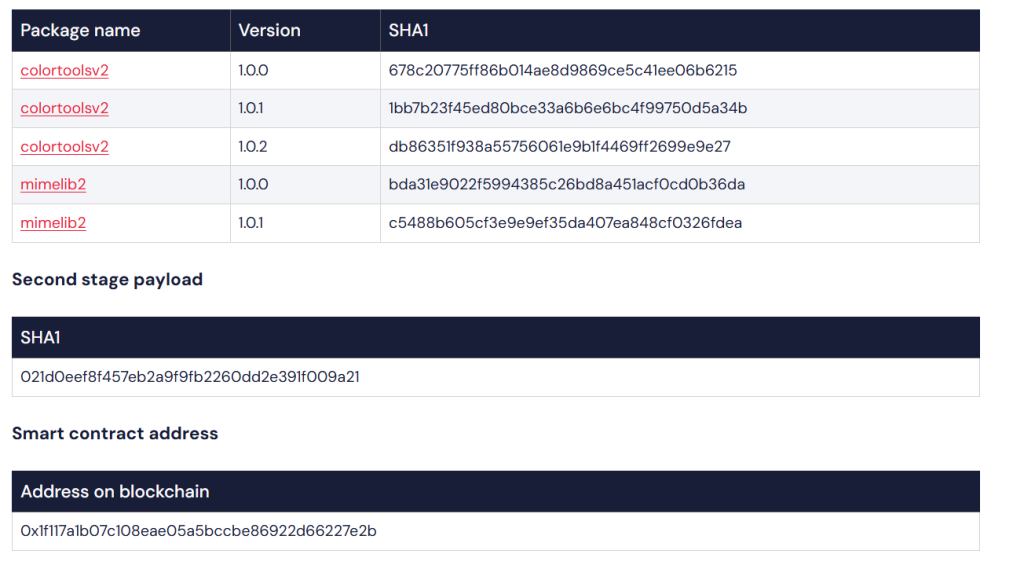
Hackers Exploit Ethereum to Inject Malware in Popular Coding LibrariesSource: ReversingLabs

How Ethereum Smart Contracts Turn Into Malware Command Centers

These packages are part of broader open-source libraries affecting both NPM and GitHub, where malicious supply chain actors use advanced social engineering and deception tactics to trick developers into incorporating harmful code into their projects.

According to ReversingLabs, 2025 has witnessed a diverse range of malicious campaigns targeting NPM, the leading online repository for JavaScript packages.

In March, RL documented the discovery of NPM packages ethers-provider2 and ethers-providerz

Since discovering the ethers campaign, researchers have detected numerous additional infostealers, downloaders, and droppers found on NPM.

At the beginning of July, RL researcher Karlo Zanki discovered and reported a new NPM campaign involving a basic package that deployed blockchain in a novel way to deliver a malicious second stage.

The exact package colortoolsv2 is being used to infiltrate Ethereum smart contracts.

According to RL researchers, the malware is a basic NPM package containing just two files.

The major file is a script named index.js, which contains a hidden malicious payload.

Once installed in a project, the script would run to fetch blockchain data and execute a harmful command by loading the URL for a command and control (C2) server that would then download second-stage malware to the requesting system.

Although “downloader” malware is a common method hackers use in NPM repositories to target victims, this specific malware is unusual as it uses Ethereum smart contracts to host the URLs where malicious commands are located for downloading the second-stage malware.

Notably, the cybersecurity researchers acknowledge that they haven’t encountered this approach previously.

Two-File Malware Hides a $2.5M Bridge Exploit Method

The researchers uncovered a Solana-trading-bot infected by the malicious colortoolsv2 package called solana-trading-bot-v2, which appears to be a trustworthy GitHub project to the average observer.

Hackers Exploit Ethereum to Inject Malware in Popular Coding LibrariesSource: ReversingLabs

It has thousands of commits, several active contributors, and a decent number of stars and watchers, all characteristics of legitimate open-source repositories.

However, all these details were fabricated, and any developer who installs it risks having user wallets that interact with the bot drained of funds.

Software supply chain attacks targeting smart contracts and blockchain infrastructure are now on the rise.

In July, hackers exploited a vulnerability in Arcadia Finance’s Rebalancer contract, draining approximately $2.5 million in cryptocurrency from the decentralized finance platform operating on Base blockchain.

The attackers manipulated arbitrary swapData parameters to execute unauthorized swaps that emptied user vaults.

A recent report by blockchain analytics firm Global Ledger revealed that hackers have now stolen $3 billion worth of crypto in 119 separate incidents during the first half of 2025, which is 150% more than all of 2024.

Hackers Exploit Ethereum to Inject Malware in Popular Coding LibrariesSource: Global Ledger

Slava Demchuk, CEO of analytics firm AMLBot, said access-control flaws and smart contract vulnerabilities, especially in bridges, continue to be dominant attack methods.

Demchuk told Cryptonews that these hackers are exploiting the interconnected and composable nature of decentralized finance (DeFi) protocols to amplify the impact.

Blockchain auditors advised that it is critical for developers to assess each library they are considering implementing before deciding to include it in their development cycle.


AI Strategy: Powered 24/7

AI Strategy: Powered 24/7AI Strategy: Powered 24/7

Generate automated strategies using natural language

면책 조항: 본 사이트에 재게시된 글들은 공개 플랫폼에서 가져온 것으로 정보 제공 목적으로만 제공됩니다. 이는 반드시 MEXC의 견해를 반영하는 것은 아닙니다. 모든 권리는 원저자에게 있습니다. 제3자의 권리를 침해하는 콘텐츠가 있다고 판단될 경우, [email protected]으로 연락하여 삭제 요청을 해주시기 바랍니다. MEXC는 콘텐츠의 정확성, 완전성 또는 시의적절성에 대해 어떠한 보증도 하지 않으며, 제공된 정보에 기반하여 취해진 어떠한 조치에 대해서도 책임을 지지 않습니다. 본 콘텐츠는 금융, 법률 또는 기타 전문적인 조언을 구성하지 않으며, MEXC의 추천이나 보증으로 간주되어서는 안 됩니다.

No Chart Skills? Still Profit

No Chart Skills? Still ProfitNo Chart Skills? Still Profit

Copy top traders in 3s with auto trading!