

SurgeXRP Presale Review: Is the SGP Token Legit or a Potential Scam?
SurgeXRP is a new XRP Ledger real estate RWA project now selling the SGP token through the SurgeXRP presale. The project aims to build a marketplace for tokenized rental properties, featuring fractional ownership, RLUSD rental income, staking vaults, DAO governance, and RWA-backed lending.
The presale began on May 18, 2026, and is scheduled to run for 60 days, ending on July 18, 2026. At the time of writing, the project website shows the presale had filled almost 10% of its 100,000 XRP soft cap by May 21, meaning the publicly claimed raise was roughly 10,000 XRP.
SurgeXRP is not an empty one-page presale. It has a website, docs, token pages, risk disclosures, a roadmap, and repeated press releases.
But the important question we are trying to determine before investors put money into this presale is whether SurgeXRP has what it takes to build a real, solid RWA platform, or if the project is based entirely on hype and marketing, attempting to reach fundraising goals with little to no emphasis on real product development, similar to many other prior presales.
What SurgeXRP Claims to Be Building
SurgeXRP describes itself as a real estate RWA launchpad and marketplace built on the XRP Ledger. Its main idea is simple: users would buy fractional exposure to income-generating rental properties through blockchain-based tokens.
The project will focus first on operational rental properties, including short-term and vacation rental assets. It describes four main product areas: a real estate marketplace, DAO governance, RWA-backed lending, and staking vaults. The rental income will be distributed in RLUSD, Ripple’s USD-pegged stablecoin.
This structure is not completely new. Tokenized real estate, fractional ownership, staking, governance, and asset-backed lending have existed in different forms for years. SurgeXRP’s narrower pitch is that it wants to bring this model to XRPL and package it around rental income.
That may interest XRP holders. But it is not a new category by itself.
SurgeXRP Whitepaper Explains the Vision but Leaves Gaps Around Legal Structure and Operations
SurgeXRP’s whitepaper contains limited information, and much of what it does provide is highly conceptual and overly general. It includes pages for the platform overview, token utility, roadmap, how to buy SGP, trustline setup, privacy policy, terms, and risk disclosures.
The problem is what the whitepaper does not show.
The whitepaper does not share the founding team information. No legal structure diagrams are shown for how real estate ownership would actually connect to token holders. No information on the different jurisdictions is provided. No public property acquisition pipeline is listed. No breakdown explains how presale funds will specifically be allocated across legal work, compliance, development, liquidity, operations, or property sourcing.
The website uses broad statements about “on-chain title and deed” ownership structures. In practice, real estate tokenization usually depends heavily on off-chain legal agreements, LLC structures, custody arrangements, jurisdiction-specific property law, and contractual claims.
The project also fails to clearly explain the regulatory structure underlying the offering. No detailed framework was provided explaining how the platform plans to handle securities compliance, investor eligibility restrictions, cross-border participation, or jurisdiction-specific real estate regulations tied to tokenized property ownership.
Without deeper legal and operational disclosures, the current documentation should be viewed primarily as a high-level vision document rather than a fully detailed operational blueprint for a functioning real estate RWA platform.
SurgeXRP Team Transparency Problems Raise Questions About Accountability and Operations
One of the biggest weaknesses in the SurgeXRP presale is the lack of clear public leadership.
The official project materials do not provide a clearly identifiable founding team with biographies, LinkedIn profiles, or prior projects. Some press releases mention media contacts named “Artem” or “Charlotte Harris,” but these names are presented as communication contacts rather than publicly accountable executives.
That distinction matters.
Anonymous teams are common in meme coin launches and speculative trading projects. Real estate RWA platforms operate differently. Property tokenization involves legal compliance, accounting, asset management, contracts, tenant operations, and investor reporting obligations.
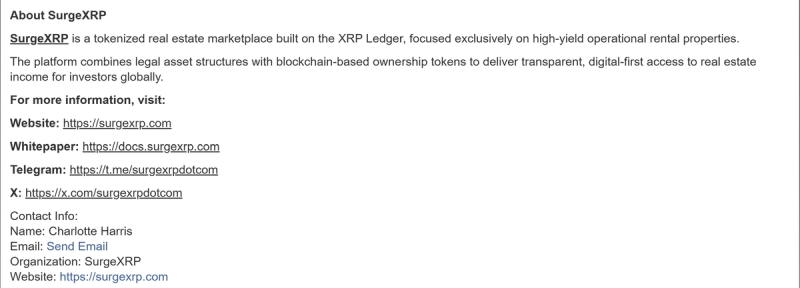 SurgeXRP press release lists unverified contact identity, potentially made up. Source: https://www.streetinsider.com/Press+Releases/SurgeXRP+Announces+Seed+Round%2C+Targeting+The+%243+Trillion+Global+Rental+Real+Estate+Market+On+The+XRP+Ledger/26345788.html
Retail investors are effectively being asked to trust unidentified operators with a future real estate investment infrastructure.
The project also creates some jurisdiction uncertainty. Several press releases were distributed from George Town, Cayman Islands. Other publications referenced Tallinn, Estonia. The relationship between these locations, if any, is not clearly explained in the official documentation.
None of this proves fraud or scam activity by itself.
But limited transparency increases counterparty risk substantially for investors evaluating whether the SGP token is legit or potentially unsafe.
SurgeXRP Tokenomics and the SGP Fully Diluted Valuation are Difficult to Evaluate
The SGP token has a fixed supply of 200 million tokens.
According to the project’s allocation structure:
- 50% is allocated to the presale
- 20% to staking rewards
- 15% to the team
- 5% to treasury reserves
- 5% to DEX liquidity
- 2.5% to advisors
- 2.5% to community initiatives
A 50% public allocation is larger than many crypto presales currently operating in the market. That reduces some concentration risk compared with heavily insider-controlled launches.
But the token structure still raises important questions.
The project does not provide a detailed vesting schedule showing exact unlock timelines for the team, advisor, or staking allocations.
The SurgeXRP presale also uses a dynamic pricing model to determine the token presale price. The final SGP token price will be determined only after the presale closes, based on the total XRP raised. However, the exact pricing formula, allocation mechanics, and final circulating valuation methodology are not clearly explained in the documentation.
This means retail investors don’t know the fully diluted valuation (FDV) of the project when they invest. A very strange and unclear presale mechanic, in our opinion, which leaves investors blind to one of the most important investment considerations.
SurgeXRP Product Development Status Shows the Platform Is Still in the Pre-Launch Stage
The current SurgeXRP platform is still largely conceptual.
The roadmap says the project plans to launch beta functionality during Q3 2026, including wallet connectivity, onboarding systems, KYC integration, and initial tokenized property listings. The roadmap then targets a broader public marketplace launch during Q4 2026.
At the time of review, no public beta platform was available.
No live tokenized properties are visible. No operational lending product or test environment was available during this review. No rental income distribution system was publicly demonstrated. No public dashboard with property ownership data, tenant metrics, or yield reporting was available.
The team has shared dashboard screenshots on X, suggesting that frontend development work may be underway. However, interface previews alone do not demonstrate the development status of the underlying marketplace infrastructure.
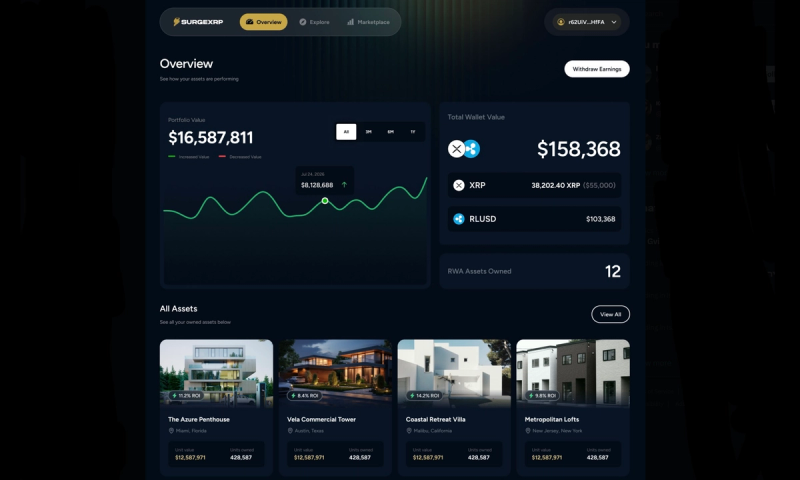 SurgeXRP RWA marketplace dashboard preview. Source: X/@surgexrpdotcom
Existing tokenized real estate platforms like RealT and Lofty already operate systems involving property SPVs, income distributions, investor dashboards, and active property marketplaces. SurgeXRP has not yet publicly demonstrated comparable operational infrastructure.
Important operational questions also remain unanswered, including who will manage the underlying properties, how tenant operations and maintenance will be handled, what legal rights token holders will receive, how vacancies or disputes will be managed, and how cross-border compliance requirements will function across different jurisdictions.
The hardest part of a real estate RWA platform is not creating a website or token contract.
The difficult part is legal compliance, property sourcing, operational management, reporting, investor protections, and maintaining liquidity after launch.
So far, SurgeXRP has not publicly demonstrated those operational capabilities.
SurgeXRP Audit Status and Security Disclosures Remain Limited
We did not find a published third-party audit report for SurgeXRP during this review.
That is important because the project plans to operate token infrastructure, staking systems, lending functionality, and presale payment flows involving XRP deposits from retail users.
Even if a simple token audit were to appear, that alone would not fully cover the broader ecosystem risks associated with lending systems, reward mechanisms, marketplace functionality, or treasury controls.
Until a public audit report on the infrastructure and core software by a reputable security firm is released, investors should treat the current audit status as incomplete.
SurgeXRP Marketing Relies Heavily on Paid Syndication and Presale Visibility Campaigns
SurgeXRP’s marketing strategy appears heavily focused on press release distribution and sponsored crypto media exposure. The project gained visibility through syndicated content published in crypto media outlets and on PR distribution sites.
That does not automatically make SurgeXRP deceptive. Many crypto presales use paid distribution to reach investors during fundraising periods. But investors should understand the difference between paid visibility and independent reporting. During this review, we did not find any independent investigative coverage verifying the project’s team, legal structure, property pipeline, platform development, or operational claims.
The marketing language is also aggressive. SurgeXRP’s own website says SGP is planned to list on XPMarket and XMagnetic at “30% higher than final presale price.” Sponsored content also uses urgency around the limited 60-day presale window, encouraging users to secure SGP before the planned decentralized exchange (DEX) listing phase.
Promotional content is using the familiar crypto presale “100x” framing. That type of language is common in speculative presale campaigns, but it should be treated carefully because it shifts attention from execution risk, legal risk, token liquidity, and valuation uncertainty toward possible upside.
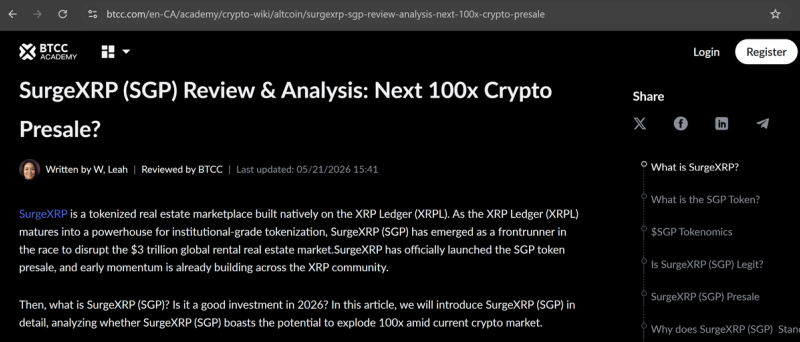 SurgeXRP 100x promotional article lacks sponsored disclaimer. Source: https://www.btcc.com/en-CA/academy/crypto-wiki/altcoin/surgexrp-sgp-review-analysis-next-100x-crypto-presale
Final Verdict on the SurgeXRP Presale and Whether the SGP is Legit or Potentially Scam
The SurgeXRP presale shows a more structured narrative than many low-effort crypto presales that entered the market in recent years.
The project has a whitepaper, a defined roadmap, a visible XRPL focus, a token allocation structure, and a coherent explanation of how the SGP token is intended to function within the proposed ecosystem.
At the same time, several major credibility gaps remain unresolved.
The team is hiding. No detailed legal ownership structure is demonstrated. No property acquisition pipeline is disclosed. No operational marketplace or any other product exists yet. No public comprehensive audit report, or even a future plan, was found. The tokenomics framework and presale mechanics leave investors in the dark about the project’s valuation.
Those issues matter more because SurgeXRP is presenting itself as a real estate RWA platform rather than a simple speculative meme token.
Based on the information currently available, SurgeXRP shows signs of prior crypto presales that left investors bruised and bleeding.
The SurgeXRP presale is a high-risk, speculative crypto presale with a plausible business concept but limited operational evidence so far and several scam signals.


You May Also Like
Something Is Brewing In XRP’s On-Chain Data. Here’s the Latest

Justice Department has 'gone off the rails' for Trump's 'pretzel logic': analysis
SUPER Price Soars 20.52%: Social Media Buzz Ignites



