

Citigroup Ups S&P 500 Target to 8,100 Despite Market Turbulence — What’s Behind the Confidence?
Key Highlights
- Citigroup increased its S&P 500 year-end projection to 8,100 from 7,700
- The benchmark index tumbled 2.5% on Friday, marking its steepest decline since October
- The firm upgraded its 2026 earnings-per-share projection to $350 from $320
- A tentative 2027 EPS estimate of $400 has been established
- Analysts caution that AI capital expenditures may decelerate post-2027, potentially triggering market headwinds
Following the S&P 500’s steepest single-session decline since October—a 2.5% plunge that ended a nine-week rally—Citigroup strategist Scott Chronert responded by elevating his year-end price target from 7,700 to 8,100 that same Friday evening.
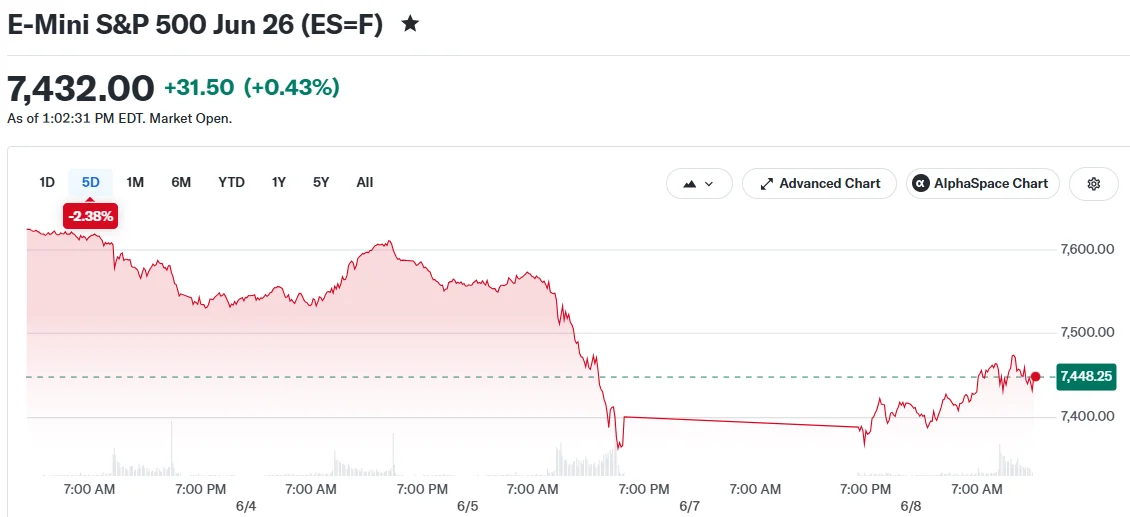 E-Mini S&P 500 Jun 26 (ES=F)
This revised forecast suggests approximately 10% potential gains from the index’s most recent closing level.
The tech-heavy Nasdaq suffered its most severe single-day setback in over twelve months on Friday. Anxiety surrounding artificial intelligence infrastructure investments and Broadcom’s quarterly results were identified as primary catalysts behind the market retreat.
Chronert maintained that the downturn hasn’t altered his fundamental outlook. He contends that profit expansion, rather than valuation multiples expanding further, will propel the index upward going forward.
Profit Projections Receive Boost
Citigroup elevated its 2026 S&P 500 earnings-per-share forecast to $350, revising upward from the $320 figure established in December 2025. The institution also unveiled an initial 2027 EPS projection of $400.
He emphasized that artificial intelligence-driven expansion is no longer confined to technology corporations alone. Additional sectors are beginning to capture benefits, which diversifies the earnings narrative throughout the broader market.
Citigroup becomes another major Wall Street institution joining peers who have pushed their S&P 500 projections beyond the 8,000 threshold in recent months.
AI Investment: Primary Catalyst With Uncertainty Ahead
Citigroup characterizes the present AI investment landscape as a “one-time capex supercycle” rather than a conventional business cycle. This distinction carries significance because it intensifies focus on earnings justifying current equity valuations moving forward.
The bank indicated that market attention will ultimately pivot toward whether corporations can demonstrate tangible productivity improvements from AI technologies. That validation, Chronert noted, isn’t yet being demanded by market participants.
Citigroup did sound a cautionary note regarding the post-2027 period. The firm recognized that some moderation in AI capital spending appears probable eventually, potentially creating a “hangover effect” across equity markets.
Presently, macroeconomic concerns including Middle East tensions involving Iran, crude oil volatility, inflationary pressures, and monetary policy dynamics represent secondary considerations. Citigroup’s assessment is that underlying AI sector fundamentals remain the primary investor focus.
Even if AI-related spending moderates at some juncture, widespread adoption of these technologies could establish an additional foundation supporting corporate profitability.
The S&P 500 maintains approximately 8% gains year-to-date, notwithstanding Friday’s significant retreat.
The post Citigroup Ups S&P 500 Target to 8,100 Despite Market Turbulence — What’s Behind the Confidence? appeared first on Blockonomi.


You May Also Like

Former Epstein assistant Lesley Groff appears before House panel

Stellar faces renewed selling pressure amid bearish derivatives data

How to Spot a South African Cyber-Scam Before You Click “Pay”



