

Networking : Why You Should Understand the IPv4 Header Beyond Chasing Tools
\ In a trendy tech industry, network engineering seems overshadowed by many trends, and many people forget the importance of the fundamentals of networking.
Cloud, AI, Cybersecurity, Cloud computing, Software development, how many times do you see networking mentioned among the critical skills to learn? In the fast-paced tech industry, network engineering often gets overlooked amidst emerging trends. Many tend to forget the crucial role of networking fundamentals.
Consider this: when discussions revolve around critical skills to acquire, how frequently is networking mentioned alongside cloud, AI, cybersecurity, and software development?
:::info This is article is dedicated to anyone struggling to learn networking,not experts in the field
:::
Network engineering is the foundation
In this AI era, we see the emergence of massive data centers around the world, including Stargate UAE, Stargate Norway, and xAI's Colossus, slated to be the world's largest AI supercomputer, as well as other projects in the making for the AI race. One question arises: who will build the infrastructure?
Network engineers and architects are essential for maintaining the internet and ensuring a connected future. The global economy depends on their ability to route information across all environments, from the sky to the oceans; without their expertise, nothing would function.
Imagine a day with 24 hours of no connectivity, where the world is unconnected with all the continents without internet access. Space entrepreneurship, exemplified by Starlink, highlights the critical role of connectivity. It bridges the gap for previously unconnected global regions, unlocking new opportunities. Without robust networking, global connections would be impossible. The field of network engineering is continuously evolving, ensuring that those with mastery of these skills will always be in high demand.
Consider a world where, for 24 hours, all continents are without connectivity, an unthinkable scenario!
Tools come and go, the foundation is forever

It’s easy to adopt some tools and skip fundamentals; unfortunately, your gaps will betray you in the long run!
Seeing the trends, many people neglected networking to jump quickly to cloud, cybersecurity, or automation.
\
-
How to deploy networks you do not understand?
\
-
How to secure a network you do not understand?
\
-
How to automate workflows you do not understand?
\ Reality check: those who neglected networking will come back to learn
Just because script kiddies use some tools to hack means they know what they do; networking is complex and requires the fundamentals to understand what happens under the hood. Today, it’s possible to meet cloud engineers with huge gaps in networking!
Because of the ease of use of some graphical user interfaces to provision devices and networks, network engineering was neglected, and we will see a huge skill gap in the future. Once a network is down, how can it be fixed from the graphical user interface? \n \n How many cloud engineers or pentesters can interpret a packet capture analysis from Wireshark?
The lack of fundamentals in networking is a barrier to advancing in many tech fields today!
Protocols: the languages of the internet
We understand each other daily because we speak a common language with a group of people, the same applies for computers, without protocols, they can’t communicate and understand each other!
Escaping protocols and how they work is a huge waste of time, to learn cybersecurity, network automation, cloud,…
Without understanding how they work, you will be limited in your knowledge to understand what happens in the network.
Advice: Learning networking is the best tech choice for a lifetime.
The IPv4 header
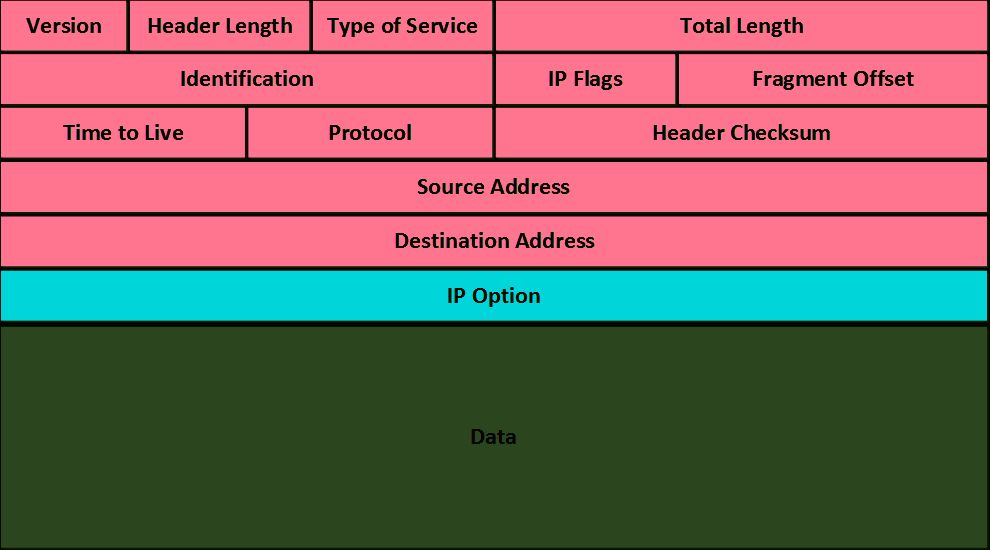
The IPv4 header is the control information at the beginning of an Internet Protocol version 4 (IPv4) packet, containing essential data for routing and delivering the packet. Understanding how things work is crucial to knowing what’s happening in a network.
Let’s break down each part step by step :
| Version | This field defines the IP version,4 or 6. | |----|----| | Header length | This field defines the header length | | Type of service (ToS) | This field defines the type of service of this packet and includes some details such as maximize reliability, maximize throughput … | | Total Length | This field defines the total IP datagram, including the data or the fragment; its value is 65,535. |
\
| Identification | Routing is essential for information to travel between two points, ensuring that each packet is uniquely identified for efficient back-and-forth transmission. This field uniquely identifies each packet. | |----|----| | IP Flags | This field, which determines if a packet is fragmented (M) or not (D), can be exploited by experienced hackers with networking knowledge to bypass Intrusion Detection Systems (IDS) or firewalls. | | Fragment Offset | This field specifies the offset from the beginning of the IP header where fragmented packets should be reassembled. |
\
| Time to live (TTL) | This field defines the number of hops (Routers) across the Internet before a packet expires. | |----|----| | Protocol | Protocols are the languages of the internet; this field defines what protocol is being used and shows a code for each one: 1 for ICMP, the protocol behind Ping,17 for UDP, the protocol behind VOIP. | | Header Checksum | This error-checking field ensures data integrity during transmission. It calculates a checksum using a simple algorithm to verify the header's data. |
\
| Source / Destination | The IP header's most crucial component is likely the source and destination IP addresses, which are found in these rows. | |----|----|
\
| Options | This field's length is variable, and its utilization is optional | |----|----| | Padding | This field is utilized to complete any remaining bits and bytes of the header, as required. |
Hands-on: Beyond the IPv4 headers concepts
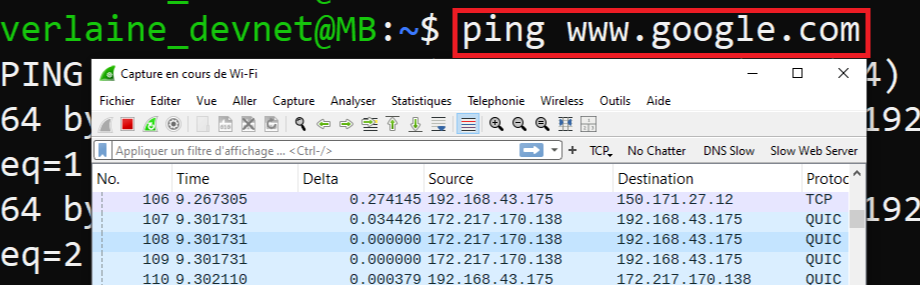
From the CLI, let’s ping www.google.com and capture the traffic on Wireshark
\ 
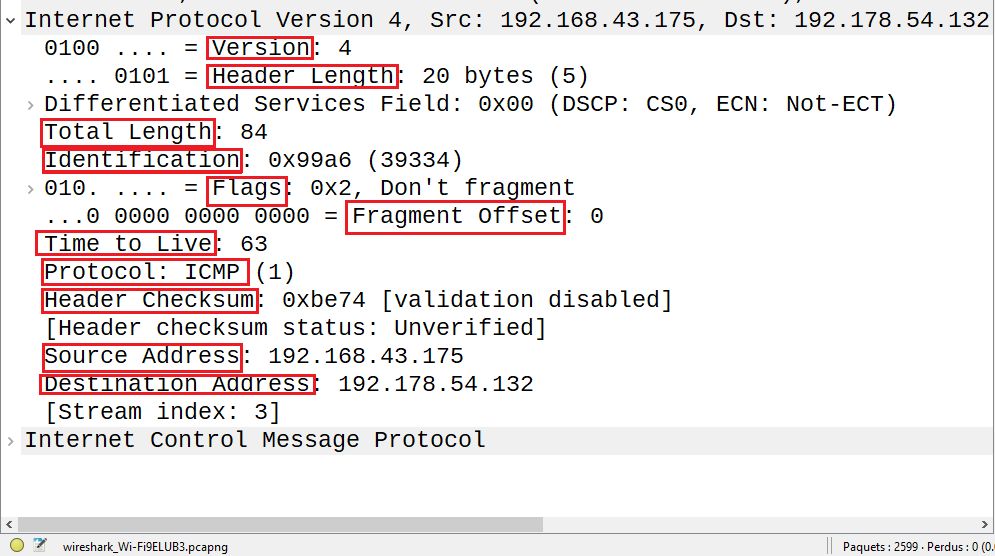
If we choose the ICMP traffic, we will see the critical field on the left pane of Wireshark and how it works every time we capture the traffic.
\ 
Conclusion
\Whether you are chasing cybersecurity, automation, or cloud, without network fundamentals, your journey will be a waste of time without understanding what happens behind every network and how to improve its behavior. \n \n Experienced hackers know how to escape Intrusion detection systems and firewalls by manipulating some fields in the IPv4 header. Why? Because they understand networking better than anyone else, learn networking to unlock a bunch of skills, and the rest is easy.
You May Also Like

Franklin Templeton CEO Dismisses 50bps Rate Cut Ahead FOMC


Gallaxia – The Future of Gaming
