Shib vs Doge compares two meme‑origin cryptos with different philosophies: Dogecoin (DOGE) is a payment‑focused, inflationary coin with its own blockchain, while Shiba Inu (SHIB) is an Ethereum‑basedShib vs Doge compares two meme‑origin cryptos with different philosophies: Dogecoin (DOGE) is a payment‑focused, inflationary coin with its own blockchain, while Shiba Inu (SHIB) is an Ethereum‑based
Shiba Inu (SHIB) vs Dogecoin(DOGE): Everything You Need to Know Before Investing
Shib vs Doge compares two meme‑origin cryptos with different philosophies: Dogecoin (DOGE) is a payment‑focused, inflationary coin with its own blockchain, while Shiba Inu (SHIB) is an Ethereum‑based token evolving into a broader DeFi ecosystem with utility layers like ShibaSwap and Shibarium.
TL;DR
- Origins & Philosophy: DOGE was launched in 2013 as a fun digital currency; SHIB launched in 2020 aiming to build a community‑driven DeFi ecosystem.
- Tech & Infrastructure: DOGE runs on its own PoW blockchain; SHIB is an ERC‑20 token on Ethereum with planned Layer‑2 scaling (Shibarium).
- Tokenomics: DOGE has uncapped inflation; SHIB uses deflationary burns and multi‑token utility (e.g., BONE, LEASH).
- Use Cases: DOGE focuses on payments and tipping; SHIB targets DeFi participation, staking, and ecosystem growth.
- Community & Growth: Strong cultures on both sides; DOGE’s long history and memetic recognition vs. SHIB’s expanding ecosystem and governance.
Introduction
In the rapidly evolving world of cryptocurrencies, meme coins have carved out a significant niche. Among them, Shiba Inu (SHIB) and Dogecoin (DOGE) stand out as iconic symbols of community‑driven digital assets. While they both leverage the Shiba Inu dog meme, their goals, architecture, and ecosystem ambitions differ substantially.

This article offers an intermediate‑level, publishable comparison of SHIB vs DOGE that goes beyond surface‑level memes, blending historical context, technology, tokenomics, community impact, and practical uses. Along the way, you’ll find placeholders for further readings that deepen your understanding of the Shiba Inu ecosystem and broader crypto frameworks.
Origins & Philosophies
Dogecoin (DOGE)
Dogecoin debuted in 2013 as a lighthearted fork of Litecoin, created by Billy Markus and Jackson Palmer. Designed as a fun, accessible digital currency, DOGE’s intent was never to be complex—just usable and community‑friendly. Its rise was organic, with the Shiba Inu dog meme fueling its early popularity.
For a deeper historical perspective on DOGE’s inception, mechanism, and cultural relevance, see: What is Dogecoin? Origins, Mechanism, Meme Culture, and Relevance
Shiba Inu (SHIB)
Shiba Inu (SHIB) launched in August 2020 as a community experiment and “Dogecoin killer.” While it began with meme positioning, SHIB’s roadmap was always more ambitious — leveraging Ethereum’s smart contracts and laying foundations for a DeFi ecosystem that includes DEXs, staking, and Layer‑2 scaling.
Technology & Infrastructure
Dogecoin Tech
- Blockchain: Native, Proof of Work (PoW)
- Consensus: Similar to Litecoin’s model
- Primary Use: Simple peer‑to‑peer transfers with low fees
- Scalability: Modest — not intended for complex apps
DOGE’s straightforward design makes it easy to transact, but limits scalability and advanced utility.
Shiba Inu Tech
- Blockchain: ERC‑20 token on Ethereum
- Layer‑2 Integration: Scaling via Shibarium
- Smart Contracts: Supports complex DeFi mechanisms
SHIB’s architecture enables programmable finance, which in turn unlocks features like staking, liquidity mining, and NFTs.
Further Readings:
Tokenomics & Supply Models
Dogecoin Tokenomics
- Inflationary Model: No maximum supply; miners continually issue new DOGE
- Effect: Persistent inflation can dilute value over time
- Reward Structure: Emphasizes liquidity and usage over scarcity
Shiba Inu Tokenomics
- Deflationary Focus: Community and on‑chain burns reduce circulating supply
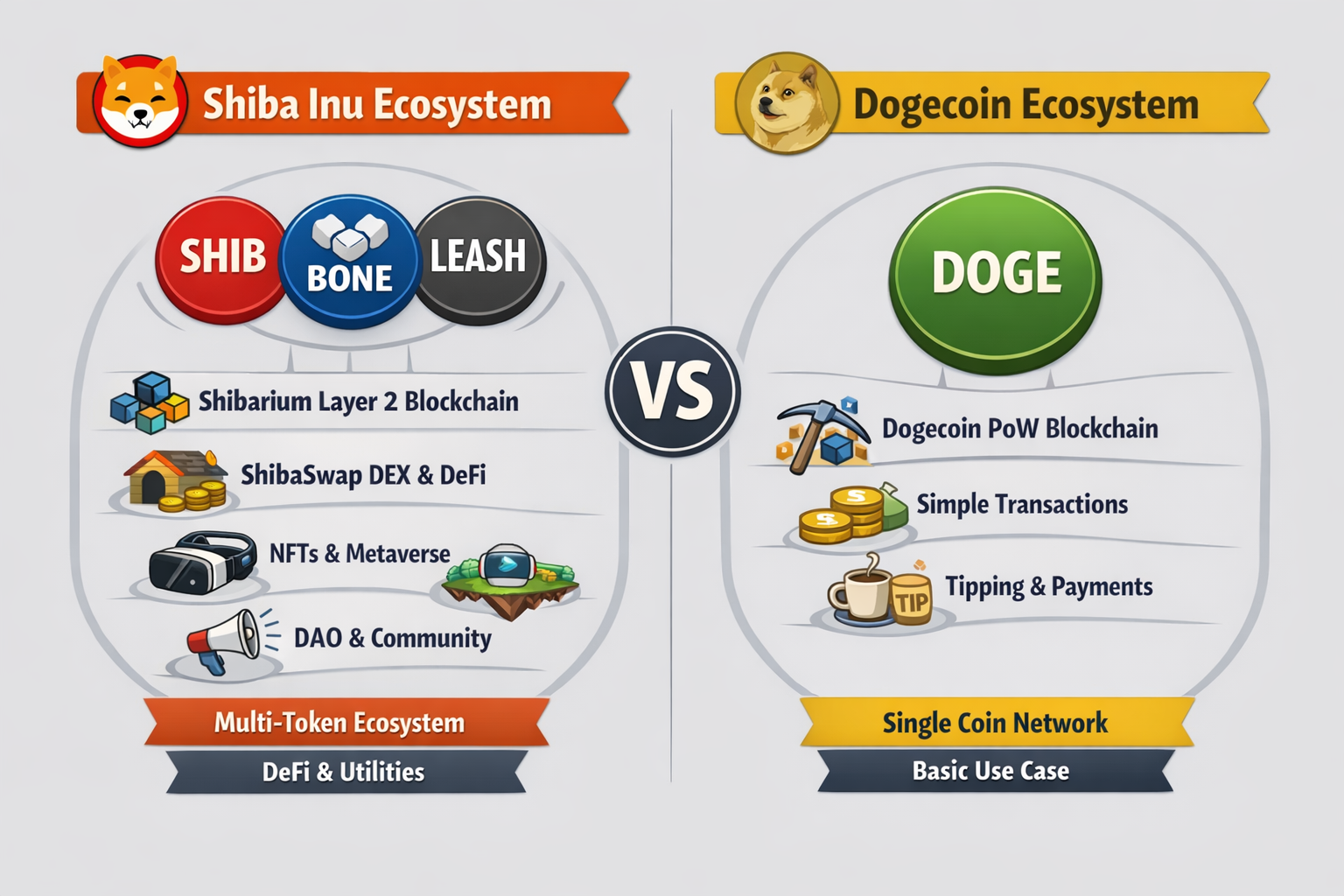
- Multi‑Token System: Includes utility tokens BONE and LEASH
- Ecosystem Incentives: Incentives tied to staking, DeFi yields, and governance participation
SHIB’s model seeks to balance utility and scarcity, unlike DOGE’s purely inflationary design.
Visual Comparison: Tokenomics & Supply
Feature | Dogecoin (DOGE) | Shiba Inu (SHIB) |
Blockchain | Dogecoin Network (PoW) | ERC‑20 on Ethereum + Shibarium (Layer‑2) |
Supply Model | Inflationary, uncapped | Deflationary focus (burns) + multi‑token ecosystem |
Native Utility Tokens | DOGE only | SHIB, BONE, LEASH |
Governance Capabilities | None | Yes (via BONE) |
Smart Contract Utility | Minimal | Full (DeFi, NFTs, AMMs) |
Use Cases & Real‑World Utility
Dogecoin
- Payments & Tipping: Low fees make DOGE popular for microtransactions
- Brand Loyalty: Used by communities for tipping creators or engaging in social campaigns
- Broad Recognition: One of the most recognized coins globally
Shiba Inu
- DeFi Participation: Through ShibaSwap, users can stake (Bury) and provide liquidity (Dig)
- Layer‑2 (Shibarium): Lower fees and expanded use cases for payments and smart contracts
- Ecosystem Growth: Tokens like BONE (governance) and LEASH (scarcity premium) extend utility

Further Readings
Community & Adoption
Dogecoin’s Community: One of the earliest memecoin fan bases, supported by long‑term holders and mainstream awareness. Its strength lies in brand familiarity and viral culture, often amplified by influencers and high‑profile tweets.
Shiba Inu’s Community: SHIB’s community is deeply involved in ecosystem development and decentralized governance, emphasizing collective participation over single figure endorsement. This aligns with a broader DeFi participation model, beyond pure meme status.
Performance & Market Metrics
- Market Capitalization: DOGE has historically maintained a larger market cap than SHIB, reflecting longer time in market and broader liquidity.
- Circulating Supply: DOGE’s uncapped issuance results in hundreds of billions of coins; SHIB’s supply spans hundreds of trillions, which impacts price sensitivity and theoretical valuation.
- Volatility: Both tokens experience high volatility typical of meme assets, but SHIB’s evolving ecosystem introduces additional variables that affect price (burn rates, staking rewards, Layer‑2 adoption signals).
Side‑by‑Side Technical & Ecosystem Comparison
Visual Comparison Table: SHIB vs DOGE
Aspect | Dogecoin (DOGE) | Shiba Inu (SHIB) |
Launch Date | 2013 | 2020 |
Primary Use Case | Digital currency & tipping | DeFi ecosystem participation |
Blockchain | Dogecoin Network (PoW) | Ethereum (ERC‑20) + Shibarium (Layer‑2) |
Tokenomics | Inflationary, no cap | Deflationary focus via burns + multiple tokens |
Governance | No | Yes (via BONE) |
Smart Contracts | Not supported | Full support via Ethereum and Shibarium |
Ecosystem Tools | Limited | Staking, DEX, NFT, Layer‑2 |
Community Style | Broad & memetic | Organized & ecosystem‑focused |
Adoption Strength | High for payments and tipping | Growing in DeFi & utility |
FAQ
Q: What is the key difference between Shib vs Doge?
Answer: DOGE is a standalone cryptocurrency focused on simple transactions and tipping, while SHIB is an Ethereum‑based token with an expanding ecosystem focused on DeFi utility.
Q: Which has a bigger ecosystem?
Answer: Shiba Inu’s ecosystem includes DeFi (ShibaSwap), Layer‑2 (Shibarium), and multiple tokens (BONE, LEASH), whereas Dogecoin remains primarily a digital currency with limited additional infrastructure.
Q: Is one more scarce than the other?
Answer: Yes — SHIB’s burn mechanisms aim at reducing supply over time, whereas DOGE’s supply is uncapped and inflationary.
Q: Does Shib have a Layer‑2 solution?
Answer: Yes — Shibarium aims to improve scalability and reduce transaction costs, expanding SHIB’s utility beyond mere token transfers.
Q: Where can I learn more about Dogecoin’s history and mechanics?
Answer: Check out this deep dive on Dogecoin’s origins, meme culture, and relevance: What is Dogecoin? Origins, Mechanism, Meme Culture, and Relevance.
Conclusion
The shib vs doge narrative is more than a meme coin comparison; it reflects two distinct paths in the evolution of community‑centric cryptocurrencies. Dogecoin remains a beloved, inflationary digital currency with strong payment use and memetic power. In contrast, Shiba Inu is expanding its role as a multi‑token ecosystem with broader functional potential.
Which is “better” largely depends on your goals: DOGE excels in broad adoption and simplicity, while SHIB offers ecosystem utility and DeFi engagement. Intermediate users should evaluate both in light of their own strategies, risk tolerance, and the broader crypto market environment.
Further Readings:
Disclaimer
This article is for educational purposes only and does not constitute financial advice. Cryptocurrency markets are highly volatile. Always conduct your own research and verify current data from reputable sources before making investment decisions. Never invest more than you can afford to lose.
Oportunitate de piață
Pret SHIBAINU (SHIB)
$0.000007265
$0.000007265$0.000007265
USD
SHIBAINU (SHIB) graficul prețurilor în timp real