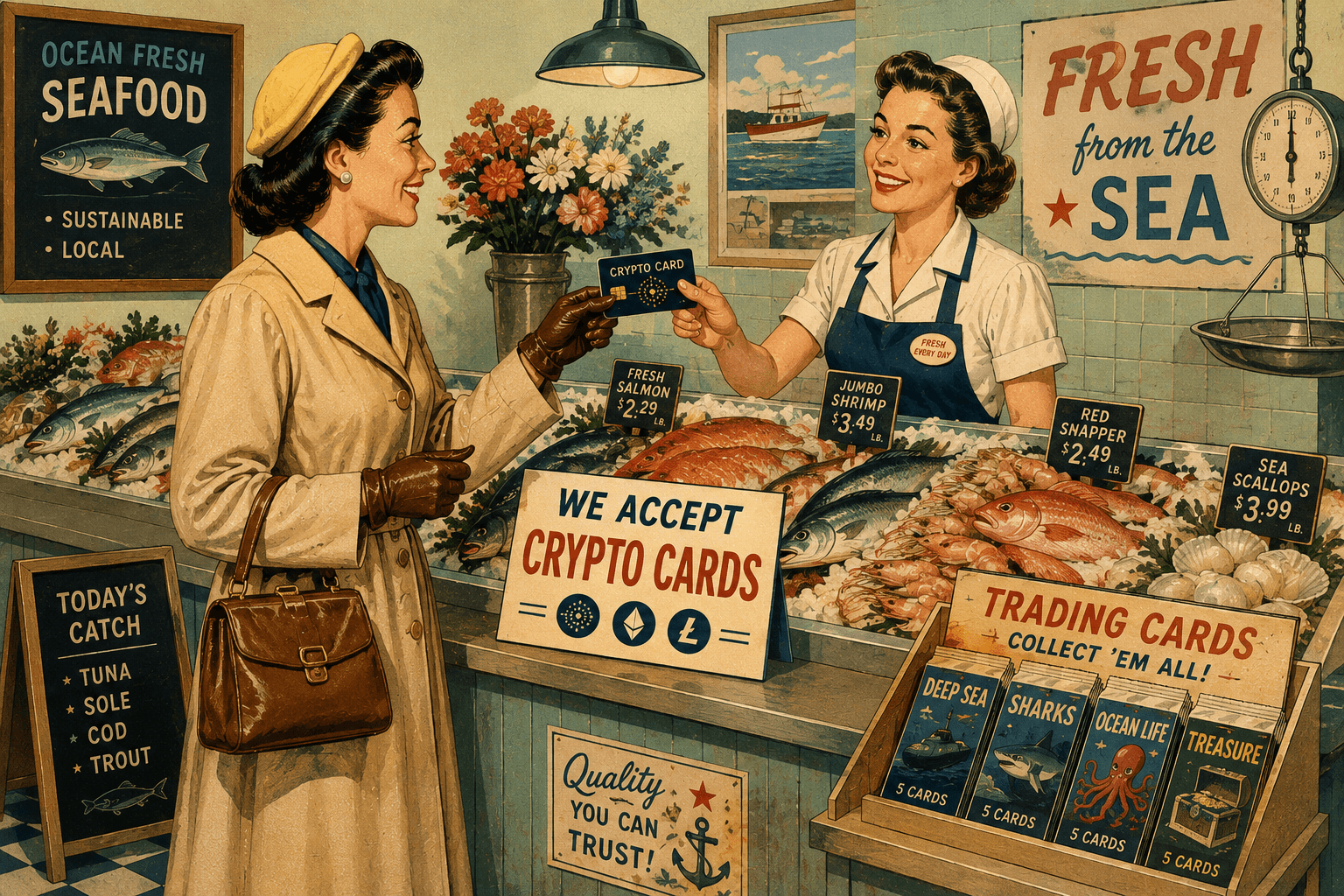
Pikachu is going onchain, and the dollars on your card have quietly switched from fiat to stablecoins. In a week where BTC round-tripped $65K and bored us all to sleep, the real action is in cards: the kind you swipe and the kind you collect. Note: one of these chart lines is a children's card game.
The Main Character: Cards for Swipe, Cards for Play
The Story: Two card stories this week. The first is about your grocery run.
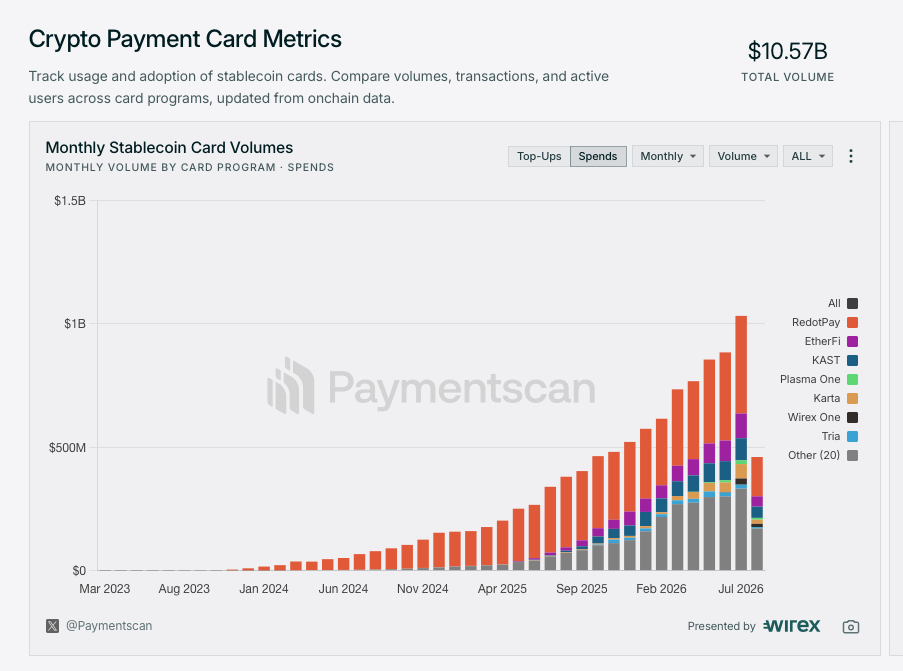
Crypto card spending is the cleanest adoption metric we have: do people actually use this stuff as money? Paymentscan says yes, louder every month: $759 million spent in July, roughly 2.5x from $306 million a year earlier, across about 9 million purchases averaging $86 each.
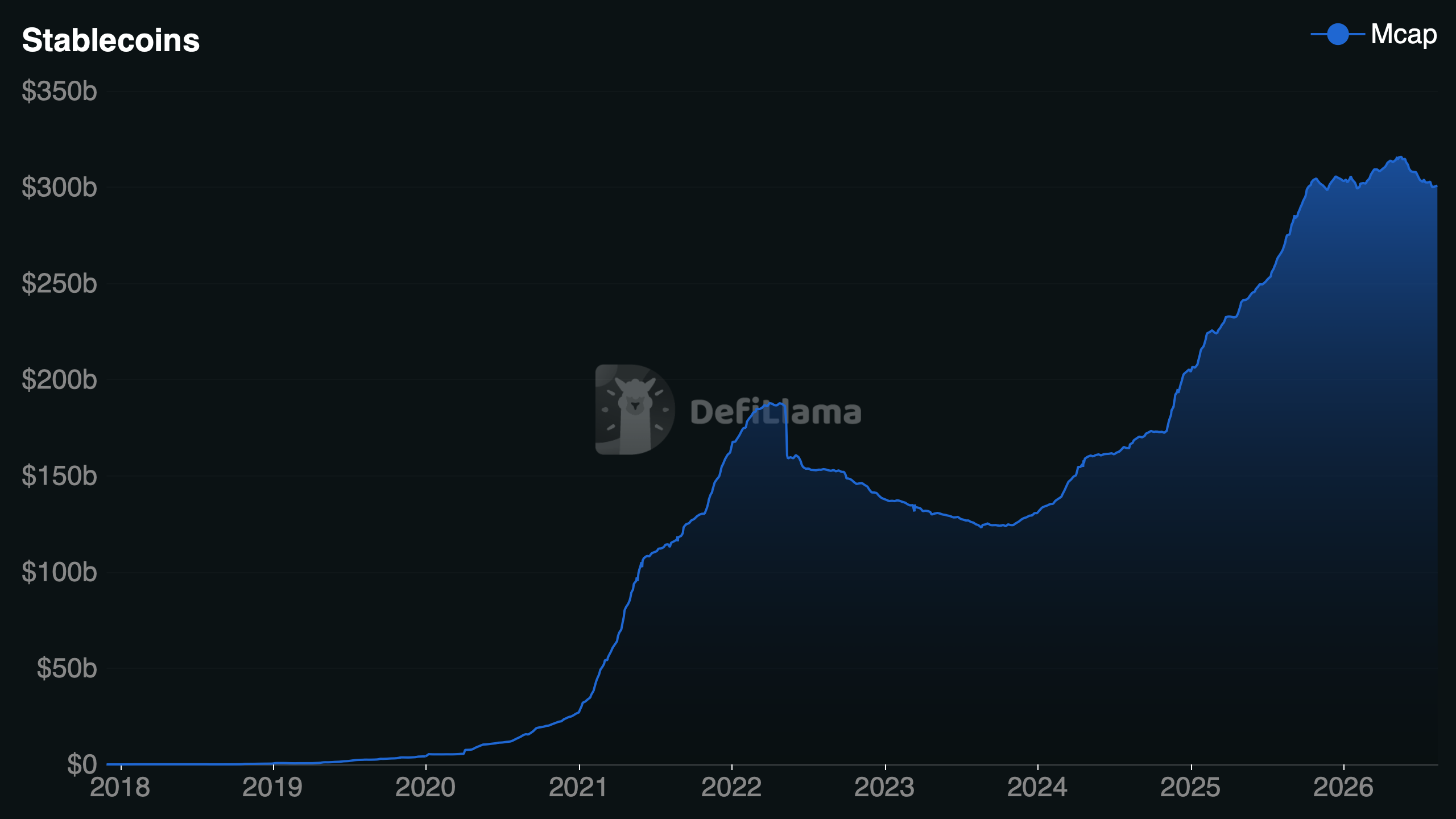
Here's the twist: over the same stretch, total stablecoin supply peaked near $315 billion in mid-May and has dropped about $15 billion since. The pile is shrinking while the checkout line grows.
The second story is about your childhood.
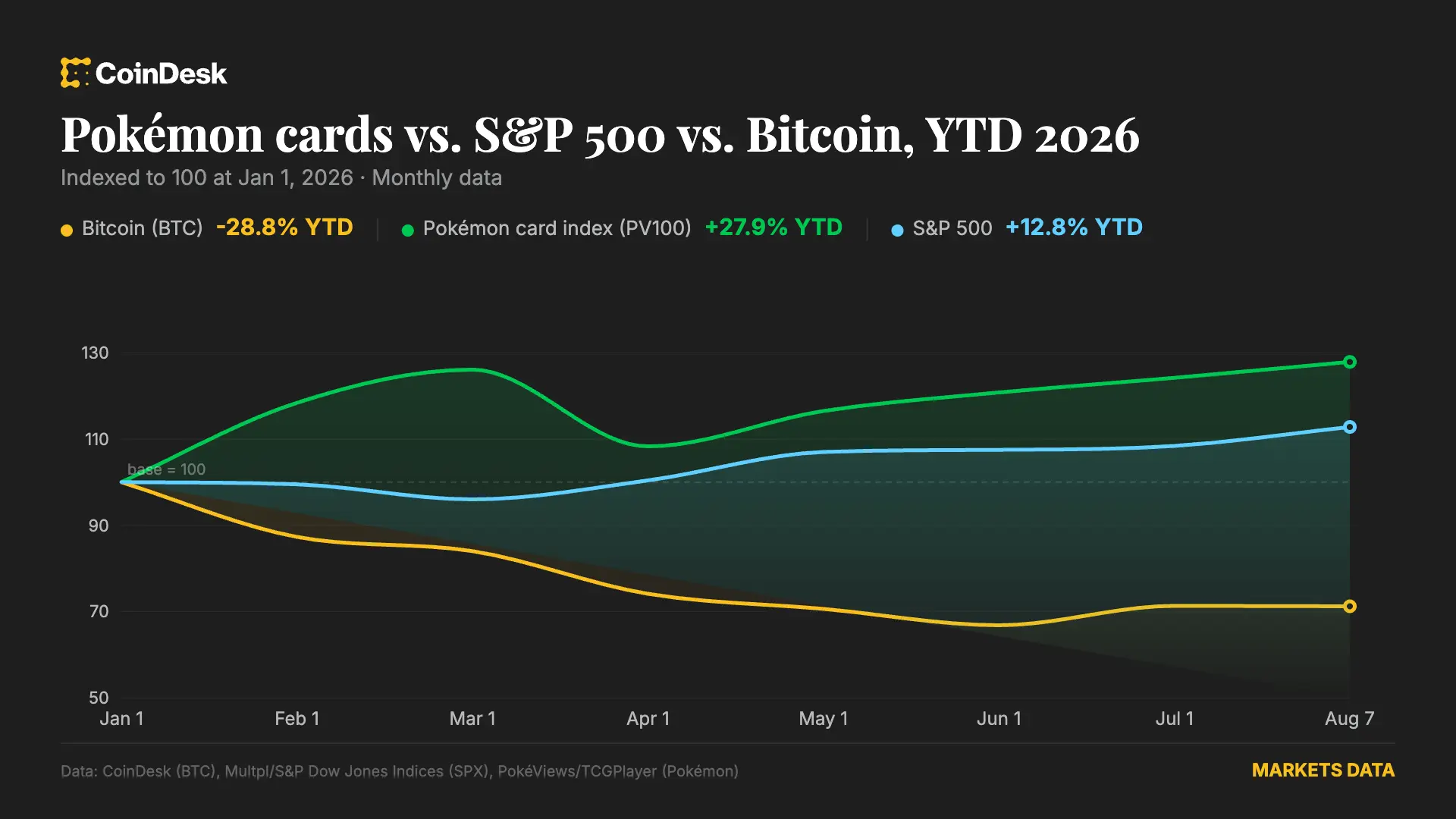
Pokémon cards have outperformed both the S&P 500 and BTC this year, and platforms like Courtyard are turning that into a crypto market: digital packs backed by physical cards sitting in a vault. Courtyard is currently doing roughly $139 million in 30-day volume at an annualized fee run rate of about $48 million, per DefiLlama. That's not a novelty. That's a business.
The Trigger: On the swipe side, blame the fine print.
The GENIUS Act bars payment stablecoin issuers from paying interest to holders, so parking stopped paying. The yield just moved next door: tokenized Treasuries have grown from about $9 billion on New Year's Day to $16.2 billion today, up nearly 80% this year.
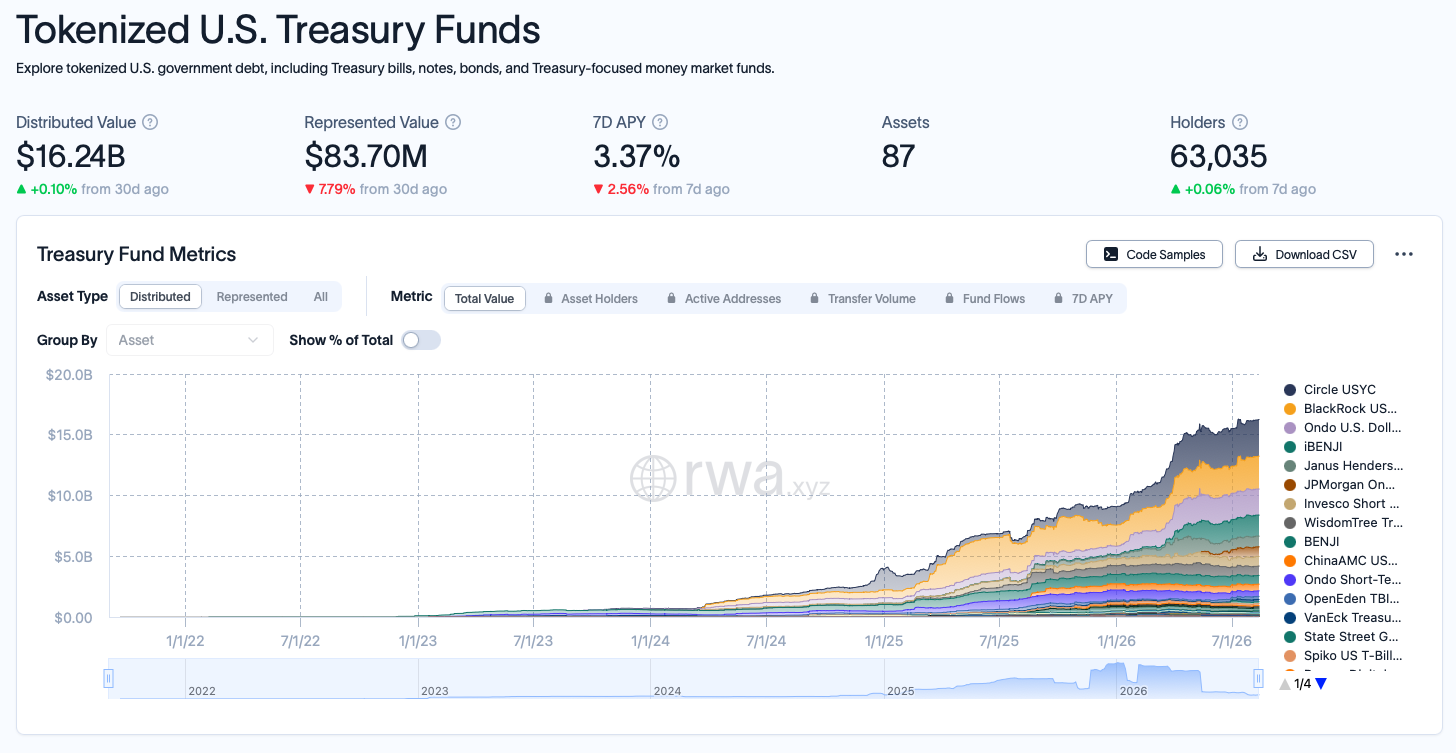
It started as an institutional club, BlackRock's BUIDL, Circle's USYC, Ondo's funds, with minimums that start at "call your lawyer." Now exchanges are wrapping the same T-bill yield into one-tap earn products, parking user deposits in Treasury-backed tokens like USDGO, no suit required. The result: the money that wanted a savings account found one with better branding, and what stayed behind in plain stablecoins is money that actually gets used.
On the play side, risk appetite isn't dead, it's looking for a story.
Alts are short on fresh narratives, and speculative energy always finds assets with one attached. Since Covid, that story has been sitting in a binder in your parents' house, and tokenization just gave the binder a market that trades 24/7.
The Stakes:
1. Watch the composition, not the headline. Card spend used to settle almost entirely on Gnosis, home of the first Visa card wired to a self-custodial wallet. As of July: Optimism carries ~29% of volume, Solana and Base ~19% each, Gnosis is down to ~2%. The currency mix flipped too: USDC is 58% of volume (from ~48%), USDT 26% (from ~7%), euro stablecoins collapsed from 88% of early-2024 spend to ~2%. Digital dollars won, spending is migrating to the fastest rails, and none of it shows up in market cap. A shrinking supply plus rising spend is a usage signal wearing a bearish costume; if you only watch headline numbers, you'll misread this cycle. Payment flow is quietly becoming a fundamentals story for chains, and it's a data series worth following.
2. Your "stablecoin yield" is now a Fed trade. For earn products built on Treasury wrappers, the APR on your idle balance is basically the front of the Treasury curve with a crypto interface. Want proof? The tokenized Treasury category currently yields 3.37% (rwa.xyz), and Binance's RWUSD pays 3.36%. Same vault, different app. When the Fed moves, that yield moves, one more reason inflation weeks like this one matter to people who never touch futures. (Lending-based earn rates are a different animal; they track crypto leverage demand, not the Fed. Know which one you're holding.)
3. Collectibles are RWA's retail test. Treasuries proved institutions will tokenize; Courtyard's fee numbers suggest retail will too. If vaulted collectibles keep trading like this, tokenization stops being an experiment and becomes a norm, and "what gets tokenized next" becomes a real watchlist question.
The two most telling prints of the week told the same story twice: real-world value and crypto rails merging, stablecoins flowing out to the checkout while collectibles flow in from the vault. Whether card spend keeps compounding through Q3, whether chain share keeps rotating, whether tokenized collectibles graduate into an asset class, those are the threads we'll keep pulling. This week wasn't a coincidence. It was a preview.
Quick Hits
Gold doesn't need a theme week. Gold and other risk assets started rallying last week, and gold is now near a 10-week high around $4,400. To sustain that into year-end, it either needs the dollar and yields to keep falling, or it needs to prove it can rally without them.
Chipflation gets its proof point. Semiconductor prices have been climbing, and Applied Materials reports just as this lands in your inbox, with Wall Street expecting EPS up roughly 37% on the memory and advanced-logic boom. If the print delivers, "chipflation" stops being a cute word and starts being a margin story.
Inflation night came and went. July CPI printed broadly in line, easing fears of a September rate hike, though the market is still split on hike vs hold. PPI follows tonight. BTC's verdict: a shrug. It's still hovering near $63K, below both its 20-day and 50-day moving averages, exactly where it sat before the print.
New & Noteworthy
The IPO premium didn't die, it moved earlier. Crypto's listing class reports this week, and the tape is rough: Gemini down ~89% from its debut, BitGo ~77%. Even measured from their offer prices, most are underwater. The exceptions are telling: Circle sits ~110% above its offer, Figure ~24%, gains that landed before the opening bell, not after. Which is why the pre-listing shelf keeps filling: Enflame Technology joins Unitree and KIMI on Pre-IPO.
The card you swipe is now a card you can trade. Chime (CHYM) lists the same week crypto card spending hit a record. This issue's thesis now has a ticker, at 0 fees.
[Get Early Access]{https://www.mexc.com/announcements/new-listings}
Stay Updated
Follow us on Telegram to be notified whenever a new digest drops.
[Follow MEXC on Telegram]{https://t.me/MEXC_OfficialAnnouncements}
Translation
"We let you down this month."
- Leopold Aschenbrenner, letter to Situational Awareness investors, early August
Translation: the year's hottest AI hedge fund just learned that being early with 4x borrowed money is the same as being wrong. The thesis might survive; the leverage didn't. Even the betting markets agree: Polymarket's "AI bubble burst by 2026" odds fell after the blowup, to about 14%, pricing this as one fund's problem, not the trade's. Confident, or confidently wrong?
Before You Go
0808 0-Fee Stock Season is live. Wall Street, minus the fees and the opening bell. Stocks at 0 fees for eligible users while the season runs.
[Trade Wall Street]{https://www.mexc.com/announcements/article/mexc-0808-17827791537298}
Not financial advice. We describe, you decide.