

Hyperliquid Policy Center Stands against CME and ICE Market Manipulation Allegations
Key Insights
- Hyperliquid Policy Center stands against CME and ICE over allegations of market manipulation and calls for regulation.
- The policy arm of Hyperliquid claims the DEX is fully transparent, which is hostile to market manipulation and insider trading
- Hyperliquid remains a dominant DEX platform as new Hyperliquid ETFs are generating significant interest in the market
Hyperliquid pushed back against growing regulatory pressure after traditional exchange operators raised concerns about trading activity on the decentralized derivatives platform.
The response followed reports that CME Group and Intercontinental Exchange, the parent company of the New York Stock Exchange, urged the U.S. Commodity Futures Trading Commission to review Hyperliquid’s operations more closely.
Hyperliquid Defends Trading Transparency
However, HPC debunked these concerns, noting that the DEX offers complete transparency with onchain record of transactions. It stated that this makes it very hostile to market manipulation and insider trading.
According to the advocacy group, Hyperliquid transparency is “a strong deterrent for misconduct and facilitates surveillance, detection, and investigation by regulators and law enforcement.”
HPC was formed in February and is funded using HYPE token allocation as a research and advocacy group for DeFi in the US. It aims to work with policymakers and lawmakers.
The statement added that Hyperliquid, based in Singapore, also offers 24/7 trading, which improves market efficiency compared to traditional exchanges. “Continuous trading eliminates gaps and discontinuities between legacy market hours, improving price discovery for all participants,” it said.
Meanwhile, the HPC acknowledged that the existing US law does not address decentralized derivatives markets like Hyperliquid. However, it expressed a commitment to working with policymakers to ensure regulatory clarity for onchain markets.
Unsurprisingly, the report of traditional exchanges calling for US regulations to cover Hyperliquid has drawn observations from some in the crypto community. Pseudonymous onchain sleuth ZachXBT noted that the NYSE appears to have only a problem with Hyperliquid, not Polymarket.
The predictions platform has been at the center of several concerns about insider trading and is currently seeking CFTC registration in the US. Intercontinental Exchange (ICE) has invested $1.64 billion in Polymarket.
Hyperliquid Continues to Dominate Derivatives DEXes as HYPE ETFs Launch
The call for increased scrutiny of Hyperliquid comes amidst the increasing dominance of the DEX. Hyperliquid is the leading perp DEX, with $178.5 billion in 24-hour volume. The closest to it is Aster, which has $52 billion.
This has translated into revenue for the DEX, which last week recorded $11 million in revenue, 43% of all blockchain network revenue.
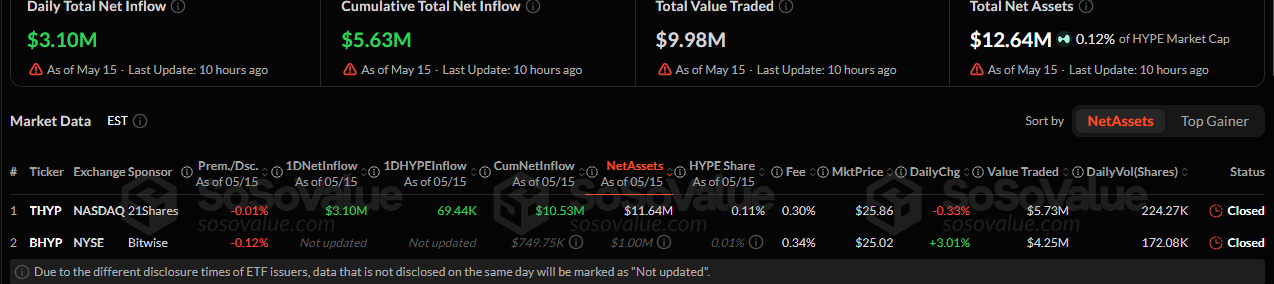 Hyperliquid ETFs Trading Data. Source: Sosovalue
However, Hyperliquid also faces competition from centralized exchanges such as Binance, Coinbase, and Kraken. These exchanges are now offering derivatives on commodities such as oil, which has driven mainstream users to their platforms.
Interestingly, that has not had much impact on its price, with its token HYPE up by 68% year to date. However, it is currently trading at $40 after falling 9% amidst the broader market decline.
Meanwhile, HYPE exchange-traded funds (ETFs) are seeing massive interest. The 21Shares Hyperliquid ETF, which launched earlier this week, is the first of its kind, followed quickly by the Bitwise HYPE ETF.
Together, the two products have seen $5.6 million in net inflows with total assets now at $12.64 million according to Sosovalue.
The post Hyperliquid Policy Center Stands against CME and ICE Market Manipulation Allegations appeared first on The Market Periodical.


You May Also Like

OKX Ventures Maps AI Agent Economy as x402 Transactions Crater 92%

NYDFS Mandates Blockchain Analysis for Banks’ Digital Asset Offerings




