Polkadot (DOT) is preparing to launch a new stablecoin, pUSD, through the RFC-155 proposal. The Polkadot community is championing pUSD as a key solution to unleash its DeFi potential, cut dependence on USDT/USDC, and boost ecosystem autonomy. However, some are concerned that they might repeat past mistakes. pUSD is an over-collateralized stablecoin fully backed by DOT, deployed on Asset Hub, and using the Honzon protocol developed by Acala. Acala is the former issuer of aUSD, a stablecoin project that failed disastrously. Can pUSD Stablecoin Avoid the Same Fate as aUSD? Reusing Honzon – the framework Acala previously relied on to issue aUSD is raising concerns. That incident eroded trust in the Acala team, with some even accusing them of “blaming a hack” while failing to compensate users adequately. “Acala’s stablecoin (aUSD) launch was a complete disaster and it really killed my trust in the team. I don’t see myself supporting their project anymore. What I’d love to see is a proper, reliable, native solution. Honestly, it’s frustrating that with all the talent in the Polkadot/Substrate space, nobody has managed to build something better yet.” – A community member shared. Approval rate of the proposal at the time of writing. Source: Polkadot Even those who support Polkadot launching its native stablecoin still see Honzon and Acala as lessons that cannot be ignored. They propose the project should “move forward independently from the Acala team.” In addition, they call for the Technical Council to take clear responsibility for governance. “With these assurances, I would be prepared to vote AYE. Without them, the risk of repeating past mistakes is too great.” Another member noted. Too Many Risks Setting aside concerns about Honzon and the Acala team, Polkadot’s pUSD also faces skepticism within the community. One primary reason is the structure that DOT solely backs it. While the exact overcollateralization ratio remains unclear, this could trigger liquidation cascades and add selling pressure on the token. Although the pUSD model is safer than Terra’s UST because it is overcollateralized, relying only on DOT as collateral introduces significant risks. Previously, MakerDAO’s DAI also started as ETH-only collateral. But today, MakerDAO supports Multi-Collateral DAI (MCD). They allow users to back DAI with crypto assets such as ETH, WBTC, LINK, UNI, stETH, and even Real World Assets (RWAs) like US Treasuries. “Backed only by DOT, which could trigger liquidation cascades and add additional selling pressure on the token. Remember the notorious DAI depeg in 2020, which forced MakerDAO to diversify its collateral.” A user on X commented. Additionally, another X user pointed out that the Polkadot ecosystem already has more advanced native solutions like HOLLAR. The Hydration runtime builds this stablecoin, optimizes it for appchains, and positions it as superior to the legacy aUSD architecture. Therefore, many argue that instead of repeating a “regular” EVM model, Polkadot should leverage its unique strengths. This would enable the creation of a stable, secure solution worthy of its ecosystem’s potential. pUSD is undoubtedly a strategic move by Polkadot to unlock DeFi potential. It could bring significant benefits if it proves secure and sees widespread adoption in the ecosystem. However, the ghost of aUSD’s failure continues to cast doubt within the community. To avoid repeating the same mistakes, Polkadot must work to dispel those lingering concerns. The fact that the DOT supply is capped at 2.1 billion, as reported by BeInCrypto, could help fuel the ecosystem’s growth.Polkadot (DOT) is preparing to launch a new stablecoin, pUSD, through the RFC-155 proposal. The Polkadot community is championing pUSD as a key solution to unleash its DeFi potential, cut dependence on USDT/USDC, and boost ecosystem autonomy. However, some are concerned that they might repeat past mistakes. pUSD is an over-collateralized stablecoin fully backed by DOT, deployed on Asset Hub, and using the Honzon protocol developed by Acala. Acala is the former issuer of aUSD, a stablecoin project that failed disastrously. Can pUSD Stablecoin Avoid the Same Fate as aUSD? Reusing Honzon – the framework Acala previously relied on to issue aUSD is raising concerns. That incident eroded trust in the Acala team, with some even accusing them of “blaming a hack” while failing to compensate users adequately. “Acala’s stablecoin (aUSD) launch was a complete disaster and it really killed my trust in the team. I don’t see myself supporting their project anymore. What I’d love to see is a proper, reliable, native solution. Honestly, it’s frustrating that with all the talent in the Polkadot/Substrate space, nobody has managed to build something better yet.” – A community member shared. Approval rate of the proposal at the time of writing. Source: Polkadot Even those who support Polkadot launching its native stablecoin still see Honzon and Acala as lessons that cannot be ignored. They propose the project should “move forward independently from the Acala team.” In addition, they call for the Technical Council to take clear responsibility for governance. “With these assurances, I would be prepared to vote AYE. Without them, the risk of repeating past mistakes is too great.” Another member noted. Too Many Risks Setting aside concerns about Honzon and the Acala team, Polkadot’s pUSD also faces skepticism within the community. One primary reason is the structure that DOT solely backs it. While the exact overcollateralization ratio remains unclear, this could trigger liquidation cascades and add selling pressure on the token. Although the pUSD model is safer than Terra’s UST because it is overcollateralized, relying only on DOT as collateral introduces significant risks. Previously, MakerDAO’s DAI also started as ETH-only collateral. But today, MakerDAO supports Multi-Collateral DAI (MCD). They allow users to back DAI with crypto assets such as ETH, WBTC, LINK, UNI, stETH, and even Real World Assets (RWAs) like US Treasuries. “Backed only by DOT, which could trigger liquidation cascades and add additional selling pressure on the token. Remember the notorious DAI depeg in 2020, which forced MakerDAO to diversify its collateral.” A user on X commented. Additionally, another X user pointed out that the Polkadot ecosystem already has more advanced native solutions like HOLLAR. The Hydration runtime builds this stablecoin, optimizes it for appchains, and positions it as superior to the legacy aUSD architecture. Therefore, many argue that instead of repeating a “regular” EVM model, Polkadot should leverage its unique strengths. This would enable the creation of a stable, secure solution worthy of its ecosystem’s potential. pUSD is undoubtedly a strategic move by Polkadot to unlock DeFi potential. It could bring significant benefits if it proves secure and sees widespread adoption in the ecosystem. However, the ghost of aUSD’s failure continues to cast doubt within the community. To avoid repeating the same mistakes, Polkadot must work to dispel those lingering concerns. The fact that the DOT supply is capped at 2.1 billion, as reported by BeInCrypto, could help fuel the ecosystem’s growth.

Polkadot Bets on pUSD Stablecoin — But Can It Escape aUSD’s Shadow?

2025/09/29 11:00

Polkadot (DOT) is preparing to launch a new stablecoin, pUSD, through the RFC-155 proposal. The Polkadot community is championing pUSD as a key solution to unleash its DeFi potential, cut dependence on USDT/USDC, and boost ecosystem autonomy.

However, some are concerned that they might repeat past mistakes. pUSD is an over-collateralized stablecoin fully backed by DOT, deployed on Asset Hub, and using the Honzon protocol developed by Acala. Acala is the former issuer of aUSD, a stablecoin project that failed disastrously.

Can pUSD Stablecoin Avoid the Same Fate as aUSD?

Reusing Honzon – the framework Acala previously relied on to issue aUSD is raising concerns. That incident eroded trust in the Acala team, with some even accusing them of “blaming a hack” while failing to compensate users adequately.
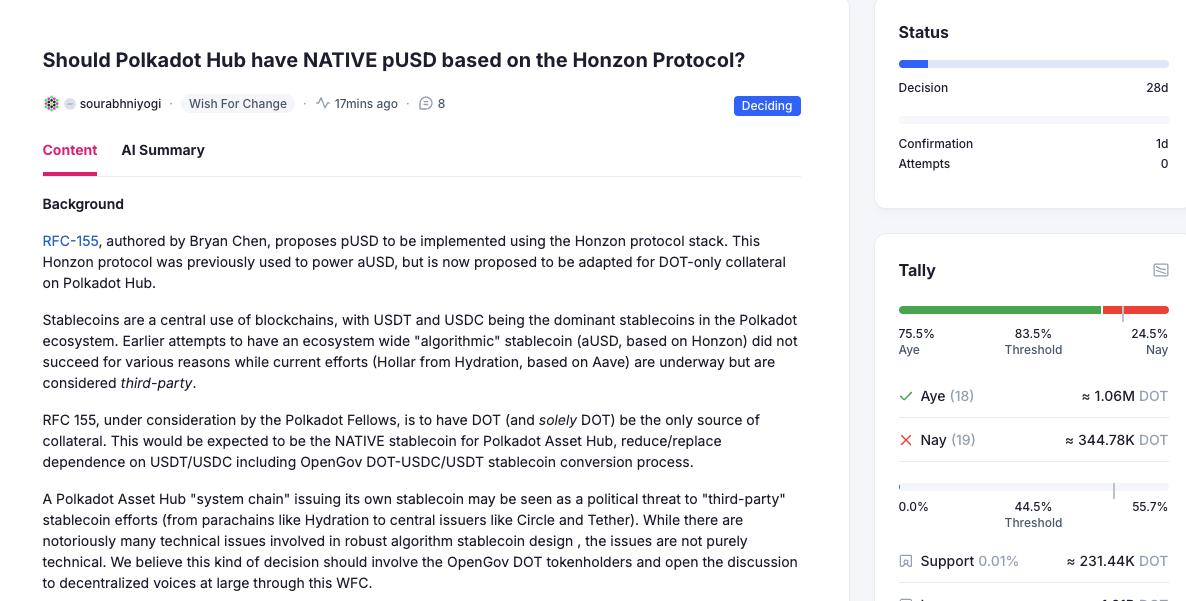
Approval rate of the proposal at the time of writing. Source: PolkadotApproval rate of the proposal at the time of writing. Source: Polkadot

Even those who support Polkadot launching its native stablecoin still see Honzon and Acala as lessons that cannot be ignored. They propose the project should “move forward independently from the Acala team.” In addition, they call for the Technical Council to take clear responsibility for governance.

Too Many Risks

Setting aside concerns about Honzon and the Acala team, Polkadot’s pUSD also faces skepticism within the community. One primary reason is the structure that DOT solely backs it.

While the exact overcollateralization ratio remains unclear, this could trigger liquidation cascades and add selling pressure on the token. Although the pUSD model is safer than Terra’s UST because it is overcollateralized, relying only on DOT as collateral introduces significant risks.

Previously, MakerDAO’s DAI also started as ETH-only collateral. But today, MakerDAO supports Multi-Collateral DAI (MCD). They allow users to back DAI with crypto assets such as ETH, WBTC, LINK, UNI, stETH, and even Real World Assets (RWAs) like US Treasuries.

Additionally, another X user pointed out that the Polkadot ecosystem already has more advanced native solutions like HOLLAR. The Hydration runtime builds this stablecoin, optimizes it for appchains, and positions it as superior to the legacy aUSD architecture. Therefore, many argue that instead of repeating a “regular” EVM model, Polkadot should leverage its unique strengths. This would enable the creation of a stable, secure solution worthy of its ecosystem’s potential.

pUSD is undoubtedly a strategic move by Polkadot to unlock DeFi potential. It could bring significant benefits if it proves secure and sees widespread adoption in the ecosystem. However, the ghost of aUSD’s failure continues to cast doubt within the community.

To avoid repeating the same mistakes, Polkadot must work to dispel those lingering concerns. The fact that the DOT supply is capped at 2.1 billion, as reported by BeInCrypto, could help fuel the ecosystem’s growth.

Disclaimer: The articles reposted on this site are sourced from public platforms and are provided for informational purposes only. They do not necessarily reflect the views of MEXC. All rights remain with the original authors. If you believe any content infringes on third-party rights, please contact [email protected] for removal. MEXC makes no guarantees regarding the accuracy, completeness, or timeliness of the content and is not responsible for any actions taken based on the information provided. The content does not constitute financial, legal, or other professional advice, nor should it be considered a recommendation or endorsement by MEXC.

You May Also Like

Tokenized Assets Shift From Wrappers to Building Blocks in DeFi
Tokenized Assets Shift From Wrappers to Building Blocks in DeFi

The post Tokenized Assets Shift From Wrappers to Building Blocks in DeFi appeared on BitcoinEthereumNews.com. RWAs are rapidly moving on-chain, unlocking new opportunities for investors and DeFi protocols, according to a new report from Dune and RWAxyz. Tokenized real-world assets (RWAs) are moving beyond digital versions of traditional securities to become key building blocks of decentralized finance (DeFi), according to the 2025 RWA Report from Dune and RWAxyz. The report notes that Treasuries, bonds, credit, and equities are now being used in DeFi as collateral, trading instruments, and yield products. This marks tokenization’s “real breakthrough” – composability, or the ability to combine and reuse assets across different protocols. Projects are already showing how this works in practice. Asset manager Maple Finance’s syrupUSDC, for example, has grown to $2.5 billion, with more than 30% placed in DeFi apps like Spark ($570 million). Centrifuge’s new deJAAA token, a wrapper for Janus Henderson’s AAA CLO fund, is already trading on Aerodrome, Coinbase and other exchanges, with Stellar planned next. Meanwhile, Aave’s Horizon RWA Market now lets institutional users post tokenized Treasuries and CLOs as collateral. This trend underscores a bigger shift: RWAs are no longer just copies of traditional assets; instead, they are becoming core parts of on-chain finance, powering lending, liquidity, and yield, and helping to close the gap between traditional finance (TradFi) and DeFi. “RWAs have crossed the chasm from experimentation to execution,” Sid Powell, CEO of Maple Finance, says in the report. “Our growth to $3.5B AUM reflects a broader shift: traditional financial services are adopting crypto assets while institutions seek exposure to on-chain markets.” Investor demand for higher returns and more diversified options is mainly driving this growth. Tokenized Treasuries proved there is strong demand, with $7.3 billion issued by September 2025 – up 85% year-to-date. The growth was led by BlackRock, WisdomTree, Ondo, and Centrifuge’s JTRSY (Janus Henderson Anemoy Treasury Fund). Spark’s $1…
Share
BitcoinEthereumNews2025/09/18 06:10