- Quick Buy/SellBuy & sell with cards and mobile payments
- P2PTrade with local payments at best prices
- Fiat DepositDeposit in BRL, COP, EUR, and more
- Global Bank TransferBuy and sell via local banks
- MEXC CardSpend your crypto worldwide
- USDT-MPerpetual Futures settled in USDT
- USDC-MPerpetual Futures settled in USDC
- USD1-MPerpetual Futures settled in USD1
- Coin-MPerpetual Futures settled in other cryptos
- Futures EarnEarn on balance and unlock higher APR as you trade
- Grid TradingCapture volatility with automated trading
- AI Copy TradeNew & improved AI-Masters with precise style matching
- Demo TradingSimulate Futures trading risk-free
- Futures OverviewExplore Futures tools, products, and features
- OIL Futures24/7 access to top liquidity & leveraged trading
- BTC FuturesMarket's lowest fees and high leverage
- ETH FuturesMarket's lowest fees and high leverage
- MEXC EarnEarn high APR on your crypto
- Hold and EarnHold assets and earn interest daily
- Futures EarnEarn on balance and unlock higher APR as you trade
- On-Chain EarnEasy staking. Real on-chain yield
- MEXC LoansBorrow instantly at competitive rates
- Rewards HubGet started with $10,000 in bonuses
- Event CenterHigher rewards, 0 fees
- Invite and EarnInvite friends and earn 140 USDT each
- $500K BTC CarnivalWin up to 1 BTC & more!
- LaunchpadAccess top tokens early or at a discount
- Airdrop+Deposit and trade to claim new airdrops
- KickstarterHold MX to earn new tokens
- 0 FeesTrade hot futures, enjoy limited 0 fees
- Futures M-DayTrade Futures and claim daily rewards
- Futures Loss Coverage PlanGet triple protection and win $5,000 in XAUT
- Referral ProgrammeInvite friends and unlock commissions from 40%
- Affiliate ProgrammeTop-tier affiliate commissions up to 70%
- MEXC VVIPM-Score into Wealth, 10+ Elite Benefits Upgrading
- MEXC × TradingViewConnect MEXC to trade directly on TradingView
- Crypto NewsFollow the latest crypto headlines
- AnnouncementsStay on top of every happening on MEXC
- LearnStrong crypto fundamentals for every beginner
- MEXC InstitutionalTailored solutions for institutional clients
Solana Alpenglow: What 150ms Finality Really Changes
Overview
Solana is preparing one of the most important consensus changes in its history. Solana Alpenglow is scheduled to activate on mainnet in epoch 1064, which the Solana Foundation currently expects to begin on October 21, 2026 at approximately 15:00 UTC. The upgrade replaces TowerBFT with Votor and targets roughly 150 milliseconds of transaction finality, compared with about 12.8 seconds under the previous consensus model.
The most important distinction is that 150ms refers to finality, not block or slot time. Solana's slot duration was reduced separately toward approximately 200ms through another upgrade path. Alpenglow does not fundamentally change the SVM execution environment; it changes how validators agree that a block is irreversible. Votor removes conventional validator vote transactions from blocks and instead allows validators to exchange votes directly, producing certificates that establish finality much faster.
This matters because financial applications do not only care about how quickly a transaction appears. They also care about when that transaction becomes safe to rely on. Exchanges, payment systems, trading applications and tokenized-asset infrastructure often wait for strong finality before releasing assets or advancing to the next leg of a transaction.
Alpenglow therefore shifts the performance discussion from raw throughput toward time-to-certainty. However, 150ms remains an expected protocol target rather than a guaranteed end-to-end latency for every transaction.
Key Takeaways
- Solana Alpenglow is expected to activate in epoch 1064 beginning October 21.
- Votor replaces TowerBFT and targets approximately 150ms finality versus about 12.8 seconds previously.
- 150ms finality is not 150ms slot time; slot duration is a separate approximately 200ms metric.
- Votor makes “confirmed” and “finalized” effectively converge under the new consensus model.
- Rotor, Alpenglow's new data-propagation component, is planned for a later phase.
What Does Solana Alpenglow Actually Change?
Solana already produces new state quickly. The problem Alpenglow addresses is not primarily how fast a transaction can first appear, but how long the network needs before that state can be treated as final.
Under TowerBFT, validators submitted vote transactions and accumulated lockouts across successive slots. That structure gave applications increasing confidence over time, but the strongest finality state took about 12.8 seconds.
Votor changes the consensus path. Validators communicate votes directly rather than waiting for those votes to be included as ordinary transactions in blocks. The votes are aggregated into certificates that prove enough stake has agreed on a block, allowing the network to move from execution to finality much faster.
The practical flow becomes:
transaction executes
→ validators vote directly
→ certificate forms
→ block becomes final.
Under expected mainnet conditions, Solana targets roughly 150ms finality.
For broader context on the October 21 activation, see the MEXC On-Chain Daily Report: Solana Alpenglow Confirmed for October 21 Launch.
Is Solana's Block Time Falling to 150ms?
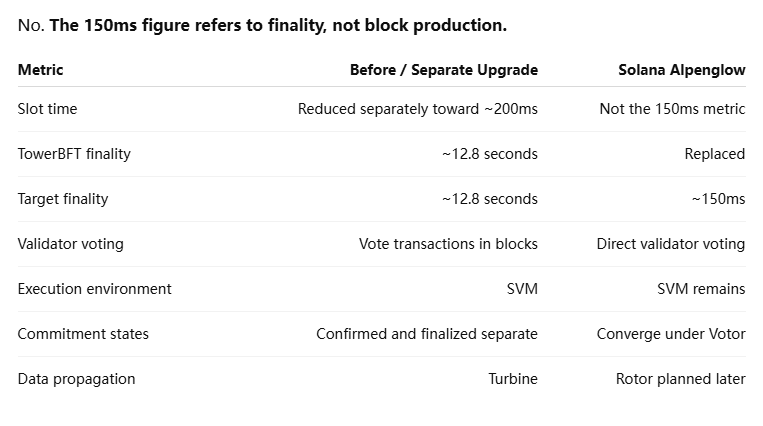
Slot time measures how frequently the network advances through block-production opportunities. Finality measures how quickly the network can treat the resulting state as irreversible under its consensus assumptions.
For users, both affect perceived speed, but they solve different problems. A transaction can appear quickly while an exchange, bridge or financial application still waits before treating it as final. Alpenglow primarily compresses that second waiting period.
Block production determines how fast state appears. Finality determines how fast that state can be trusted.
How Does Votor Reduce Finality From 12.8 Seconds?
Votor replaces the lockout-heavy voting process of TowerBFT with a more direct certificate-based approach. Validators send consensus messages to one another and aggregate signatures proving that enough stake has agreed on a block.
Under favorable conditions, the protocol can use a fast path when sufficient stake notarizes the block in the first round. If that threshold is not reached immediately, Votor has an additional voting path that can still establish finality while preserving the protocol's security assumptions.
The result is a much shorter distance between execution and consensus certainty.
However, 150ms should not be treated as a fixed service-level guarantee. The number represents expected finality under tested network and stake-distribution conditions. Real-world performance can vary depending on validator responsiveness, propagation delays and broader network conditions.
That means a block taking somewhat longer than 150ms to finalize would not necessarily indicate a problem. The more important test is whether Alpenglow consistently keeps finality in a sub-second range without sacrificing safety.
Why Does Faster Finality Matter More Than Faster Slots?
Crypto networks are often compared using transactions per second, fees and block time. Those metrics describe capacity and responsiveness, but financial infrastructure also cares about when a transaction becomes economically irreversible.
Consider a payment processor. It can see a transaction almost instantly, yet still hesitate to release goods or complete an external payment until the source-chain transfer is final. The same issue applies to an exchange crediting a deposit, a bridge releasing assets on another network or an institutional settlement system advancing to the next leg of a transaction.
Reducing finality from roughly 12.8 seconds toward 150ms compresses that waiting period.
This is why Alpenglow is more significant than a routine speed upgrade. It targets the point at which applications can safely act on Solana's state. For financial use cases, that can matter as much as how many transactions the chain processes.
The performance debate therefore begins to shift from how much work can the network process? to how quickly can another system trust the result?
What Could Faster Finality Change for DeFi and Payments?
Sub-second finality can improve several kinds of applications, especially where one action depends on the irreversible completion of another.
- DEX trading: applications can obtain stronger certainty about state transitions more quickly.
- Payments: processors can potentially treat settled transfers as final sooner.
- Exchange deposits: confirmation policies may eventually become shorter if operators are comfortable with the new consensus model.
- Cross-chain systems: bridges that depend on source-chain finality may reduce some waiting periods.
- Institutional settlement: collateral or tokenized assets can potentially move through multi-step workflows with less idle time.
The effect should not be overstated. Consensus finality is not the same as end-to-end application latency.
A user's actual experience still depends on RPC performance, wallet software, backend infrastructure and application design. A transaction may become final in hundreds of milliseconds while the frontend takes much longer to display the result.
For that reason, statements such as “all Solana transactions will complete in 150ms” are inaccurate.
What Actually Goes Live on October 21?
Alpenglow is broader than Votor alone. The overall design also includes Rotor, a new data-propagation architecture intended to replace Turbine.
The October mainnet transition focuses on Votor. Rotor is planned for a later release and does not currently have the same October 21 activation schedule.
There is also a short transition period after epoch 1064 begins. The feature gate activates first, but the network continues running TowerBFT for roughly 5,000 slots, or about 18 minutes under expected timing, before Votor takes over.
The migration therefore looks more like:
epoch 1064 begins
→ activation conditions become active
→ short TowerBFT transition period
→ Votor assumes consensus.
The approximate 15:00 UTC start time should also be treated as an estimate because epoch timing depends on actual slot progression.
What Changes for Validators?
The transition is largely invisible to ordinary users, but it is operationally significant for validators.
Validators need compatible Agave-based software, including supported builds from ecosystems such as Agave and related clients based on the required release line. They also need a registered BLS public key because Votor uses aggregated BLS signatures to form consensus certificates.
The upgrade also introduces the Validator Admission Ticket (VAT). Validators need at least 0.8 SOL above the rent-exempt minimum in the relevant vote account to cover participation requirements associated with the new system.
These changes underline that Alpenglow is not merely a frontend performance optimization. It modifies the mechanics of consensus itself, meaning validator readiness is part of the upgrade's operational risk.
A technically elegant protocol can still experience problems if a large share of validators fail to upgrade correctly or if client compatibility becomes fragmented.
Does Faster Finality Make Solana More Suitable for Institutional Finance?
It strengthens the technical case, but it does not solve every institutional requirement.
Financial institutions value certainty because waiting for settlement creates operational friction. If a transaction becomes irreversible faster, collateral can be released earlier, payment obligations can be recognized sooner and multi-step workflows can advance with less idle time.
This makes sub-second finality potentially relevant to payments, securities settlement, tokenized assets and collateral movement.
Yet institutions also need custody, compliance, identity controls, operational resilience and legal certainty. Technical finality is not the same as legal settlement finality. A token transfer can become irreversible on Solana in milliseconds while a regulated financial transaction still depends on contractual or legal processes outside the chain.
Alpenglow therefore improves one important layer of institutional infrastructure without eliminating the rest of the stack.
MEXC View: Solana Is Optimizing Time-to-Certainty
Solana has historically competed on throughput, fees and responsiveness. Alpenglow introduces a different performance metric that may become increasingly important as blockchains support more serious financial activity: time-to-certainty.
Throughput measures how much work the network can process. Slot time affects how quickly new state is produced. Finality determines how soon applications can safely treat that state as irreversible.
For trading, payments and tokenized assets, this difference is significant. A network can process large volumes of transactions while still imposing operational delays if downstream systems need to wait several seconds before trusting the result.
If Solana Alpenglow can sustain approximately 150ms finality under real mainnet conditions, it could shift part of the Layer 1 competition away from raw TPS and toward how quickly economic systems can act on completed transactions.
That would make finality—not just throughput—one of Solana's most important infrastructure advantages.
Risks and Limitations
Alpenglow is a major consensus migration, so the headline performance figure needs several qualifications.
- 150ms is an expected target, not a fixed guarantee.
- 150ms is not slot time. Solana's approximately 200ms slot duration comes from a separate upgrade path.
- Votor does not mean Rotor. Rotor is planned for a later phase.
- Application latency remains separate. Wallets, RPCs and backends can add significant delay.
- Validator migration creates operational risk.
- Faster finality does not eliminate congestion or application-level failures.
- Protocol safety remains more important than raw speed.
Solana also describes Alpenglow's fault model using separate assumptions for adversarial and offline stake. Those figures should not be simplified into a single claim that the network tolerates an equivalent percentage of malicious validators.
Solana Alpenglow Makes Finality the Next Performance Battleground
Solana Alpenglow matters because it targets a different bottleneck from the one most blockchain performance discussions emphasize. Solana already produces blocks quickly and has separately reduced slot duration toward approximately 200ms. Alpenglow focuses on how long the network needs before that state becomes final.
Replacing TowerBFT with Votor could reduce expected finality from about 12.8 seconds to roughly 150 milliseconds. If that performance holds under mainnet conditions, it can improve any workflow in which one action depends on the irreversible completion of another, including exchange deposits, DEX trading, payments and tokenized-asset settlement.
But the October 21 activation should be treated as the start of production validation rather than proof that every application will immediately operate at 150ms. Consensus finality, application latency and legal settlement remain different layers, and Rotor will arrive separately.
The deeper implication is that blockchain competition is becoming more sophisticated. TPS and fees still matter, but financial infrastructure increasingly cares about how quickly a network can provide trustworthy, irreversible state.
If Solana Alpenglow performs as expected, it could make time-to-certainty one of the defining performance metrics for the next generation of Layer 1 networks.
Sources
MEXC internal link used:
https://www.mexc.com/learn/article/mexc-on-chain-daily-report-solana-alpenglow-confirmed-for-october-21-launch
Solana Foundation — Alpenglow upgrade:
https://solana.com/upgrades/alpenglow
Solana Foundation — BLS Pubkey and Validator Admission Ticket:
https://solana.com/upgrades/bls-pubkey-vat
Risk Disclaimer: This article is for reference only and does not constitute investment advice. The cryptocurrency market is highly volatile. Please make decisions cautiously based on your individual circumstances.
You May Also Like

Stablecoins as Cash Equivalents: What FASB Could Change

Gold ETP Inflows Exceed €10 Billion as Investors Seek Protection From Fiscal Risk