The post Campaign For A Progressive Income Tax In Colorado Faces Setback appeared on BitcoinEthereumNews.com. Campaign to replace Colorado’s flat income tax with progressive rate structure runs into stumbling block. getty On June 22, 1987, Colorado became the first state in the nation to move from a progressive income tax code to a flat rate when then-Governor Roy Romer (D) signed House Bill 1331 into law. Now, nearly four decades later, A ballot measure campaign dubbed “Protect Colorado’s Future” (PCF) is seeking to move the state back to a progressive income tax system. “A coalition led by the Bell Policy Center is pushing the proposal, which is estimated to lower taxes for any person or company making less than $500,000 a year and raise them for those making more,” noted Ed Sealover, vice president of the Colorado Chamber of Commerce, of the effort to put a graduated income tax initiative on the 2026 ballot. “The plan’s method of calculating taxes is complex, with businesses and individuals paying different rates on different portions of income, such as the first $100,000, the amount between $100,000 and $500,000, the amount between $500,000 and $750,000, etc. But Bell estimated it will create an effective tax rate between 4.2% and 4.4% for those earning $500,000 or less and effective rates from 4.9% to 9.2% for those making more, with the highest rate reserved for businesses and individuals generating $10 million or more.” “Colorado is at a turning point,” said Bell Policy Center president and CEO Chris deGruy Kennedy at the May launch of the PCF coalition’s campaign for a progressive income tax. “For more than three decades, an upside-down tax code has hurt Colorado’s schools, health care, childcare and the environment. We’ve made the wealthy even wealthier while everyone else struggles to keep up.” However, Kennedy and other members of the PCF coalition recently encountered procedural hurdles that they must… The post Campaign For A Progressive Income Tax In Colorado Faces Setback appeared on BitcoinEthereumNews.com. Campaign to replace Colorado’s flat income tax with progressive rate structure runs into stumbling block. getty On June 22, 1987, Colorado became the first state in the nation to move from a progressive income tax code to a flat rate when then-Governor Roy Romer (D) signed House Bill 1331 into law. Now, nearly four decades later, A ballot measure campaign dubbed “Protect Colorado’s Future” (PCF) is seeking to move the state back to a progressive income tax system. “A coalition led by the Bell Policy Center is pushing the proposal, which is estimated to lower taxes for any person or company making less than $500,000 a year and raise them for those making more,” noted Ed Sealover, vice president of the Colorado Chamber of Commerce, of the effort to put a graduated income tax initiative on the 2026 ballot. “The plan’s method of calculating taxes is complex, with businesses and individuals paying different rates on different portions of income, such as the first $100,000, the amount between $100,000 and $500,000, the amount between $500,000 and $750,000, etc. But Bell estimated it will create an effective tax rate between 4.2% and 4.4% for those earning $500,000 or less and effective rates from 4.9% to 9.2% for those making more, with the highest rate reserved for businesses and individuals generating $10 million or more.” “Colorado is at a turning point,” said Bell Policy Center president and CEO Chris deGruy Kennedy at the May launch of the PCF coalition’s campaign for a progressive income tax. “For more than three decades, an upside-down tax code has hurt Colorado’s schools, health care, childcare and the environment. We’ve made the wealthy even wealthier while everyone else struggles to keep up.” However, Kennedy and other members of the PCF coalition recently encountered procedural hurdles that they must…

Campaign For A Progressive Income Tax In Colorado Faces Setback

2025/10/25 00:32

Campaign to replace Colorado’s flat income tax with progressive rate structure runs into stumbling block.

getty

On June 22, 1987, Colorado became the first state in the nation to move from a progressive income tax code to a flat rate when then-Governor Roy Romer (D) signed House Bill 1331 into law. Now, nearly four decades later, A ballot measure campaign dubbed “Protect Colorado’s Future” (PCF) is seeking to move the state back to a progressive income tax system.

“A coalition led by the Bell Policy Center is pushing the proposal, which is estimated to lower taxes for any person or company making less than $500,000 a year and raise them for those making more,” noted Ed Sealover, vice president of the Colorado Chamber of Commerce, of the effort to put a graduated income tax initiative on the 2026 ballot. “The plan’s method of calculating taxes is complex, with businesses and individuals paying different rates on different portions of income, such as the first $100,000, the amount between $100,000 and $500,000, the amount between $500,000 and $750,000, etc. But Bell estimated it will create an effective tax rate between 4.2% and 4.4% for those earning $500,000 or less and effective rates from 4.9% to 9.2% for those making more, with the highest rate reserved for businesses and individuals generating $10 million or more.”

“Colorado is at a turning point,” said Bell Policy Center president and CEO Chris deGruy Kennedy at the May launch of the PCF coalition’s campaign for a progressive income tax. “For more than three decades, an upside-down tax code has hurt Colorado’s schools, health care, childcare and the environment. We’ve made the wealthy even wealthier while everyone else struggles to keep up.”

However, Kennedy and other members of the PCF coalition recently encountered procedural hurdles that they must address in order for their proposal to qualify for the ballot. PFC’s effort to place a progressive income tax measure on the 2026 ballot ran into a stumbling block on October 15, when the Colorado Title-Setting Board unanimously ruled that PCF’s proposal violates the state’s single-subject rule. “Initiative supporters have until April to get the board to approve a revamped proposal that has a single subject, though it’s likely they’ll be back with an alternate proposal much sooner,” Sealover noted.

Move To Progressive Income Tax Would Make Colorado A National Outlier

Opponents of moving Colorado to a graduated income tax system with higher rates point out that competing states are largely moving in the opposite direction. In the past five years, most state legislatures have enacted income tax cuts and the number of states with a flat income tax has nearly doubled over the past decade.

“Between 2021 and 2025, eight states enacted laws to transition to a flat individual income tax structure while providing income tax relief to taxpayers across the income spectrum,” Jared Walczak, vice president of state projects at the Tax Foundation, explained in an October 8 post on what he and others refer to as the flat tax revolution.

“Six of those flat taxes have already been implemented, while two others are set to take effect in the future,” added Walczak. “Specifically, Arizona enacted a flat tax law in July 2021, followed by Iowa in March 2022, Mississippi and Georgia in April 2022, and Idaho in September 2022. Louisiana joined them in December 2024, followed by legislation adopted in Kansas in April 2025 and Ohio in June 2025.”

“When considering tax movement, it’s best to consider what each state’s competitors are doing,” wrote Rob Natelson, a senior fellow in constitutional jurisprudence at Independence Institute, in an article published October 20. “A state might be able to enact a modest rate hike without much damage if other states are acting the same way. But if other states are cutting taxes and you are raising them, the result can be disastrous.”

“In Colorado, income tax rates have moved down since 2020, thanks to voter initiatives sponsored by Independence Institute,” Natelson added. “But the reduction has been small—from 4.63% to 4.4%. By contrast, most other states’ income tax cuts have been more dramatic.”

Aside from the critique that a progressive income tax measure would have Colorado moving in the opposite direction from competing states in a way that will make Colorado’s business tax climate less conducive to job creation and economic growth, opponents of the campaign for a progressive income tax contend that such a move would harm low- and middle-income households.

“The people hurt most by punitive graduated levies are not ‘the rich,’” Natelson added. “Rich people generally find ways to avoid them. The people most harmed are those working to better themselves. Other victims of graduated taxes—although they may never know it—are the workers who lose the opportunity to thrive in new and improved enterprises. In other words, graduated taxes punish hope, hard work, productivity, upward mobility, and human thriving.”

Jake Fogleman, Natelson’s Independence Institute colleague, recently wrote about another advantage of a flat income tax, which is that it makes it harder for politicians to raise the rate. By “ensuring that tax policy changes affect all taxpayers equally,” Fogleman points out that the flat tax “prevents schemes to impose concentrated costs on small groups of residents.” As a result, added Fogleman, “the flat tax acts as a powerful political disincentive against policymakers making routine requests for higher taxes.”

In moving from a progressive income tax code in 1987 to a flat rate that has since been reduced by voters multiple times, Colorado was well ahead of a national policy trend that has become more pronounced in recent years. Were Colorado voters to approve a ballot measure in 2026 to switch back to a graduated income tax structure, Colorado would go from policy trendsetter to a national outlier.

Source: https://www.forbes.com/sites/patrickgleason/2025/10/24/campaign-for-a-progressive-income-tax-in-colorado-faces-setback/


Disclaimer: The articles reposted on this site are sourced from public platforms and are provided for informational purposes only. They do not necessarily reflect the views of MEXC. All rights remain with the original authors. If you believe any content infringes on third-party rights, please contact [email protected] for removal. MEXC makes no guarantees regarding the accuracy, completeness, or timeliness of the content and is not responsible for any actions taken based on the information provided. The content does not constitute financial, legal, or other professional advice, nor should it be considered a recommendation or endorsement by MEXC.

You May Also Like

Suspected $243M Crypto Hacker Arrested After Major Breakthrough in Global Heist

Suspected $243M Crypto Hacker Arrested After Major Breakthrough in Global Heist

Major breakthrough in $243M crypto heist as suspect arrested! $18.58M in crypto seized, linked to suspected hacker’s wallet. Dubai villa raid leads to possible arrest of crypto thief. A major breakthrough in the investigation into the $243 million crypto theft has emerged, as blockchain investigator ZachXBT claims that a British hacker, suspected of orchestrating one of the largest individual thefts in crypto history, may have been arrested. On December 5, ZachXBT revealed in a Telegram post that Danny (also known as Meech or Danish Zulfiqar Khan), the primary suspect behind the attack, was likely apprehended by law enforcement. ZachXBT pointed to a significant find: approximately $18.58 million worth of crypto currently sitting in an Ethereum wallet linked to the suspect. The investigator claimed that several addresses connected to Zulfiqar had consolidated funds to this address, mirroring patterns previously seen in law enforcement seizures. This discovery has raised suspicions that authorities may have closed in on the hacker. Moreover, ZachXBT mentioned that Zulfiqar was last known to be in Dubai, where it is alleged that a villa was raided, and multiple individuals associated with the hacker were arrested. He also noted that several contacts of Zulfiqar had gone silent in recent days, adding to the growing belief that law enforcement had made a major move against the hacker. However, no official statements from Dubai Police or UAE regulators have confirmed the arrest, and local media reports remain silent on the matter. Also Read: Song Chi-hyung: The Visionary Behind Upbit and the Future of Blockchain Innovation The $243 Million Genesis Creditor Heist: How the Attack Unfolded The arrest of Zulfiqar may be linked to one of the largest known individual crypto heists. In September 2024, ZachXBT uncovered that three attackers were involved in stealing 4,064 BTC (valued at $243 million at the time) from a Genesis creditor. The attack was carried out using sophisticated social engineering tactics. The hackers impersonated Google support to trick the victim into resetting two-factor authentication on their Gemini account, giving them access to the victim’s private keys. From there, they drained the wallet, moving the stolen BTC through a complex network of exchanges and swap services. ZachXBT previously identified the suspects by their online handles, “Greavys,” “Wiz,” and “Box,” later tying them to individuals Malone Lam, Veer Chetal, and Jeandiel Serrano. The U.S. Department of Justice later charged two of the suspects with orchestrating a $230 million crypto scam involving the theft. Further court documents revealed that the criminals had used a mix of SIM swaps, social engineering, and even physical burglaries to carry out the theft, spending millions on luxury items like cars and travel. ZachXBT’s tracking work has played a key role in uncovering several related thefts, including a $2 million scam in which Chetal was involved while out on bond. The news of Zulfiqar’s potential arrest could mark a significant turning point in the investigation, although full details are yet to emerge. Also Read: Kevin O’Leary Warns: Only Bitcoin and Ethereum Will Survive Crypto’s Reality Check! The post Suspected $243M Crypto Hacker Arrested After Major Breakthrough in Global Heist appeared first on 36Crypto.
Share
Coinstats2025/12/06 18:27
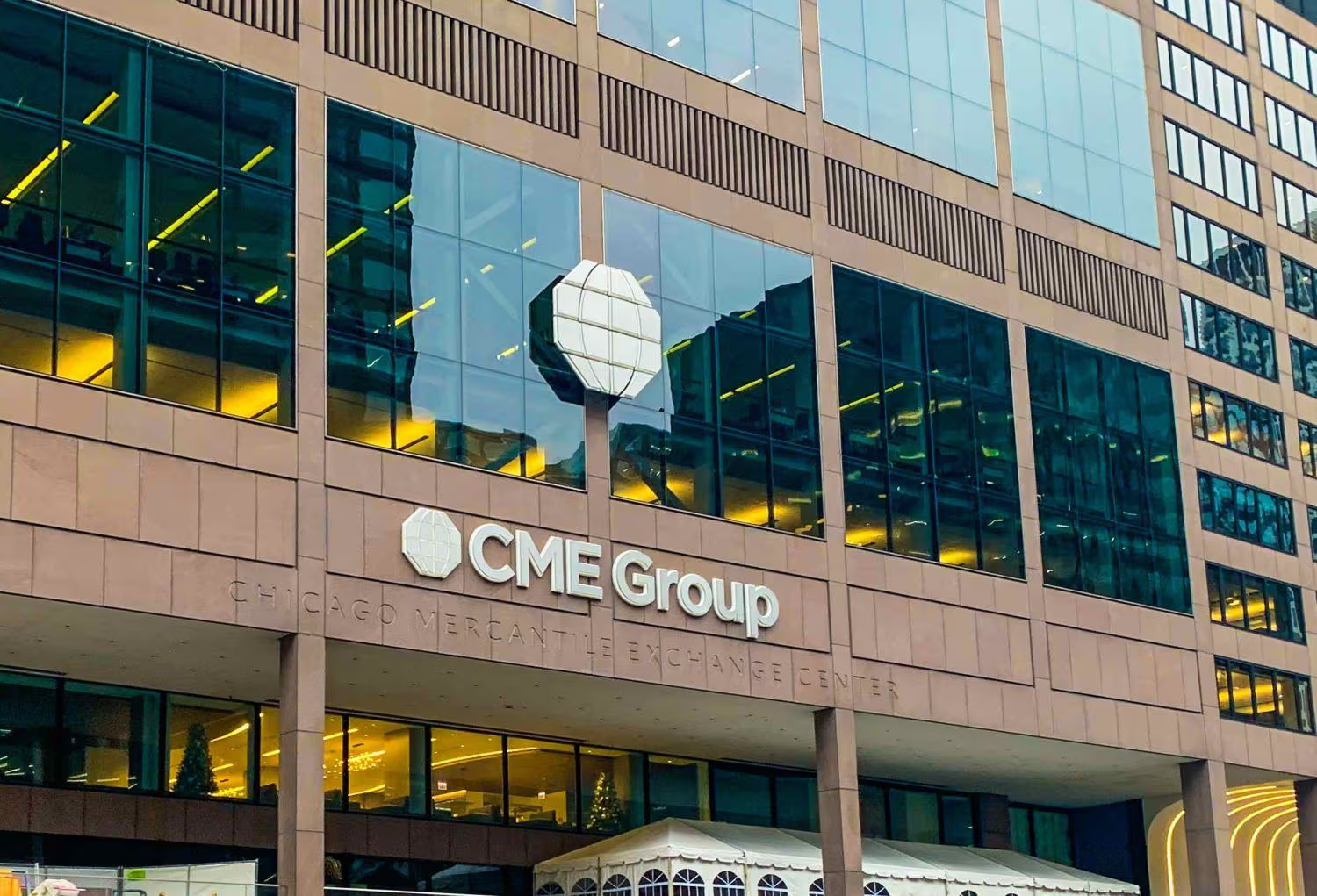
Breaking: CME Group Unveils Solana and XRP Options

Breaking: CME Group Unveils Solana and XRP Options

CME Group launches Solana and XRP options, expanding crypto offerings. SEC delays Solana and XRP ETF approvals, market awaits clarity. Strong institutional demand drives CME’s launch of crypto options contracts. In a bold move to broaden its cryptocurrency offerings, CME Group has officially launched options on Solana (SOL) and XRP futures. Available since October 13, 2025, these options will allow traders to hedge and manage exposure to two of the most widely traded digital assets in the market. The new contracts come in both full-size and micro-size formats, with expiration options available daily, monthly, and quarterly, providing flexibility for a diverse range of market participants. This expansion aligns with the rising demand for innovative products in the crypto space. Giovanni Vicioso, CME Group’s Global Head of Cryptocurrency Products, noted that the new options offer increased flexibility for traders, from institutions to active individual investors. The growing liquidity in Solana and XRP futures has made the introduction of these options a timely move to meet the needs of an expanding market. Also Read: Vitalik Buterin Reveals Ethereum’s Bold Plan to Stay Quantum-Secure and Simple! Rapid Growth in Solana and XRP Futures Trading CME Group’s decision to roll out options on Solana and XRP futures follows the substantial growth in these futures products. Since the launch of Solana futures in March 2025, more than 540,000 contracts, totaling $22.3 billion in notional value, have been traded. In August 2025, Solana futures set new records, with an average daily volume (ADV) of 9,000 contracts valued at $437.4 million. The average daily open interest (ADOI) hit 12,500 contracts, worth $895 million. Similarly, XRP futures, which launched in May 2025, have seen significant adoption, with over 370,000 contracts traded, totaling $16.2 billion. XRP futures also set records in August 2025, with an ADV of 6,600 contracts valued at $385 million and a record ADOI of 9,300 contracts, worth $942 million. Institutional Demand for Advanced Hedging Tools CME Group’s expansion into options is a direct response to growing institutional interest in sophisticated cryptocurrency products. Roman Makarov from Cumberland Options Trading at DRW highlighted the market demand for more varied crypto products, enabling more advanced risk management strategies. Joshua Lim from FalconX also noted that the new options products meet the increasing need for institutional hedging tools for assets like Solana and XRP, further cementing their role in the digital asset space. The launch of options on Solana and XRP futures marks another step toward the maturation of the cryptocurrency market, providing a broader range of tools for managing digital asset exposure. SEC’s Delay on Solana and XRP ETF Approvals While CME Group expands its offerings, the broader market is also watching the progress of Solana and XRP exchange-traded funds (ETFs). The U.S. Securities and Exchange Commission (SEC) has delayed its decisions on multiple crypto-related ETF filings, including those for Solana and XRP. Despite the delay, analysts anticipate approval may be on the horizon. This week, REX Shares and Osprey Funds are expected to launch an XRP ETF that will hold XRP directly and allocate at least 40% of its assets to other XRP-related ETFs. Despite the delays, some analysts believe that approval could come soon, fueling further interest in these assets. The delay by the SEC has left many crypto investors awaiting clarity, but approval of these ETFs could fuel further momentum in the Solana and XRP futures markets. Also Read: Tether CEO Breaks Silence on $117,000 Bitcoin Price – Market Reacts! The post Breaking: CME Group Unveils Solana and XRP Options appeared first on 36Crypto.
Share
Coinstats2025/09/18 02:35