The post Two Duke University Students Wanted To Work In Luxury. When They Created A Path, Execs Followed appeared on BitcoinEthereumNews.com. Is it time for Universities to lean heavier into fashion? Duke Business of Retail Society’s Co-Founders Sophia Yassinger and Nina Venter, are both attending Duke University as undergrads. Courtesy of: Duke Business of Retail Society At many elite campuses today, the career conveyor belt is funneling the most ambitious students into three tracks. According to a recent Harvard University survey, consulting, finance, and technology have become the most desired paths for up to 63% of its graduates. ‘The Bermuda Triangle of Talent’ as it’s been coined, has become a funnel, luring in many, increasingly more men than women. While the top majors for women at the best universities are biology, academia, social science, and general business, other subjects are attracting greater interest. With the growth of the luxury, fashion, and beauty markets, more students are looking toward those professional areas and the career paths they offer. From 2019 to 2024, the luxury category alone has grown threefold. In beauty, retailer Sephora is now the second-largest house by revenue under LVMH, behind only Louis Vuitton across its 75 houses. And this year, fashion weeks from Milan to New York—and even Riyadh—are being covered more widely and attended by more notables worldwide. DBRS member Aviv Yochai speaking to April Henning inside the Nasher Museum of Art at Duke University prior to the Luxury Fashion Panel Courtesy of DUKE BUSINESS OF RETAIL SOCIETY But at the best universities, many don’t offer majors or career paths to meet the market demand in these areas, or provide a way for students to gain the insight, networking, or mentoring they need in those spaces. This was the case at Duke University until two ambitious students decided to step off the conveyor belt and begin building a new track. One that treats fashion, beauty, and luxury as… The post Two Duke University Students Wanted To Work In Luxury. When They Created A Path, Execs Followed appeared on BitcoinEthereumNews.com. Is it time for Universities to lean heavier into fashion? Duke Business of Retail Society’s Co-Founders Sophia Yassinger and Nina Venter, are both attending Duke University as undergrads. Courtesy of: Duke Business of Retail Society At many elite campuses today, the career conveyor belt is funneling the most ambitious students into three tracks. According to a recent Harvard University survey, consulting, finance, and technology have become the most desired paths for up to 63% of its graduates. ‘The Bermuda Triangle of Talent’ as it’s been coined, has become a funnel, luring in many, increasingly more men than women. While the top majors for women at the best universities are biology, academia, social science, and general business, other subjects are attracting greater interest. With the growth of the luxury, fashion, and beauty markets, more students are looking toward those professional areas and the career paths they offer. From 2019 to 2024, the luxury category alone has grown threefold. In beauty, retailer Sephora is now the second-largest house by revenue under LVMH, behind only Louis Vuitton across its 75 houses. And this year, fashion weeks from Milan to New York—and even Riyadh—are being covered more widely and attended by more notables worldwide. DBRS member Aviv Yochai speaking to April Henning inside the Nasher Museum of Art at Duke University prior to the Luxury Fashion Panel Courtesy of DUKE BUSINESS OF RETAIL SOCIETY But at the best universities, many don’t offer majors or career paths to meet the market demand in these areas, or provide a way for students to gain the insight, networking, or mentoring they need in those spaces. This was the case at Duke University until two ambitious students decided to step off the conveyor belt and begin building a new track. One that treats fashion, beauty, and luxury as…

Two Duke University Students Wanted To Work In Luxury. When They Created A Path, Execs Followed

2025/11/03 07:48

Is it time for Universities to lean heavier into fashion?

Duke Business of Retail Society’s Co-Founders Sophia Yassinger and Nina Venter, are both attending Duke University as undergrads.

Courtesy of: Duke Business of Retail Society

At many elite campuses today, the career conveyor belt is funneling the most ambitious students into three tracks. According to a recent Harvard University survey, consulting, finance, and technology have become the most desired paths for up to 63% of its graduates. ‘The Bermuda Triangle of Talent’ as it’s been coined, has become a funnel, luring in many, increasingly more men than women.

While the top majors for women at the best universities are biology, academia, social science, and general business, other subjects are attracting greater interest. With the growth of the luxury, fashion, and beauty markets, more students are looking toward those professional areas and the career paths they offer. From 2019 to 2024, the luxury category alone has grown threefold. In beauty, retailer Sephora is now the second-largest house by revenue under LVMH, behind only Louis Vuitton across its 75 houses. And this year, fashion weeks from Milan to New York—and even Riyadh—are being covered more widely and attended by more notables worldwide.

DBRS member Aviv Yochai speaking to April Henning inside the Nasher Museum of Art at Duke University prior to the Luxury Fashion Panel

Courtesy of DUKE BUSINESS OF RETAIL SOCIETY

But at the best universities, many don’t offer majors or career paths to meet the market demand in these areas, or provide a way for students to gain the insight, networking, or mentoring they need in those spaces.

This was the case at Duke University until two ambitious students decided to step off the conveyor belt and begin building a new track. One that treats fashion, beauty, and luxury as serious, high-growth businesses. In 2023, the Duke Business of Retail Society (DBRS) was born.

The Duke Business of Retail Society

The student-run organization was founded by Sophia Yassinger and Nina Venter with a straightforward thesis: to value, nurture, and connect creative and commercial students from Duke with executives, brands, and insights within the industries they loved. By drawing top luxury, fashion, and beauty executives to campus, they could build a ‘society’ of students seeking to reframe and take action to define what a successful, professional opportunity can look like across data, design, finance, and supply chains in this space.

The results have been immediate and impactful.

The group shot of the DRBS student class of 2024-2025.

Courtesy of DUKE BUSINESS OF RETAIL SOCIETY

In just two years, the DBRS has brought in executives from leading luxury houses like Dior and Chanel, established an advisory board with industry leaders, and attracted over 1,000 students to participate. Campus-led programming, such as the Retail & Consumer Investment Panel and the Industry Immersion Series, has generated over $100,000 through grants and brand partnerships across both retail and CPG brands. From Uber to Poppi to Supergoop! and more, brands have reached out to discuss promoting and sponsoring product use, supporting social media initiatives, and activating bespoke events — such as private dinners for members. Some have even provided dedicated budgets to co-create marketing campaigns and conduct Gen Z-based research and focus groups.

“There wasn’t a true place on campus for students interested in creative industries. We saw the finance and consulting clubs, but nothing for students who wanted to explore the intersection of fashion, business, and creativity,” said Nina, who serves as DBRS Co-President “Duke is a top school, yet there was this empty space, and I felt like I couldn’t leave without building something to change that. Not just for myself, but for the students who have now found a sense of community.”

Chanel’s GM of Fashion, Rebekah McCabe and Modis Operandi President, April Henning Keynote Duke Business of Retail Society’s Fashion and Luxury Panel

Courtesy: Duke Business of Retail Society

“Growing up in LA, I was surrounded by early adopters. We created DBRS to fill a void for creative, ambitious students to start building experiences and a network in the industries we love right now.” Sophia expanded “When I got to Duke, I had a very clear vision of who I wanted to be and what I wanted to learn. So we created what we didn’t see it.”

Recently the group hosted one of their most significant events at the Nasher Museum of Art at Duke University. The Luxury Fashion Panel, offered students an opportunity to hear firsthand about careers in the luxury sector—from both heritage brands and the evolving world of e-commerce luxury. The panelists were Duke alum Rebekah McCabe, General Manager of Fashion of Chanel and April Hennig, President of Moda Operandi, a luxury e-commerce platform.

DBRS student Sophie Brooks learning from Chanel’s Rebekah McCabe inside the Nasher Museum of Art at Duke University

Courtesy of DUKE BUSINESS OF RETAIL SOCIETY

From Summer Internships to Full-Time Careers

Like many students, securing a critical summer internship and/or a coveted job upon graduation is the goal. DRBS has been able to measure its success through internships and post-grad placements with the companies it brings to campus, as well as the networking opportunities offered. Beyond that, long-term success is about creating a cultural shift in Duke’s pre-professional landscape. “Creating a culture where the industries we love are celebrated, given the spotlight they deserve, and are accessible for students to gain practical, hands-on experience and engagement opportunities they might not have had without DBRS,” Nina and Sophie Brooks, who leads speaker relationships for the group, shared.

As for what’s next, “seeing DBRS expand into multiple chapters across campuses nationwide, creating a network of students who share the same passions that we do, would be the ultimate reward,” said Yassinger.

By following their passion and having a pulse on other like-minded students across campus, it’s clear that in a world with so many options, sometimes creating your own is the best one.

Source: https://www.forbes.com/sites/dougmelville/2025/11/02/two-duke-university-students-wanted-to-work-in-luxury-when-they-created-a-path-execs-followed/

Disclaimer: The articles reposted on this site are sourced from public platforms and are provided for informational purposes only. They do not necessarily reflect the views of MEXC. All rights remain with the original authors. If you believe any content infringes on third-party rights, please contact [email protected] for removal. MEXC makes no guarantees regarding the accuracy, completeness, or timeliness of the content and is not responsible for any actions taken based on the information provided. The content does not constitute financial, legal, or other professional advice, nor should it be considered a recommendation or endorsement by MEXC.

You May Also Like

XRP Moves Sideways Above $2.00

XRP Moves Sideways Above $2.00

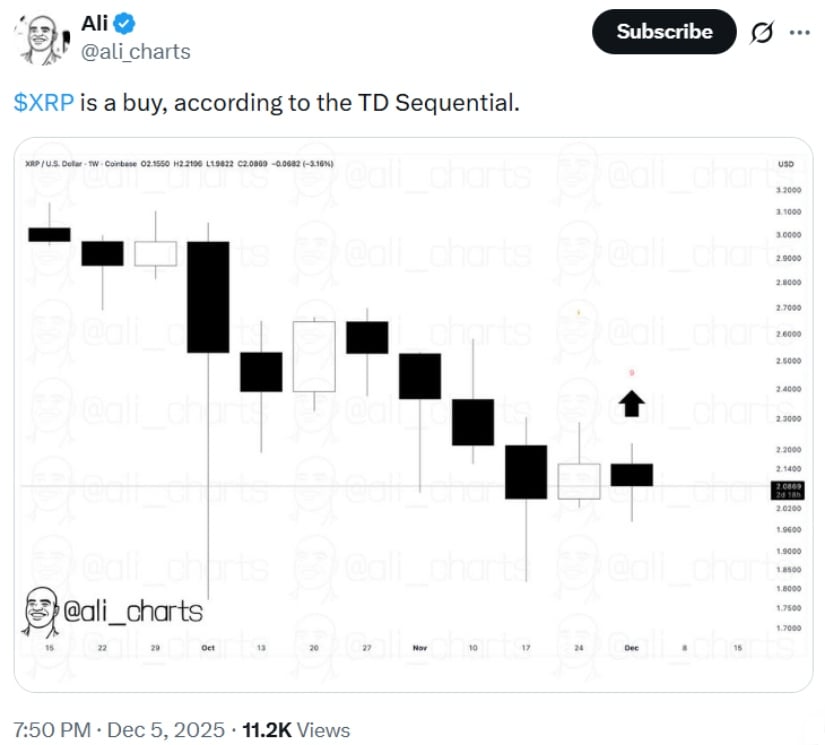
The post XRP Moves Sideways Above $2.00 appeared on BitcoinEthereumNews.com. // Price Reading time: 2 min Published: Dec 05, 2025 at 21:05 Today, the XRP price has reached a low of $2.00. XRP long-term analysis: bearish Since November 24, the price of XRP has remained below the 21-day moving average. Following the price drop on October 10, as Coinidol.com reported, the price has stabilised above the $1.80 support and below the 21-day SMA barrier. The cryptocurrency has repeatedly broken above the 21-day SMA, but buyers have been unable to sustain bullish momentum above this level. Now, if the current support is breached, bearish momentum is likely to continue towards the low of $1.82. Currently, XRP is around $2.07. XRP price indicator analysis The XRP moving average lines are positioned above the price bars. XRP declines each time it is pushed back by the 21-day SMA barrier. Doji candlesticks have formed, leading to price consolidation. On the 4-hour chart, the price bars are below the horizontal moving average lines, indicating a downtrend. Technical indicators: What is the next direction for XRP? XRP is trading above the $1.80 support level and below the $2.30 peak. The price has fallen below the moving average lines, approaching the critical support level of $2.00. On December 1, the price retested the $2.00 support before pulling back. If XRP falls and remains above $2.00, it is expected to continue moving sideways. Disclaimer. This analysis and forecast are the personal opinions of the author. The data provided is collected by the author and is not sponsored by any company or token developer. This is not a recommendation to buy or sell cryptocurrency and should not be viewed as an endorsement by Coinidol.com. Readers should do their research before investing in funds. Source: https://coinidol.com/xrp-moves-sideways/
Share
BitcoinEthereumNews2025/12/06 05:31