Details the Q-Former architecture: a 12-layer BERT-based model using 32 learnable query embeddings. These queries use cross-attention to extract visual information for MLLM input.Details the Q-Former architecture: a 12-layer BERT-based model using 32 learnable query embeddings. These queries use cross-attention to extract visual information for MLLM input.

Visual Prompt Generation: Cross-Attention in Q-Former

2025/11/20 00:00

Abstract and 1 Introduction

  1. Related Work

    2.1. Multimodal Learning

    2.2. Multiple Instance Learning

  2. Methodology

    3.1. Preliminaries and Notations

    3.2. Relations between Attention-based VPG and MIL

    3.3. MIVPG for Multiple Visual Inputs

    3.4. Unveiling Instance Correlation in MIVPG for Enhanced Multi-instance Scenarios

  3. Experiments and 4.1. General Setup

    4.2. Scenario 1: Samples with Single Image

    4.3. Scenario 2: Samples with Multiple Images, with Each Image as a General Embedding

    4.4. Scenario 3: Samples with Multiple Images, with Each Image Having Multiple Patches to be Considered and 4.5. Case Study

  4. Conclusion and References

\ Supplementary Material

A. Detailed Architecture of QFormer

B. Proof of Proposition

C. More Experiments

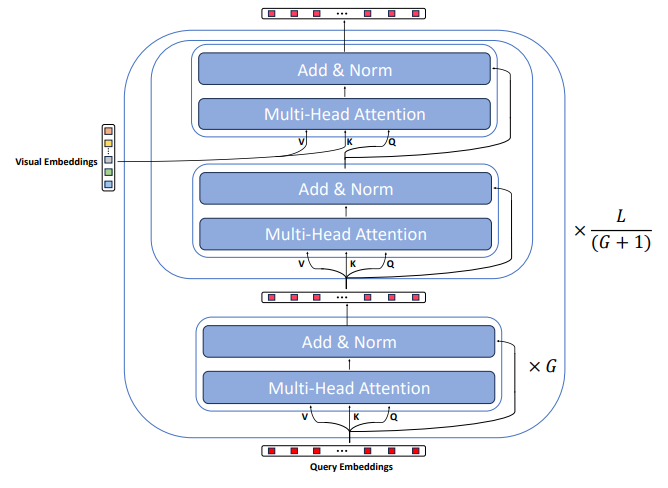
\ Figure 7. Overview of QFormer
A. Detailed Architecture of QFormer

The architecture overview is depicted in Figure 7. Specifically, QFormer is initialized as a BERT-based model[8] comprising a total of L = 12 layers. In contrast to typical BERT models that process textual inputs, QFormer takes R = 32 learnable query embeddings as inputs. These embeddings are utilized to extract visual information from the input visual data during Stage-1 pretraining in BLIP2[22]. Subsequently, they serve as visual prompt embeddings for the LLM inputs after projection.

\ Inside the QFormer, each layer includes a self-attention module composed of a Multi-Head Attention component and a Forward module (consisting of Linear, LayerNorm, and Residual Connection). The cross-attention module, initialized with random values, is inserted every G layers, where learnable query embeddings interact with visual embeddings. In the main paper, for the sake of conciseness, we condensed the representation of the multi-head attention and forward modules into self(cross) attention modules. Furthermore, we exclusively illustrated the modifications made to the cross-attention module in MIVPG, as the self-attention modules remain unchanged. The final QFormer output is represented by the last layer’s query embeddings.

\ For a more comprehensive understanding, readers are encouraged to refer to [22].

\

:::info Authors:

(1) Wenliang Zhong, The University of Texas at Arlington ([email protected]);

(2) Wenyi Wu, Amazon ([email protected]);

(3) Qi Li, Amazon ([email protected]);

(4) Rob Barton, Amazon ([email protected]);

(5) Boxin Du, Amazon ([email protected]);

(6) Shioulin Sam, Amazon ([email protected]);

(7) Karim Bouyarmane, Amazon ([email protected]);

(8) Ismail Tutar, Amazon ([email protected]);

(9) Junzhou Huang, The University of Texas at Arlington ([email protected]).

:::


:::info This paper is available on arxiv under CC by 4.0 Deed (Attribution 4.0 International) license.

:::

\

Disclaimer: The articles reposted on this site are sourced from public platforms and are provided for informational purposes only. They do not necessarily reflect the views of MEXC. All rights remain with the original authors. If you believe any content infringes on third-party rights, please contact [email protected] for removal. MEXC makes no guarantees regarding the accuracy, completeness, or timeliness of the content and is not responsible for any actions taken based on the information provided. The content does not constitute financial, legal, or other professional advice, nor should it be considered a recommendation or endorsement by MEXC.

You May Also Like

Coinbase Vs. State Regulators: Crypto Exchange Fights Legal Fragmentation

Coinbase Vs. State Regulators: Crypto Exchange Fights Legal Fragmentation

US-based crypto exchange Coinbase has made a significant appeal to the Department of Justice (DOJ) regarding a wave of lawsuits aimed at its operations. The company is urging federal action to address what it describes as an “increasingly fragmented and hostile” regulatory landscape for the crypto market. Coinbase Urges Federal Action  In a recent letter, Coinbase highlighted the steps taken by the current Administration to create a more equitable framework for digital asset regulation. This includes the introduction of stablecoin legislation and two pending bipartisan market-structure bills aimed at fostering uniformity in the oversight of cryptocurrencies.  Coinbase argues that these initiatives have begun to mitigate the adverse effects of the previous Administration’s enforcement-driven regulatory approach.  However, the company warns that certain states are perpetuating this problematic trend by adopting “expansive and flawed” interpretations of securities laws and implementing new licensing requirements that undermine the federal government’s pro-innovation stance. Related Reading: REX Shares Claims Its DOGE And XRP Spot ETFs Will Be Approved By US SEC Tomorrow They make an example with the Oregon Attorney General, who has filed a lawsuit against Coinbase, claiming that many digital assets traded on its platform qualify as alleged unregistered securities.  The letter affirms that the suit not only targets Coinbase but also encourages other states to address what the Attorney General perceives as a regulatory gap left by federal authorities.  Similarly, the New York Attorney General has initiated legal action to regulate transactions involving digital assets based on decentralized protocols as securities, further complicating the regulatory environment. Coinbase has faced cease-and-desist orders from four states, which demand the company halt its retail staking services. These orders are deemed by Coinbase as “legally unfounded and inconsistent.” Unified Framework For Digital Assets In light of these challenges, the letter to the DOJ calls for urgent federal intervention to establish broad preemption provisions. The crypto exchange argues that preemption has historically been an effective tool for addressing state interference in national markets, referencing past Congressional actions. Coinbase contends that the current patchwork of state regulations not only disrupts market efficiency but also leads to unequal access to cryptocurrency services based on geographic location. Related Reading: Citi’s Ethereum Forecast: No New All-Time High Expected, Year-End Target At $4,300 To remedy these issues, Coinbase advocates for Congress to adopt legislation that would exempt federally regulated digital assets from state blue-sky laws and clarify that state licensing requirements do not apply to crypto intermediaries.  Additionally, the company urges the SEC to expedite rulemaking and provide clearer guidance on why digital asset transactions and services, including staking, should not be classified as securities. Such clarity would help prevent states from imposing conflicting regulations based on their interpretations of securities laws. Featured image from Shutterstock, chart from TradingView.com
Share
NewsBTC2025/09/18 15:00
Maryland Man Sentenced for Allegedly Aiding North Korea’s US Company Infiltration and Sensitive Data Access

Maryland Man Sentenced for Allegedly Aiding North Korea’s US Company Infiltration and Sensitive Data Access

The post Maryland Man Sentenced for Allegedly Aiding North Korea’s US Company Infiltration and Sensitive Data Access appeared on BitcoinEthereumNews.com. North Korea’s IT workers infiltrated US companies through a Maryland man’s scheme, earning over $970,000 while enabling access to sensitive government systems. This operation supported the regime’s cyber activities, including crypto hacks that stole $2 billion in 2025, funding nuclear programs. Minh Phuong Ngoc Vong sentenced to 15 months in prison for aiding North Korean infiltration. He used fake credentials to secure jobs at 13 US firms, passing work to overseas conspirators. North Korea stole $2 billion in crypto in 2025 via hacks, totaling over $6 billion recently, per blockchain analytics firm Elliptic. Discover how North Korea’s IT infiltration and crypto hacking schemes threaten US security. Learn the details of the Maryland case and regime’s $6B theft. Stay informed on cybersecurity risks today. What is North Korea’s IT Infiltration Scheme in US Companies? North Korea’s IT infiltration scheme involves covertly placing regime-affiliated workers into US companies using fake identities to generate revenue and access sensitive systems. In a recent Maryland case, Minh Phuong Ngoc Vong was sentenced to 15 months in prison and three years of supervised release for facilitating this for three years across 13 companies. The operation netted over $970,000, much of which funded North Korea’s weapons programs through software work performed by overseas actors, including those in China near the border. How Does North Korea Use Crypto Hacking to Fund Its Programs? North Korea employs sophisticated cyber groups to target cryptocurrency exchanges and wallets, stealing digital assets that convert to fiat for regime funding. According to blockchain analytics firm Elliptic, these groups pilfered approximately $2 billion in cryptocurrencies in 2025 alone, contributing to a total exceeding $6 billion in recent years from hacks on platforms like Bybit and Upbit. This influx directly supports nuclear and missile development, as confirmed by US intelligence assessments. Experts note the regime’s…
Share
BitcoinEthereumNews2025/12/06 09:12