NEAR Foundation launched NEAR AI Cloud and Private Chat to bring verifiable, hardware-backed privacy to AI applications. Brave, OpenMind AGI, and Phala Network integrated the tools, expanding NEAR’s confidential AI reach to more than 100 million users. NEAR Foundation has launched NEAR AI Cloud and Private Chat, two linked products designed to bring verifiable privacy [...]]]>NEAR Foundation launched NEAR AI Cloud and Private Chat to bring verifiable, hardware-backed privacy to AI applications. Brave, OpenMind AGI, and Phala Network integrated the tools, expanding NEAR’s confidential AI reach to more than 100 million users. NEAR Foundation has launched NEAR AI Cloud and Private Chat, two linked products designed to bring verifiable privacy [...]]]>

NEAR Protocol Launches NEAR AI Cloud and Private Chat With Verifiable Privacy

2025/12/04 17:28
  • NEAR Foundation launched NEAR AI Cloud and Private Chat to bring verifiable, hardware-backed privacy to AI applications.
  • Brave, OpenMind AGI, and Phala Network integrated the tools, expanding NEAR’s confidential AI reach to more than 100 million users.

NEAR Foundation has launched NEAR AI Cloud and Private Chat, two linked products designed to bring verifiable privacy to AI usage. The tools are already active within Brave Nightly, OpenMind AGI, and Phala Network suites, placing the technology in front of more than 100 million users. 

According to NEAR Foundation, both products operate on the principle that users should own their interactions with AI. They rely on hardware-backed protections and cryptographic verification, offering privacy assurances that differ from mainstream AI systems that run on centralized data models.

NEAR AI Expands User-Controlled Intelligence

Additionally, Near noted that its AI Cloud processes every request through Intel TDX and NVIDIA Confidential Computing chips, which act as trusted execution environments to isolate sensitive inputs. Every interaction can be verified by a cryptographic attestation confirming that the model executed in a protected environment. As a result, users gain transparency into how their data is handled during AI queries.

Private Chat builds on the same infrastructure. It functions like a major AI assistant but removes the data-harvesting component typically tied to centralized providers. According to the announcement, the application is designed to facilitate daily research and ensure that user data is not disclosed to operators or third parties.

Brave’s integration on Nov. 20 marked one of the most visible implementations, and additional adoption from OpenMind AGI and Phala Network broadened the reach of the technology. The foundation argues that the early partnerships demonstrate the system’s readiness, given that the workloads involved sensitive queries and large-scale traffic.

Market Conditions Challenge Short-Term Momentum

The technical progress arrives as its token trades near multi-month lows. The token broke under the $1.80 range after a long time of decline and heavy selling volume. The price had previously held at the level for several months before slipping further. The resistance in the $3.00-$3.60 range has served as a constant ceiling for analysts, redirecting many attempts at recovery in 2024 and 2025.
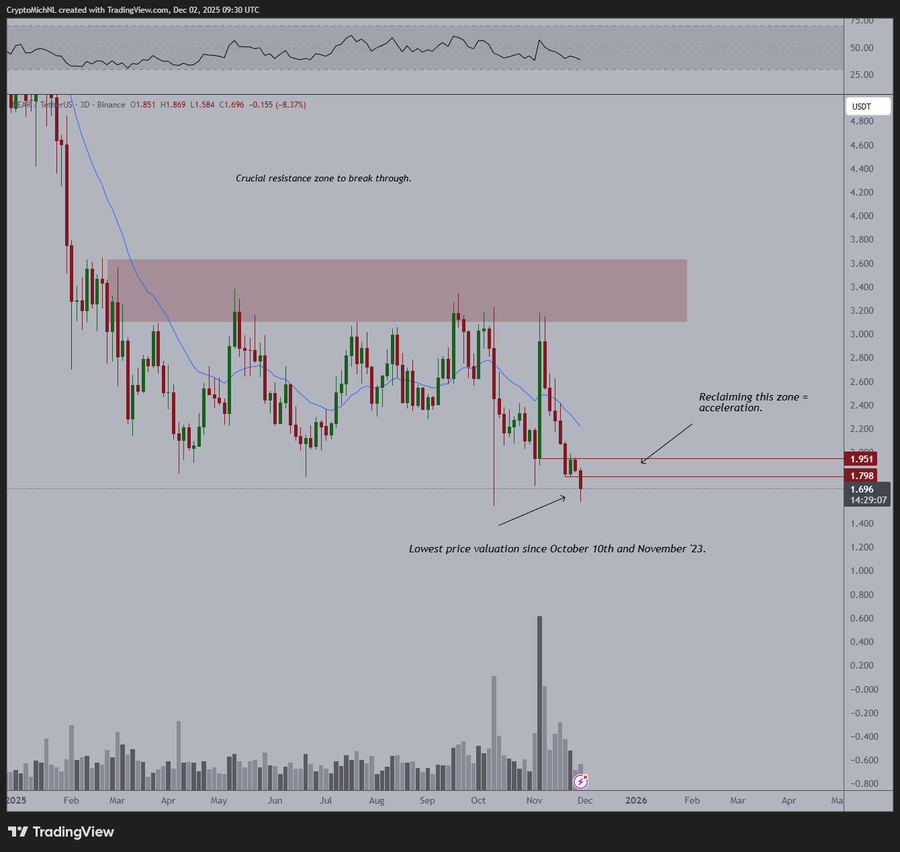
Image3-day NEAR/USDT Chart | Source: @CryptoMichNL on X

Momentum now depends on whether the token can reclaim $1.80 and advance toward $1.95, a zone that historically supported continuation during prior rebounds. According to the analyst, ‘Break through $1.80 & $1.95 and then we should be good to go upwards from here.” The breakdown from the $2.20 to $2.40 range in November intensified the decline, and large-volume sessions around the $2.00 breach suggested heavy supply pressure.

Network Activity Builds Under the Surface

The fundamentals continue to advance despite near-term market weakness. NEAR Intents, the project’s cross-chain automation system, has generated over $7 billion in lifetime volume with more than 12 million swaps and $11.68 million in fees. Unique addresses surged past 800,000 in the past 30 days, according to Dune Analytics data.

Interest also increased after the U.S. prediction market Kalshi added NEAR support on November 25. Additionally, validators voted to reduce inflation on October 28, lowering the tail emission rate from 5% to 2.5%.

]]>
Disclaimer: The articles reposted on this site are sourced from public platforms and are provided for informational purposes only. They do not necessarily reflect the views of MEXC. All rights remain with the original authors. If you believe any content infringes on third-party rights, please contact [email protected] for removal. MEXC makes no guarantees regarding the accuracy, completeness, or timeliness of the content and is not responsible for any actions taken based on the information provided. The content does not constitute financial, legal, or other professional advice, nor should it be considered a recommendation or endorsement by MEXC.

You May Also Like

Team Launches AI Tools to Boost KYC and Mainnet Migration for Investors

Team Launches AI Tools to Boost KYC and Mainnet Migration for Investors

The post Team Launches AI Tools to Boost KYC and Mainnet Migration for Investors appeared on BitcoinEthereumNews.com. The Pi Network team has announced the implementation of upgrades to simplify verification and increase the pace of its Mainnet migration. This comes before the token unlock happening this December. Pi Network Integrates AI Tools to Boost KYC Process In a recent blog post, the Pi team said it has improved its KYC process with the same AI technology as Fast Track KYC. This will cut the number of applications waiting for human review by 50%. As a result, more Pioneers will be able to reach Mainnet eligibility sooner. Fast Track KYC was first introduced in September to help new and non-users set up a Mainnet wallet. This was in an effort to reduce the long wait times caused by the previous rule. The old rule required completing 30 mining sessions before qualifying for verification. Fast Track cannot enable migration on its own. However, it is now fully part of the Standard KYC process which allows access to Mainnet. This comes at a time when the network is set for another unlock in December. About 190 million tokens will unlock worth approximately $43 million at current estimates.  These updates will help more Pioneers finish their migration faster especially when there are fewer validators available. This integration allows Pi’s validation resources to serve as a platform utility. In the future, applications that need identity verification or human-verified participation can use this system. Team Releases Validator Rewards Update The Pi Network team provided an update about validator rewards. They expect to distribute the first rewards by the end of Q1 2026. This delay happened because they needed to analyze a large amount of data collected since 2021. Currently, 17.5 million users have completed the KYC process, and 15.7 million users have moved to the Mainnet. However, there are around 3 million users…
Share
BitcoinEthereumNews2025/12/06 16:08
Solana Nears $124 Support Amid Cautious Sentiment and Liquidity Reset Potential

Solana Nears $124 Support Amid Cautious Sentiment and Liquidity Reset Potential

The post Solana Nears $124 Support Amid Cautious Sentiment and Liquidity Reset Potential appeared on BitcoinEthereumNews.com. Solana ($SOL) is approaching a critical support level at $124, where buyers must defend to prevent further declines amid cautious market conditions. A successful hold could initiate recovery toward $138 or higher, while failure might lead to deeper corrections. Solana’s price risks dropping to $124 if current support zones weaken under selling pressure. Reclaiming key resistance around $138 may drive $SOL toward $172–$180 targets. Recent data shows liquidity resets often precede multi-week uptrends, with historical patterns suggesting potential recovery by early 2026. Solana ($SOL) support at $124 tested amid market caution: Will buyers defend or trigger deeper drops? Explore analysis, liquidity signals, and recovery paths for informed trading decisions. What Is the Current Support Level for Solana ($SOL)? Solana ($SOL) is currently testing a vital support level at $124, following a decline from the $144–$146 resistance zone. Analysts from TradingView indicate that after failing to maintain momentum above $138, the token dipped toward $131 and mid-range support near $134. This positioning underscores the importance of buyer intervention to stabilize the price and prevent further erosion. Solana ($SOL) is in a crucial stage right now, with possible price drops toward important support zones. Recent price activity signals increased downside risks, analysts caution. TradingView contributor Ali notes that Solana may find quick support at $124 after falling from the $144–$146 resistance range. The token eventually tested $131 after failing to hold over $138 and plummeting toward mid-range support near $134. Source: Ali Market indicators reveal downward momentum, with potential short-term volatility around $130–$132 before possibly easing to $126–$127. Should this threshold break, $SOL could slide to the firmer support at $124–$125, according to observations from established charting platforms. Overall sentiment remains guarded, as highlighted by experts monitoring on-chain data. Ali warns that without robust buying interest, additional selling could intensify. TradingView analyst…
Share
BitcoinEthereumNews2025/12/06 16:33
What It Means for State Crypto Adoption

What It Means for State Crypto Adoption

The post What It Means for State Crypto Adoption appeared on BitcoinEthereumNews.com. Texas has become the first US state to officially purchase and hold Bitcoin (BTC), acquiring $5 million worth of BlackRock’s iShares Bitcoin Trust (IBIT) and authorizing another $5 million for direct, self-custodied BTC. The move comes at an unexpected moment: a market downturn marked by exchange-traded fund (ETF) outflows, institutional caution and stalled legislative efforts across the country. In this week’s episode of Byte-Sized Insight, we explore why Texas stepped in while many others stepped out and what the timing suggests about the state’s long-term view on digital assets. Earlier this year, more than two dozen US states introduced or debated bills that would allow public treasuries to hold Bitcoin or other digital assets. Yet most of those efforts slowed or evaporated as prices fell and political appetite waned. Texas, by contrast, accelerated. Its Bitcoin purchase is the first executed under the Texas Strategic Bitcoin Reserve Act, passed in June 2025, signaling a decisive move into digital finance at a moment when competitors hesitated. Texas isn’t new to Bitcoin Texas Governor Greg Abbott has publicly supported Bitcoin for more than a decade. In a 2014 campaign video referenced in the podcast episode, Abbott said, “Bitcoin is a new and decentralized digital cryptocurrency. It enables instant financial transactions safely and securely.” Related: As US Bitcoin Reserve stalls, Chainalysis flags $75B in seizable crypto That stance continued years later. In a 2022 conversation with the Texas Blockchain Council, Abbott outlined why he believed the state should lead in blockchain innovation, saying, “Texas is getting involved early on in this process because we see the future of what Bitcoin and what blockchain means to the entire world.” A long-term strategic play, not a short-term bet For Lee Bratcher, president of the Texas Blockchain Council, the state’s timing is no accident. Speaking on the…
Share
BitcoinEthereumNews2025/12/06 16:20