An engineer compares an LLM’s fabricated claims about printheads with real-world data, revealing why statistical models fail at physical reasoning—and why technical decisions should never rely on AI alone.An engineer compares an LLM’s fabricated claims about printheads with real-world data, revealing why statistical models fail at physical reasoning—and why technical decisions should never rely on AI alone.

A Simple Hardware Question Exposes the Limits of Today’s LLMs

2025/12/05 18:29

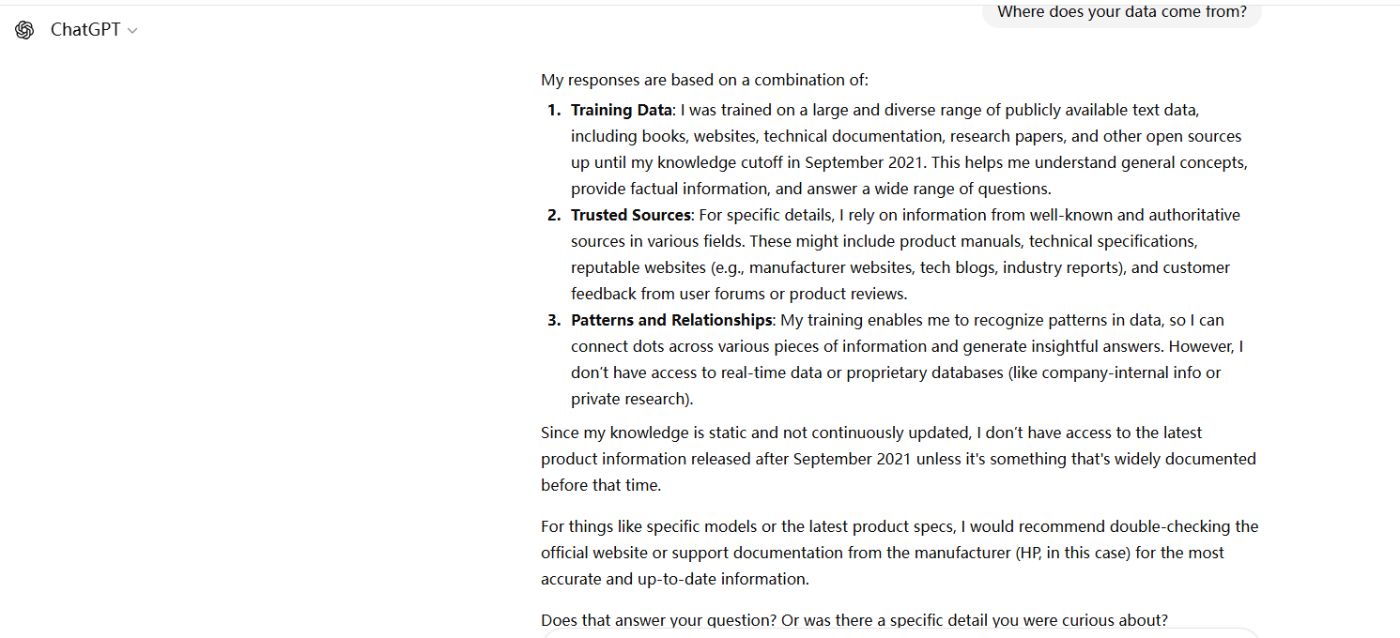
\ As engineers and builders, we're trained to trust data and specifications. So, when I decided to stress-test a popular Large Language Model (LLM) on a piece of hardware I know intimately—printheads—the results weren't just wrong; they were a masterclass in confident fabrication.

My query was straightforward: "Compare the HP 841 industrial printhead with a standard HP A3 office printhead." The LLM responded with a detailed, articulate argument that was, technically speaking, precisely backward. It touted the office-grade component as superior. This isn't a simple mistake; it's a fundamental failure of how LLMs "understand" the physical world.

\
\

The LLM's Architectural Flaw: It's a Statistician, Not an Engineer

Let's be clear: an LLM is not a reasoning engine. It's a stochastic parroting engine. Its core function is to predict the next most statistically plausible token (word fragment) based on its training corpus. It has no sensor for truth, no grounding in physics, and no concept of mechanical wear.

When asked about a technical subject, it doesn't retrieve facts from a verified database. Instead, it assembles an answer based on patterns it has seen in its training data.

The problem is, the internet is filled with:

  • Volume-skewed data: There are far more discussions, reviews, and queries about common office A3 printers than niche industrial printheads.
  • Ambiguous language: The term "A3" is often used as a proxy for "large format" or "high-quality" in casual writing, muddying the technical waters.
  • Outdated and incorrect forum posts.

The LLM absorbed this messy, imbalanced corpus and produced a response that sounded authoritative but was built on a foundation of statistical noise. It's the equivalent of asking a million people on the street about quantum mechanics and basing your thesis on the most common phrases they utter.

A Technical Reality Check: The HP 841 vs. A3 Printhead

My goal here isn't just to say the AI is wrong; it's to provide the ground truth that the LLM lacks. The difference between these components isn't a matter of opinion; it's a matter of engineering intent.

The following comparison isn't AI-generated; it's sourced from datasheets, tear-downs, and real-world deployment.

| Feature | HP 841 (Industrial PageWide) | Standard HP A3 Office Printhead | |----|----|----| | Target Application | High-throughput commercial printing, central reprographic departments | Low-to-medium volume office/desktop printing | | Core Architecture | Page-wide, fixed-array, single-pass | Scanning carriage, shuttle-based, multi-pass | | Throughput (A4) | 70-80 PPM | 15-30 PPM | | Duty Cycle | Hundreds of thousands of pages/month | Tens of thousands of pages/month | | Design Lifespan | Years (or millions of pages) | 1-2 years (or hundreds of thousands of pages) | | Cost Model | Extremely low cost-per-page | Higher cost-per-page |

The Engineering Deep Dive: Where the LLM Misses the Point

The specs above tell a clear story, but the real differentiators are in the physical design, which an LLM can never comprehend.

  1. Electrical & Contact Design:
  • HP 841: Uses a wide, dual-sided contact cable. This is for superior current delivery, lower resistance, and resilience against oxidation—a critical feature for 24/7 operation. It's built like a server power supply.

  • A3 Printhead: Typically uses a simpler, single-sided flex cable. It's sufficient for intermittent use but a single point of failure under constant load. It's a consumer-grade component.

    \

  1. Fluid Systems & Reliability:
  • HP 841: Features a sophisticated ink system with a short, tall ink sac to maintain optimal pressure and flow. Its internal architecture is designed with anti-airlock mechanisms to prevent the number one cause of printhead failure: air bubbles clogging the micro-channels.
  • A3 Printhead: Often has a longer, more passive ink path prone to starvation and air ingestion. It's the primary reason for print quality degradation and premature death.

My Perspective: Why This Matters Beyond Printers

This isn't just about printheads. It's a cautionary tale for any technical decision-maker. LLMs are phenomenal for brainstorming, boilerplate code, and summarizing well-trodden topics. 

But when your question requires:

  • Specialized, up-to-date technical knowledge
  • An understanding of physical properties and engineering constraints
  • The ability to discern between marketing fluff and technical reality

…you must treat the LLM's output as unverified, potentially hazardous draft material. It is a tool for acceleration, not a source of truth.

The final authority must always be official documentation, empirical testing, and domain expertise. In the case of the HP 841, its design is a masterpiece of industrial engineering, optimized for a single metric: total cost of ownership at scale. To claim an office-grade component is superior is to fundamentally misunderstand the problem it was built to solve.

Let's use AI for what it's good at, but never outsource our technical judgment to a model that has never held a printhead in its hand, nor seen one fail under production load.

\

Disclaimer: The articles reposted on this site are sourced from public platforms and are provided for informational purposes only. They do not necessarily reflect the views of MEXC. All rights remain with the original authors. If you believe any content infringes on third-party rights, please contact [email protected] for removal. MEXC makes no guarantees regarding the accuracy, completeness, or timeliness of the content and is not responsible for any actions taken based on the information provided. The content does not constitute financial, legal, or other professional advice, nor should it be considered a recommendation or endorsement by MEXC.

You May Also Like

Team Launches AI Tools to Boost KYC and Mainnet Migration for Investors

Team Launches AI Tools to Boost KYC and Mainnet Migration for Investors

The post Team Launches AI Tools to Boost KYC and Mainnet Migration for Investors appeared on BitcoinEthereumNews.com. The Pi Network team has announced the implementation of upgrades to simplify verification and increase the pace of its Mainnet migration. This comes before the token unlock happening this December. Pi Network Integrates AI Tools to Boost KYC Process In a recent blog post, the Pi team said it has improved its KYC process with the same AI technology as Fast Track KYC. This will cut the number of applications waiting for human review by 50%. As a result, more Pioneers will be able to reach Mainnet eligibility sooner. Fast Track KYC was first introduced in September to help new and non-users set up a Mainnet wallet. This was in an effort to reduce the long wait times caused by the previous rule. The old rule required completing 30 mining sessions before qualifying for verification. Fast Track cannot enable migration on its own. However, it is now fully part of the Standard KYC process which allows access to Mainnet. This comes at a time when the network is set for another unlock in December. About 190 million tokens will unlock worth approximately $43 million at current estimates.  These updates will help more Pioneers finish their migration faster especially when there are fewer validators available. This integration allows Pi’s validation resources to serve as a platform utility. In the future, applications that need identity verification or human-verified participation can use this system. Team Releases Validator Rewards Update The Pi Network team provided an update about validator rewards. They expect to distribute the first rewards by the end of Q1 2026. This delay happened because they needed to analyze a large amount of data collected since 2021. Currently, 17.5 million users have completed the KYC process, and 15.7 million users have moved to the Mainnet. However, there are around 3 million users…
Share
BitcoinEthereumNews2025/12/06 16:08
Solana Nears $124 Support Amid Cautious Sentiment and Liquidity Reset Potential

Solana Nears $124 Support Amid Cautious Sentiment and Liquidity Reset Potential

The post Solana Nears $124 Support Amid Cautious Sentiment and Liquidity Reset Potential appeared on BitcoinEthereumNews.com. Solana ($SOL) is approaching a critical support level at $124, where buyers must defend to prevent further declines amid cautious market conditions. A successful hold could initiate recovery toward $138 or higher, while failure might lead to deeper corrections. Solana’s price risks dropping to $124 if current support zones weaken under selling pressure. Reclaiming key resistance around $138 may drive $SOL toward $172–$180 targets. Recent data shows liquidity resets often precede multi-week uptrends, with historical patterns suggesting potential recovery by early 2026. Solana ($SOL) support at $124 tested amid market caution: Will buyers defend or trigger deeper drops? Explore analysis, liquidity signals, and recovery paths for informed trading decisions. What Is the Current Support Level for Solana ($SOL)? Solana ($SOL) is currently testing a vital support level at $124, following a decline from the $144–$146 resistance zone. Analysts from TradingView indicate that after failing to maintain momentum above $138, the token dipped toward $131 and mid-range support near $134. This positioning underscores the importance of buyer intervention to stabilize the price and prevent further erosion. Solana ($SOL) is in a crucial stage right now, with possible price drops toward important support zones. Recent price activity signals increased downside risks, analysts caution. TradingView contributor Ali notes that Solana may find quick support at $124 after falling from the $144–$146 resistance range. The token eventually tested $131 after failing to hold over $138 and plummeting toward mid-range support near $134. Source: Ali Market indicators reveal downward momentum, with potential short-term volatility around $130–$132 before possibly easing to $126–$127. Should this threshold break, $SOL could slide to the firmer support at $124–$125, according to observations from established charting platforms. Overall sentiment remains guarded, as highlighted by experts monitoring on-chain data. Ali warns that without robust buying interest, additional selling could intensify. TradingView analyst…
Share
BitcoinEthereumNews2025/12/06 16:33
What It Means for State Crypto Adoption

What It Means for State Crypto Adoption

The post What It Means for State Crypto Adoption appeared on BitcoinEthereumNews.com. Texas has become the first US state to officially purchase and hold Bitcoin (BTC), acquiring $5 million worth of BlackRock’s iShares Bitcoin Trust (IBIT) and authorizing another $5 million for direct, self-custodied BTC. The move comes at an unexpected moment: a market downturn marked by exchange-traded fund (ETF) outflows, institutional caution and stalled legislative efforts across the country. In this week’s episode of Byte-Sized Insight, we explore why Texas stepped in while many others stepped out and what the timing suggests about the state’s long-term view on digital assets. Earlier this year, more than two dozen US states introduced or debated bills that would allow public treasuries to hold Bitcoin or other digital assets. Yet most of those efforts slowed or evaporated as prices fell and political appetite waned. Texas, by contrast, accelerated. Its Bitcoin purchase is the first executed under the Texas Strategic Bitcoin Reserve Act, passed in June 2025, signaling a decisive move into digital finance at a moment when competitors hesitated. Texas isn’t new to Bitcoin Texas Governor Greg Abbott has publicly supported Bitcoin for more than a decade. In a 2014 campaign video referenced in the podcast episode, Abbott said, “Bitcoin is a new and decentralized digital cryptocurrency. It enables instant financial transactions safely and securely.” Related: As US Bitcoin Reserve stalls, Chainalysis flags $75B in seizable crypto That stance continued years later. In a 2022 conversation with the Texas Blockchain Council, Abbott outlined why he believed the state should lead in blockchain innovation, saying, “Texas is getting involved early on in this process because we see the future of what Bitcoin and what blockchain means to the entire world.” A long-term strategic play, not a short-term bet For Lee Bratcher, president of the Texas Blockchain Council, the state’s timing is no accident. Speaking on the…
Share
BitcoinEthereumNews2025/12/06 16:20