BitcoinWorld Crypto Holdings Shakeup: MSCI’s Controversial Plan to Purge Bitcoin-Heavy Firms from Key Indexes A seismic shift may be coming for how major financial indexes treat cryptocurrency. In a move sending shockwaves through both traditional finance and digital asset circles, global index provider MSCI is reportedly considering a policy that could see companies with substantial crypto holdings booted from its influential benchmarks. This proposal strikes at the heart of […] This post Crypto Holdings Shakeup: MSCI’s Controversial Plan to Purge Bitcoin-Heavy Firms from Key Indexes first appeared on BitcoinWorld.BitcoinWorld Crypto Holdings Shakeup: MSCI’s Controversial Plan to Purge Bitcoin-Heavy Firms from Key Indexes A seismic shift may be coming for how major financial indexes treat cryptocurrency. In a move sending shockwaves through both traditional finance and digital asset circles, global index provider MSCI is reportedly considering a policy that could see companies with substantial crypto holdings booted from its influential benchmarks. This proposal strikes at the heart of […] This post Crypto Holdings Shakeup: MSCI’s Controversial Plan to Purge Bitcoin-Heavy Firms from Key Indexes first appeared on BitcoinWorld.

Crypto Holdings Shakeup: MSCI’s Controversial Plan to Purge Bitcoin-Heavy Firms from Key Indexes
2025/12/06 09:25
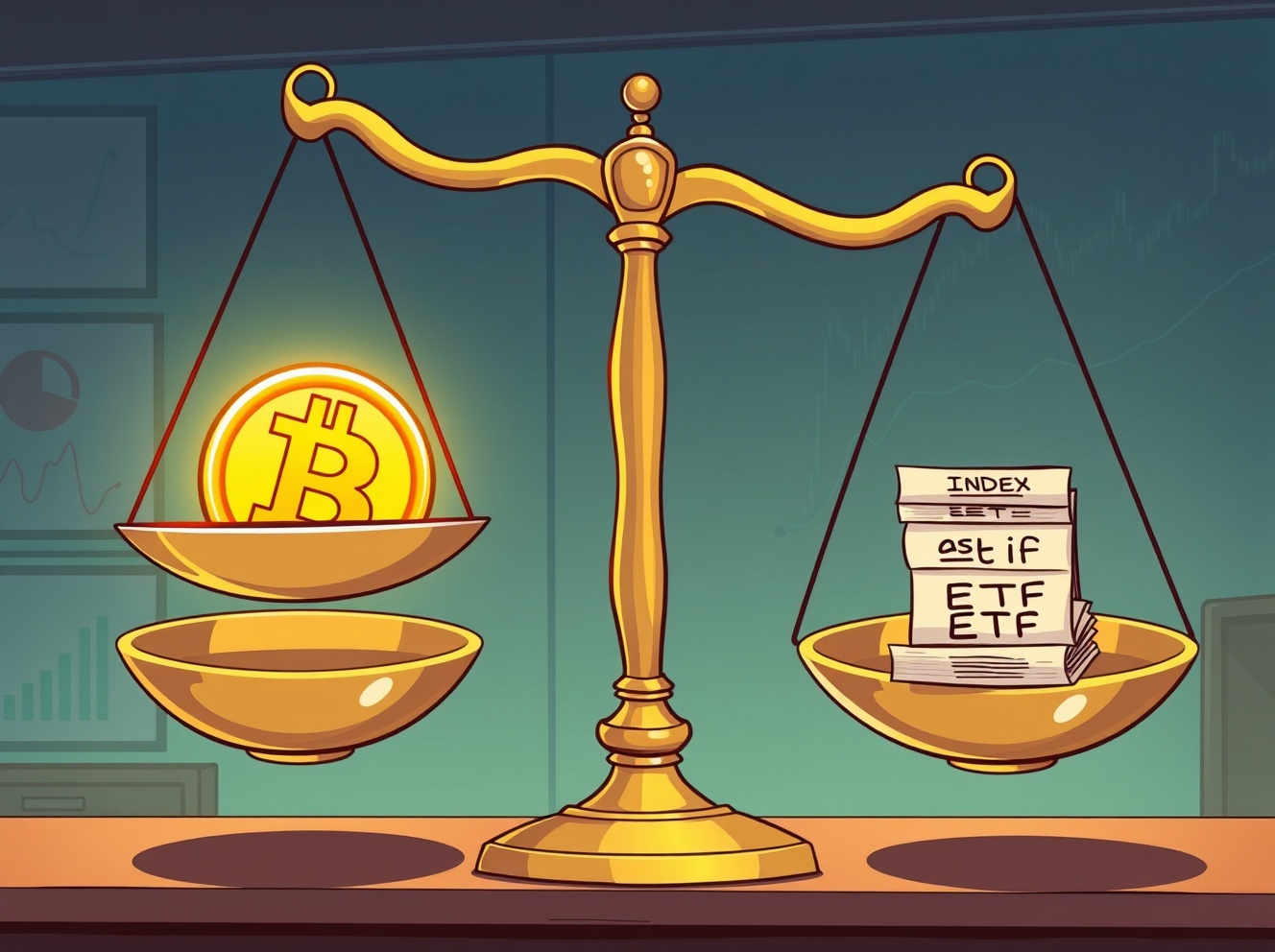
Cartoon illustration of a scale tipping under the weight of large crypto holdings versus traditional assets.

BitcoinWorld

Crypto Holdings Shakeup: MSCI’s Controversial Plan to Purge Bitcoin-Heavy Firms from Key Indexes

A seismic shift may be coming for how major financial indexes treat cryptocurrency. In a move sending shockwaves through both traditional finance and digital asset circles, global index provider MSCI is reportedly considering a policy that could see companies with substantial crypto holdings booted from its influential benchmarks. This proposal strikes at the heart of a growing trend: public companies using their balance sheets to bet big on Bitcoin and other digital assets.

What is MSCI Proposing for Companies with Major Crypto Holdings?

According to a report from The Block, MSCI is weighing a new rule that would exclude companies from its indexes if their digital asset holdings exceed 50% of their total assets. Index providers like MSCI create the benchmarks that guide trillions of dollars in institutional investment through funds like ETFs. Therefore, inclusion or exclusion from these indexes is a major deal for a company’s visibility and investor appeal.

This threshold is not arbitrary. It directly targets a specific class of firm that has emerged in recent years: the corporate Bitcoin whale. The most prominent example is MicroStrategy (MSTR), a business intelligence company that has transformed itself into a de facto Bitcoin investment vehicle. With over 650,000 BTC on its books, its crypto holdings far surpass the proposed 50% limit, making it a prime candidate for removal if the policy is enacted.

Why is This MSCI Crypto Policy So Controversial?

The reaction from the crypto-invested community was swift and pointed. Strive, a Nasdaq-listed asset manager that also holds Bitcoin, sent a strongly-worded letter to MSCI CEO Henry Fernandez. Their core argument challenges the very premise of the rule.

  • Undermining Market Neutrality: Strive contends that setting an arbitrary cap on crypto holdings violates the principle of market neutrality that index providers are supposed to uphold. An index should reflect the market, not judge a company’s strategy.
  • Picking Winners and Losers: The firm argues that evaluating a company’s financial strategy should be left to investors and market mechanisms, not an index committee. By setting this limit, MSCI would be making a value judgment on the legitimacy of holding digital assets.
  • A Slippery Slope: Critics ask: if 50% for crypto, what about other asset classes? Should companies be excluded for holding too much gold, real estate, or treasury bonds? The policy sets a concerning precedent for active management of index constituents.

What Are the Real-World Implications of Excluding Crypto Holdings?

If implemented, the fallout would extend beyond just a few companies getting a demerit. The consequences could reshape investment flows and corporate strategy.

First, companies like MicroStrategy could face immediate selling pressure from index funds and ETFs that track MSCI benchmarks. These funds are mandated to mirror the index, forcing them to sell any excluded stock. This creates a potential liquidity event unrelated to the company’s performance or Bitcoin’s price.

Second, it sends a chilling signal to other public companies considering adding Bitcoin to their treasury. The threat of index exclusion adds a new layer of reputational and financial risk. Why would a CFO risk their company’s place in a major index for a volatile asset class that the index provider seemingly disapproves of?

Finally, it highlights the growing tension between the innovative, disruptive world of cryptocurrency and the established, rules-based world of institutional finance. As crypto holdings move from the fringe to the mainstream, traditional systems are grappling with how to categorize and regulate them.

The Bottom Line: A Pivotal Moment for Institutional Crypto

MSCI’s consideration is more than a minor rule change; it’s a litmus test for digital assets in traditional finance. Will major institutions adapt their frameworks to accommodate this new asset class, or will they erect barriers to maintain the status quo? The debate over crypto holdings in corporate treasuries is now moving from boardrooms to index committee rooms.

The outcome will influence whether cryptocurrency remains a parallel investment universe or becomes fully integrated into the global financial system. For investors, the key takeaway is to watch this space closely. Index provider policies are a powerful, behind-the-scenes force that can significantly impact asset prices and market structure.

Frequently Asked Questions (FAQs)

Q: What is MSCI?
A: MSCI Inc. is a leading provider of critical decision support tools and services for the global investment community. They create and maintain stock market indexes that are used as benchmarks for trillions of dollars in investment funds.

Q: Which company is most at risk from this proposed MSCI rule?
A: MicroStrategy (MSTR) is the most prominent example. The company’s Bitcoin holdings represent a vast majority of its total assets, far exceeding the proposed 50% threshold, making it a likely candidate for exclusion.

Q: Why does index inclusion matter so much?
A: Inclusion in a major index like those from MSCI guarantees automatic buying from passive index funds and ETFs that track it. This provides consistent demand, liquidity, and prestige. Exclusion triggers forced selling from those same funds.

Q: Has MSCI made a final decision?
A> No. As of this reporting, MSCI is only “considering” the proposal. It has not been implemented as official policy. The strong pushback from firms like Strive may influence the final outcome.

Q: Does this affect Bitcoin ETFs like the spot Bitcoin ETF?
A> Not directly. This proposal concerns companies that hold Bitcoin on their balance sheet (like MicroStrategy), not funds that hold Bitcoin as their underlying asset (like a Bitcoin ETF). However, it reflects a broader institutional scrutiny of crypto exposure.

Found this analysis of MSCI’s potential crypto crackdown insightful? The conversation about institutional adoption is just getting started. Help others stay informed by sharing this article on your social media channels like Twitter or LinkedIn. Let’s keep the debate going!

To learn more about the latest institutional adoption trends, explore our article on key developments shaping Bitcoin integration into the traditional financial system.

This post Crypto Holdings Shakeup: MSCI’s Controversial Plan to Purge Bitcoin-Heavy Firms from Key Indexes first appeared on BitcoinWorld.

Disclaimer: The articles reposted on this site are sourced from public platforms and are provided for informational purposes only. They do not necessarily reflect the views of MEXC. All rights remain with the original authors. If you believe any content infringes on third-party rights, please contact [email protected] for removal. MEXC makes no guarantees regarding the accuracy, completeness, or timeliness of the content and is not responsible for any actions taken based on the information provided. The content does not constitute financial, legal, or other professional advice, nor should it be considered a recommendation or endorsement by MEXC.

You May Also Like

Team Launches AI Tools to Boost KYC and Mainnet Migration for Investors

Team Launches AI Tools to Boost KYC and Mainnet Migration for Investors

The post Team Launches AI Tools to Boost KYC and Mainnet Migration for Investors appeared on BitcoinEthereumNews.com. The Pi Network team has announced the implementation of upgrades to simplify verification and increase the pace of its Mainnet migration. This comes before the token unlock happening this December. Pi Network Integrates AI Tools to Boost KYC Process In a recent blog post, the Pi team said it has improved its KYC process with the same AI technology as Fast Track KYC. This will cut the number of applications waiting for human review by 50%. As a result, more Pioneers will be able to reach Mainnet eligibility sooner. Fast Track KYC was first introduced in September to help new and non-users set up a Mainnet wallet. This was in an effort to reduce the long wait times caused by the previous rule. The old rule required completing 30 mining sessions before qualifying for verification. Fast Track cannot enable migration on its own. However, it is now fully part of the Standard KYC process which allows access to Mainnet. This comes at a time when the network is set for another unlock in December. About 190 million tokens will unlock worth approximately $43 million at current estimates.  These updates will help more Pioneers finish their migration faster especially when there are fewer validators available. This integration allows Pi’s validation resources to serve as a platform utility. In the future, applications that need identity verification or human-verified participation can use this system. Team Releases Validator Rewards Update The Pi Network team provided an update about validator rewards. They expect to distribute the first rewards by the end of Q1 2026. This delay happened because they needed to analyze a large amount of data collected since 2021. Currently, 17.5 million users have completed the KYC process, and 15.7 million users have moved to the Mainnet. However, there are around 3 million users…
Share
BitcoinEthereumNews2025/12/06 16:08
Solana Nears $124 Support Amid Cautious Sentiment and Liquidity Reset Potential

Solana Nears $124 Support Amid Cautious Sentiment and Liquidity Reset Potential

The post Solana Nears $124 Support Amid Cautious Sentiment and Liquidity Reset Potential appeared on BitcoinEthereumNews.com. Solana ($SOL) is approaching a critical support level at $124, where buyers must defend to prevent further declines amid cautious market conditions. A successful hold could initiate recovery toward $138 or higher, while failure might lead to deeper corrections. Solana’s price risks dropping to $124 if current support zones weaken under selling pressure. Reclaiming key resistance around $138 may drive $SOL toward $172–$180 targets. Recent data shows liquidity resets often precede multi-week uptrends, with historical patterns suggesting potential recovery by early 2026. Solana ($SOL) support at $124 tested amid market caution: Will buyers defend or trigger deeper drops? Explore analysis, liquidity signals, and recovery paths for informed trading decisions. What Is the Current Support Level for Solana ($SOL)? Solana ($SOL) is currently testing a vital support level at $124, following a decline from the $144–$146 resistance zone. Analysts from TradingView indicate that after failing to maintain momentum above $138, the token dipped toward $131 and mid-range support near $134. This positioning underscores the importance of buyer intervention to stabilize the price and prevent further erosion. Solana ($SOL) is in a crucial stage right now, with possible price drops toward important support zones. Recent price activity signals increased downside risks, analysts caution. TradingView contributor Ali notes that Solana may find quick support at $124 after falling from the $144–$146 resistance range. The token eventually tested $131 after failing to hold over $138 and plummeting toward mid-range support near $134. Source: Ali Market indicators reveal downward momentum, with potential short-term volatility around $130–$132 before possibly easing to $126–$127. Should this threshold break, $SOL could slide to the firmer support at $124–$125, according to observations from established charting platforms. Overall sentiment remains guarded, as highlighted by experts monitoring on-chain data. Ali warns that without robust buying interest, additional selling could intensify. TradingView analyst…
Share
BitcoinEthereumNews2025/12/06 16:33
What It Means for State Crypto Adoption

What It Means for State Crypto Adoption

The post What It Means for State Crypto Adoption appeared on BitcoinEthereumNews.com. Texas has become the first US state to officially purchase and hold Bitcoin (BTC), acquiring $5 million worth of BlackRock’s iShares Bitcoin Trust (IBIT) and authorizing another $5 million for direct, self-custodied BTC. The move comes at an unexpected moment: a market downturn marked by exchange-traded fund (ETF) outflows, institutional caution and stalled legislative efforts across the country. In this week’s episode of Byte-Sized Insight, we explore why Texas stepped in while many others stepped out and what the timing suggests about the state’s long-term view on digital assets. Earlier this year, more than two dozen US states introduced or debated bills that would allow public treasuries to hold Bitcoin or other digital assets. Yet most of those efforts slowed or evaporated as prices fell and political appetite waned. Texas, by contrast, accelerated. Its Bitcoin purchase is the first executed under the Texas Strategic Bitcoin Reserve Act, passed in June 2025, signaling a decisive move into digital finance at a moment when competitors hesitated. Texas isn’t new to Bitcoin Texas Governor Greg Abbott has publicly supported Bitcoin for more than a decade. In a 2014 campaign video referenced in the podcast episode, Abbott said, “Bitcoin is a new and decentralized digital cryptocurrency. It enables instant financial transactions safely and securely.” Related: As US Bitcoin Reserve stalls, Chainalysis flags $75B in seizable crypto That stance continued years later. In a 2022 conversation with the Texas Blockchain Council, Abbott outlined why he believed the state should lead in blockchain innovation, saying, “Texas is getting involved early on in this process because we see the future of what Bitcoin and what blockchain means to the entire world.” A long-term strategic play, not a short-term bet For Lee Bratcher, president of the Texas Blockchain Council, the state’s timing is no accident. Speaking on the…
Share
BitcoinEthereumNews2025/12/06 16:20