The post Solana Price Prediction: How High Can SOL Price Go in 2025 appeared first on Coinpedia Fintech News The crypto market has slipped into one of its most unstable phases of the year—a pattern often seen near year-end, but this time the pressure feels different. While major altcoins like Solana are losing momentum, Bitcoin’s retreat below $90,000 has pushed sentiment deep into fear. With the SOL price now drifting toward the crucial $130 …The post Solana Price Prediction: How High Can SOL Price Go in 2025 appeared first on Coinpedia Fintech News The crypto market has slipped into one of its most unstable phases of the year—a pattern often seen near year-end, but this time the pressure feels different. While major altcoins like Solana are losing momentum, Bitcoin’s retreat below $90,000 has pushed sentiment deep into fear. With the SOL price now drifting toward the crucial $130 …

Solana Price Prediction: How High Can SOL Price Go in 2025
2025/12/06 21:37
Solana’s Bold “Hello Wall St.” Viral Ad Ignite Hype — Can SOL Hit $200 Next?

The post Solana Price Prediction: How High Can SOL Price Go in 2025 appeared first on Coinpedia Fintech News

The crypto market has slipped into one of its most unstable phases of the year—a pattern often seen near year-end, but this time the pressure feels different. While major altcoins like Solana are losing momentum, Bitcoin’s retreat below $90,000 has pushed sentiment deep into fear. With the SOL price now drifting toward the crucial $130 support, traders are beginning to question whether this fade is merely a shakeout… or the first signal of a larger trend shift.

Solana has entered a critical price zone as heightened market volatility drags major altcoins back toward key supports. After failing to sustain above its recent range highs, SOL has slipped toward the $130 region, a level that has repeatedly acted as a make-or-break point for trend continuation. With sentiment weakening and sellers pressing harder, traders are now watching whether Solana can defend this support or if the current pullback signals a deeper shift in short-term momentum.
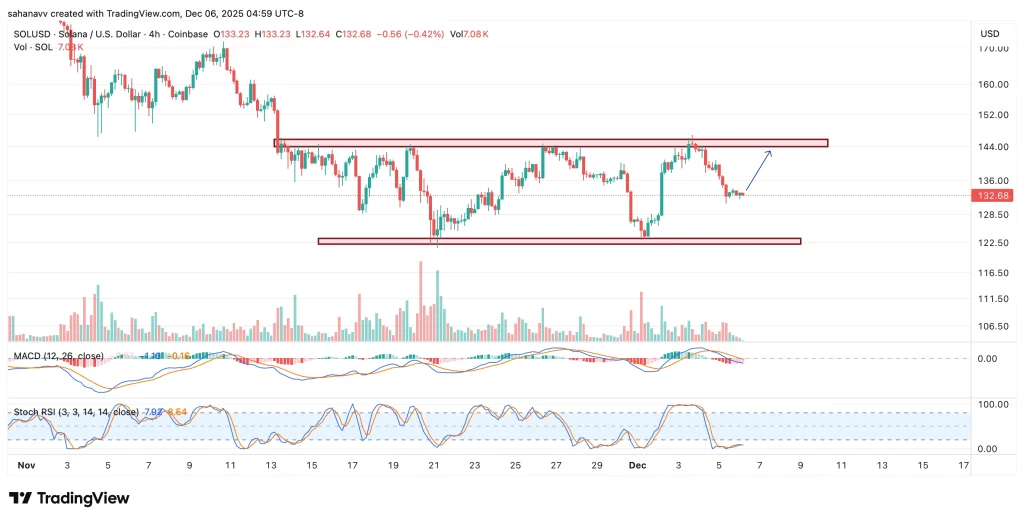
sol price

The 4-hour chart shows SOL trading within a well-defined horizontal range, with strong resistance at $145–$150 and support at $120–$125. Price is currently hovering near the mid-range after a rejection from the upper boundary. Momentum indicators are attempting to stabilize: the MACD is flattening after a bearish crossover, while the Stoch RSI is deeply oversold and beginning to curl upward, hinting at a possible short-term bounce. However, failing to reclaim $138 may reopen the path toward lower support.

Conclusion

Solana is entering a pivotal phase where neither bulls nor bears have a clear upper hand. The next reaction around the $130–$138 zone will decide whether SOL remains in its multi-week consolidation or slips into a deeper correction. Oversold indicators suggest that a short-term bounce is possible, but traders shouldn’t mistake that for a confirmed trend reversal—not unless Solana can reclaim the $145 resistance with conviction.

For now, SOL’s trajectory hinges less on its own fundamentals and more on Bitcoin’s ability to stabilize above key psychological support. If BTC steadies, SOL has room to recover; if not, a retest of $120–$125 becomes increasingly likely.

Disclaimer: The articles reposted on this site are sourced from public platforms and are provided for informational purposes only. They do not necessarily reflect the views of MEXC. All rights remain with the original authors. If you believe any content infringes on third-party rights, please contact [email protected] for removal. MEXC makes no guarantees regarding the accuracy, completeness, or timeliness of the content and is not responsible for any actions taken based on the information provided. The content does not constitute financial, legal, or other professional advice, nor should it be considered a recommendation or endorsement by MEXC.

You May Also Like

When Your Mom Can Use DePIN, Mass Adoption Has Arrived

When Your Mom Can Use DePIN, Mass Adoption Has Arrived

The post When Your Mom Can Use DePIN, Mass Adoption Has Arrived appeared on BitcoinEthereumNews.com. In a perfect world, the internet works like tap water: you turn it on, and it flows. Seamlessly. Nobody really wants to think about a ‘better connection spot,’ SIM cards, or the nearest cell towers. Users just want a fast, stable connection wherever they are. The good thing is they’re quietly getting it without even knowing it. The internet we have is broken (and expensive) Traditional telecom infrastructure is heavy and expensive. Every tower requires a site lease, permits, maintenance, and marketing. Every expansion takes months or years (of both construction and red tape) and can cost from $5 million to $100 million, which means installing even one small cell tower can drain a business’s finances by up to $300,000. In this system, we’re not really paying for the gigabytes we use — we’re paying for the bureaucracy built around them. This system doesn’t make economic sense anymore. Telecom companies can no longer afford to spend billions on connections that don’t improve and become harder and harder to maintain with more users all over the globe. The good news is that a better alternative is already in people’s homes and devices, even though you don’t see it on billboards. DePIN (Decentralized Physical Infrastructure Networks) is turning the Wi-Fi routers around you into a new kind of connectivity. From towers to routers According to crypto asset manager Grayscale, DePIN is already widely used in day-to-day life, and the company calls it a “significant” investment opportunity. Why? DePIN takes a software-first approach, meaning it uses what already exists. A lightweight app or firmware update turns a regular Wi-Fi router into a small piece of a bigger network. When you’re nearby, your device automatically connects through that router. With DePIN’s rising popularity, people and businesses are already implementing it: Nodle, a smartphone-based DePIN,…
Share
BitcoinEthereumNews2025/12/07 00:07
Two Casascius coins with $2,000 Bitcoin move after 13 years of dormancy

Two Casascius coins with $2,000 Bitcoin move after 13 years of dormancy

The post Two Casascius coins with $2,000 Bitcoin move after 13 years of dormancy appeared on BitcoinEthereumNews.com. Key Takeaways Two Casascius physical Bitcoin coins containing about $2,000 moved after 13 years of dormancy. Casascius coins are rare, physical coins embedding private keys beneath a tamper-evident hologram. Two Casascius physical Bitcoin coins containing approximately $2,000 worth of Bitcoin moved this week after remaining dormant for 13 years, according to Timechain Index founder Sani. Casascius, which creates physical Bitcoins that embed real crypto value through a private key concealed beneath a tamper-evident hologram, allows holders to redeem the associated Bitcoin on the blockchain. The coins include a private key hidden under the hologram, intended to secure the Bitcoin until the owner chooses to access it. These physical Bitcoin coins are considered rare collectibles due to their early issuance, making any movement of such coins a rare occurrence for crypto observers. The coins were among the earliest physical representations of Bitcoin, creating historical artifacts that bridge the digital currency’s early days with its current market presence. Casascius coins and similar physical Bitcoin representations sometimes become active after extended periods of inactivity, typically generating attention within the crypto community when holders decide to access their dormant holdings. Source: https://cryptobriefing.com/casascius-coins-move-dormant-bitcoin-activity-2025/
Share
BitcoinEthereumNews2025/12/07 00:23
Music body ICMP laments “wilful” theft of artists’ work

Music body ICMP laments “wilful” theft of artists’ work

The post Music body ICMP laments “wilful” theft of artists’ work appeared on BitcoinEthereumNews.com. A major music industry group, ICMP, has lamented the use of artists’ work by AI companies, calling them guilty of “wilful” copyright infringement, as the battle between the tech firms and the arts industry continues. The Brussels-based group known as the International Confederation of Music Publishers (ICMP) comprises major record labels and other music industry professionals. Their voice adds to many others within the arts industry that have expressed displeasure at AI firms for using their creative work to train their systems without permission. ICMP accuses AI firms of deliberate copyright infringement ICMP director general John Phelan told AFP that big tech firms and AI-specific companies were involved in what he termed “the largest copyright infringement exercise that has been seen.” He cited the likes of OpenAI, Suno, Udio, and Mistral as some of the culprits. The ICMP carried out an investigation for nearly two years to ascertain how generative AI firms were using material by creatives to enrich themselves. The Brussels-based group is one of a number of industry bodies that span across news media and publishing to target the fast-growing AI sector over its use of content without paying any royalties. Suno and Udio, who are AI music generators, can produce tracks with voices, melodies, and musical styles that echo those of the original artists such as the Beatles, Depeche Mode, Mariah Carey, and the Beach boys. “What is legal or illegal is how the technologies are used. That means the corporate decisions made by the chief executives of companies matter immensely and should comply with the law,” Phelan told AFP. “What we see is they are engaged in wilful, commercial-scale copyright infringement.” Phelan. In June last year, a US trade group, the Recording Industry Association of America, filed a lawsuit against Suno and Udio. However, an exception…
Share
BitcoinEthereumNews2025/09/18 04:41