The post Can HYPE Price Hold the $30 Level Amid Market-Wide Selling Pressure? appeared first on Coinpedia Fintech News This week’s HYPE price update highlights a sharp shift in sentiment as the broader crypto market downturn pressures Hyperliquid’s native token. Despite strong revenue fundamentals and bold long-term projections, short-term weakness and declining open interest raise important questions for the HYPE price prediction outlook. Revenue Strength Fuels Long-Term Interest in HYPE One of the biggest …The post Can HYPE Price Hold the $30 Level Amid Market-Wide Selling Pressure? appeared first on Coinpedia Fintech News This week’s HYPE price update highlights a sharp shift in sentiment as the broader crypto market downturn pressures Hyperliquid’s native token. Despite strong revenue fundamentals and bold long-term projections, short-term weakness and declining open interest raise important questions for the HYPE price prediction outlook. Revenue Strength Fuels Long-Term Interest in HYPE One of the biggest …

Can HYPE Price Hold the $30 Level Amid Market-Wide Selling Pressure?

2025/12/06 22:03
Hyperliquid Price

The post Can HYPE Price Hold the $30 Level Amid Market-Wide Selling Pressure? appeared first on Coinpedia Fintech News

This week’s HYPE price update highlights a sharp shift in sentiment as the broader crypto market downturn pressures Hyperliquid’s native token. Despite strong revenue fundamentals and bold long-term projections, short-term weakness and declining open interest raise important questions for the HYPE price prediction outlook.

Revenue Strength Fuels Long-Term Interest in HYPE

One of the biggest drivers of attention around HYPE crypto comes from the company’s extraordinary financial profile. Hyperliquid is generating an estimated $1.15 billion in annual recurring revenue with a team of only 11 employees, making it one of the most profitable and lean operations in the sector, per David Schamis, CEO of Hyperliquid Strategies.

This level of efficiency and scale has prompted David to ambitiously project HYPE’s valuation growth trajectory significantly higher than today’s. He said in a video clip that he expects the token could achieve a 20× expansion from current market cap levels, provided the ecosystem continues compounding revenue without reliance on outside capital.

Although this narrative supports a strong long-term HYPE price forecast, the immediate challenge lies in the market environment, where macro weakness is overpowering fundamentals.

Short-Term Outlook Hinges on Key Support Levels

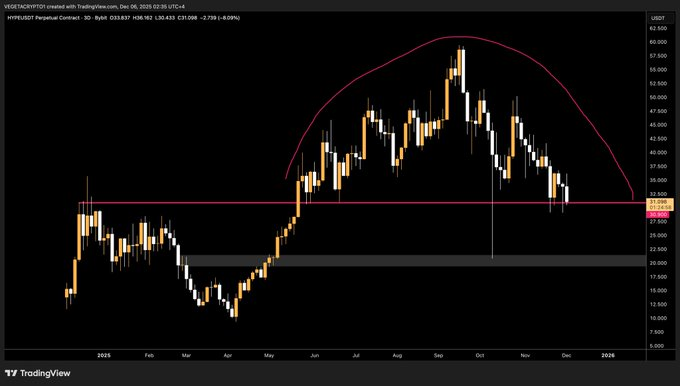
While long-term optimism persists, the near-term structure of the HYPE price chart is displaying decisive pressure. Technical discussions across the community highlight that the $30–$31 range is a critical support zone. If this level fails, the HYPE price USD could slide sharply toward the $20 region, reflecting broader capitulation across high-beta altcoins.
Can HYPE Price Hold the $30 Level Amid Market-Wide Selling Pressure?

Conversely, if the token manages to hold this support and reclaim upward momentum, analysts note that a meaningful reversal could emerge into 2026, especially once the broader crypto market stabilizes. This makes the current range one of the most important regions for traders tracking the next move.

Open Interest Decline Signals Lower Risk Appetite

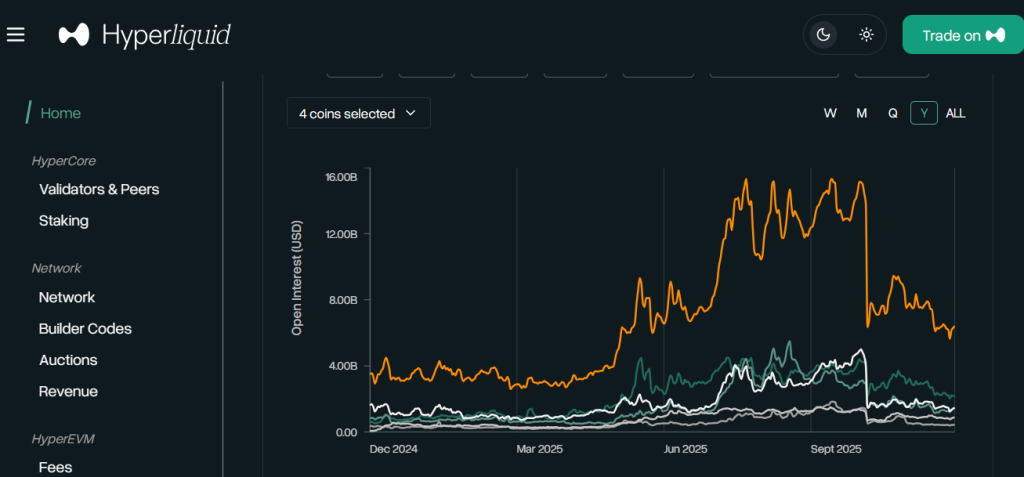
Another factor shaping market expectations is the dramatic decline in trading activity. During Bitcoin’s all-time high period earlier in October, Hyperliquid recorded open interest (OI) near $16 billion, supported by intense trading across BTC and ETH. However, by early December, OI has fallen to around $6 billion, marking a significant contraction.

This drop suggests that traders are taking fewer positions, reducing leverage exposure, and acting with greater caution amid ongoing market pullbacks. At the same time, the pattern also implies that once leading assets such as Bitcoin and Ethereum regain strength, the derivatives activity on Hyperliquid and possibly the HYPE price itself could see a strong resurgence.
Can HYPE Price Hold the $30 Level Amid Market-Wide Selling Pressure?

Altogether, reduced risk-taking, weakening technical structure, and exceptional revenue fundamentals all converge to define this week’s evolving narrative around Hyperliquid.

Disclaimer: The articles reposted on this site are sourced from public platforms and are provided for informational purposes only. They do not necessarily reflect the views of MEXC. All rights remain with the original authors. If you believe any content infringes on third-party rights, please contact [email protected] for removal. MEXC makes no guarantees regarding the accuracy, completeness, or timeliness of the content and is not responsible for any actions taken based on the information provided. The content does not constitute financial, legal, or other professional advice, nor should it be considered a recommendation or endorsement by MEXC.

You May Also Like

Citadel pushes SEC to classify open-source developers as unregistered stockbrokers

Citadel pushes SEC to classify open-source developers as unregistered stockbrokers

The post Citadel pushes SEC to classify open-source developers as unregistered stockbrokers appeared on BitcoinEthereumNews.com. On Dec. 2, Citadel Securities filed a 13-page letter with the SEC arguing that decentralized protocols facilitating tokenized US equity trading already meet statutory definitions of exchanges and broker-dealers, and regulators should treat them accordingly. Two days later, the SEC’s Investor Advisory Committee convened a panel on tokenized equities that made clear the question is no longer whether stocks can move on-chain, but whether they can do so without dismantling the permissionless architecture that built DeFi. The gap between those two positions now defines the most consequential regulatory fight in crypto since the Howey test debates. Citadel’s letter arrived at the moment when tokenized equities stopped being a thought experiment. The firm welcomes tokenization in principle but insists that realizing its benefits requires applying “the key bedrock principles and investor protections that underpin the fairness, efficiency, and resiliency of US equity markets.” In other words, the document suggests that companies seeking to trade tokenized Apple shares must comply with Nasdaq rules, including transparent fees, consolidated tape reporting, market surveillance, fair access, and registration as an exchange or broker-dealer. The filing warns that granting broad exemptive relief to DeFi platforms creates a shadow US equity market in which liquidity fragments, retail investors lose Exchange Act protections, and incumbents face regulatory arbitrage from unregistered competitors. Within hours, Uniswap founder Hayden Adams fired back on X, calling Citadel’s position an attempt to “treat software developers of decentralized protocols like centralized intermediaries.” He invoked ConstitutionDAO, the 2021 crowdfunding effort that pooled $47 million in Ethereum to bid on a first-edition Constitution at Sotheby’s, only to lose to Griffin’s $43.2 million bid. Additionally, Adams zeroed in on Citadel’s fair-access argument, calling it “actual nerve” from the dominant player in retail order flow. The exchange captured crypto’s core narrative of permissionless code versus gatekeeper control and…
Share
BitcoinEthereumNews2025/12/07 02:32
RWA Tokenization and Crypto Activities Declared High-Risk, Unapproved

RWA Tokenization and Crypto Activities Declared High-Risk, Unapproved

The post RWA Tokenization and Crypto Activities Declared High-Risk, Unapproved appeared on BitcoinEthereumNews.com. Key Takeaways: Seven major Chinese financial associations issued a coordinated warning against RWA tokenization and all virtual-currency-related activity. Regulators stressed that no RWA tokenization projects are authorized in China, citing risks of fraud, speculation, and illegal fundraising. Institutions and individuals were told to avoid all forms of crypto involvement, while enforcement measures widen to include foreign firms serving mainland users. China has delivered one of its strongest signals yet that crypto-linked products, especially RWA tokenization remain firmly off-limits. A rare joint notice issued by seven national financial associations warns that emerging narratives around “stablecoins,” “air coins,” mining, and tokenized real-world assets are now being used as fronts for fraudulent fundraising, cross-border fund transfers, and market manipulation. Below is a structured, journalist-style breakdown of the alert, written uniquely, with expanded insights to help readers understand the regulatory landscape and its implications for global crypto markets. Read More: China to Shake Crypto Markets With First-Ever Yuan Stablecoin Plan Amid U.S. Dollar Dominance China’s Joint Warning: RWA Tokenization Not Approved and Considered High-Risk China’s latest advisory makes it clear that the rapid rise of RWA tokenization in global markets does not translate into tolerance at home. The notice states that financial regulators have not approved any RWA token issuance, trading, or financing activities inside the mainland. Officials emphasized that tokenizing traditional assets such as bonds, real estate claims, or corporate receivables introduces several layers of risk. These include: Fake or unverifiable underlying assets Operational and governance failures Speculative hype marketed as financial innovation Use of RWA tokens for illegal fundraising or unapproved securities issuance The message is unambiguous: any assumption that RWAs occupy a regulatory grey zone in China is incorrect. They are grouped alongside virtual currencies, mining schemes, and stablecoins as activities that can trigger criminal liability when conducted domestically. Why RWAs…
Share
BitcoinEthereumNews2025/12/07 02:40