Wall Street research firm Bernstein has reiterated one of the boldest long-term calls in traditional finance, confirming a $1 million Bitcoin price target for 2033 while materially revising how and when it expects the market to get there. Bernstein Keeps $1 Million Price Target For Bitcoin The latest shift surfaced after Matthew Sigel, head of digital assets research at VanEck, shared an excerpt from a new Bernstein note on X. In it, the analysts write: “In view of recent market correction, we believe, the Bitcoin cycle has broken the 4-year pattern (cycle peaking every 4 years) and is now in an elongated bull-cycle with more sticky institutional buying offsetting any retail panic selling.” The analyst from Bernstein added: “Despite a ~30% Bitcoin correction, we have seen less than 5% outflows via ETFs. We are moving our 2026E Bitcoin price target to $150,000, with the cycle potentially peaking in 2027E at $200,000. Our long term 2033E Bitcoin price target remains ~$1,000,000.” Related Reading: Did 2025 Mark A Bear Market For Bitcoin? Predictions Point To A $150,000 Rally In 2026 This marks a clear evolution from Bernstein’s earlier cycle roadmap. In mid-2024, when the firm first laid out the $1 million-by-2033 thesis as part of its initiation on MicroStrategy, it projected a “cycle-high” of around $200,000 by 2025, up from an already-optimistic $150,000 target, explicitly driven by strong US spot ETF inflows and constrained supply. Subsequent commentary reiterated that path and framed Bitcoin firmly within the traditional four-year halving rhythm: ETF demand would supercharge, but not fundamentally alter, the classic post-halving boom-and-bust pattern. Reality forced an adjustment. Bitcoin did break to new highs on the back of ETF demand, validating Bernstein’s structural call that regulated spot products would be a decisive catalyst. However, price action has fallen short of the earlier timing: the market topped out in the mid-$120,000s rather than the $200,000 band originally envisaged for 2025, and a roughly 30% drawdown followed. Related Reading: Bitcoin To Hit $50 Million By 2041, Says EMJ Capital CEO What changed is not the end-state, but the path. Bernstein now argues that the four-year template has been superseded by a longer, ETF-anchored bull cycle. The critical datapoint underpinning this view is behavior in the recent correction: despite a near one-third price decline, spot Bitcoin ETFs have seen only about 5% net outflows, which the firm interprets as evidence of “sticky” institutional capital rather than the reflexive retail capitulation that defined previous tops. In the new framework, earlier targets are effectively rescheduled rather than abandoned. The mid-2020s six-figure region is shifted out by roughly one to two years, with $150,000 now penciled in for 2026 and a potential cycle peak near $200,000 in 2027, while the 2033 $1 million objective is left unchanged. In that sense, Bernstein’s track record is mixed but internally consistent. The firm has been directionally right on the drivers—ETF adoption, institutionalization, and supply absorption—but too aggressive on the speed at which those forces would translate into price. The latest note formalizes that recognition: same destination, slower ascent, and a Bitcoin market that Bernstein now sees as governed less by halvings and more by the behavior of large, ETF-mediated capital pools over the rest of the decade. At press time, BTC traded at $90,319. Featured image created with DALL.E, chart from TradingView.comWall Street research firm Bernstein has reiterated one of the boldest long-term calls in traditional finance, confirming a $1 million Bitcoin price target for 2033 while materially revising how and when it expects the market to get there. Bernstein Keeps $1 Million Price Target For Bitcoin The latest shift surfaced after Matthew Sigel, head of digital assets research at VanEck, shared an excerpt from a new Bernstein note on X. In it, the analysts write: “In view of recent market correction, we believe, the Bitcoin cycle has broken the 4-year pattern (cycle peaking every 4 years) and is now in an elongated bull-cycle with more sticky institutional buying offsetting any retail panic selling.” The analyst from Bernstein added: “Despite a ~30% Bitcoin correction, we have seen less than 5% outflows via ETFs. We are moving our 2026E Bitcoin price target to $150,000, with the cycle potentially peaking in 2027E at $200,000. Our long term 2033E Bitcoin price target remains ~$1,000,000.” Related Reading: Did 2025 Mark A Bear Market For Bitcoin? Predictions Point To A $150,000 Rally In 2026 This marks a clear evolution from Bernstein’s earlier cycle roadmap. In mid-2024, when the firm first laid out the $1 million-by-2033 thesis as part of its initiation on MicroStrategy, it projected a “cycle-high” of around $200,000 by 2025, up from an already-optimistic $150,000 target, explicitly driven by strong US spot ETF inflows and constrained supply. Subsequent commentary reiterated that path and framed Bitcoin firmly within the traditional four-year halving rhythm: ETF demand would supercharge, but not fundamentally alter, the classic post-halving boom-and-bust pattern. Reality forced an adjustment. Bitcoin did break to new highs on the back of ETF demand, validating Bernstein’s structural call that regulated spot products would be a decisive catalyst. However, price action has fallen short of the earlier timing: the market topped out in the mid-$120,000s rather than the $200,000 band originally envisaged for 2025, and a roughly 30% drawdown followed. Related Reading: Bitcoin To Hit $50 Million By 2041, Says EMJ Capital CEO What changed is not the end-state, but the path. Bernstein now argues that the four-year template has been superseded by a longer, ETF-anchored bull cycle. The critical datapoint underpinning this view is behavior in the recent correction: despite a near one-third price decline, spot Bitcoin ETFs have seen only about 5% net outflows, which the firm interprets as evidence of “sticky” institutional capital rather than the reflexive retail capitulation that defined previous tops. In the new framework, earlier targets are effectively rescheduled rather than abandoned. The mid-2020s six-figure region is shifted out by roughly one to two years, with $150,000 now penciled in for 2026 and a potential cycle peak near $200,000 in 2027, while the 2033 $1 million objective is left unchanged. In that sense, Bernstein’s track record is mixed but internally consistent. The firm has been directionally right on the drivers—ETF adoption, institutionalization, and supply absorption—but too aggressive on the speed at which those forces would translate into price. The latest note formalizes that recognition: same destination, slower ascent, and a Bitcoin market that Bernstein now sees as governed less by halvings and more by the behavior of large, ETF-mediated capital pools over the rest of the decade. At press time, BTC traded at $90,319. Featured image created with DALL.E, chart from TradingView.com
Wall Street Giant Bernstein Predicts Bitcoin Price To Hit $1 Million By 2033

2025/12/10 01:00

Wall Street research firm Bernstein has reiterated one of the boldest long-term calls in traditional finance, confirming a $1 million Bitcoin price target for 2033 while materially revising how and when it expects the market to get there.

Bernstein Keeps $1 Million Price Target For Bitcoin

The latest shift surfaced after Matthew Sigel, head of digital assets research at VanEck, shared an excerpt from a new Bernstein note on X. In it, the analysts write: “In view of recent market correction, we believe, the Bitcoin cycle has broken the 4-year pattern (cycle peaking every 4 years) and is now in an elongated bull-cycle with more sticky institutional buying offsetting any retail panic selling.”

The analyst from Bernstein added: “Despite a ~30% Bitcoin correction, we have seen less than 5% outflows via ETFs. We are moving our 2026E Bitcoin price target to $150,000, with the cycle potentially peaking in 2027E at $200,000. Our long term 2033E Bitcoin price target remains ~$1,000,000.”

This marks a clear evolution from Bernstein’s earlier cycle roadmap. In mid-2024, when the firm first laid out the $1 million-by-2033 thesis as part of its initiation on MicroStrategy, it projected a “cycle-high” of around $200,000 by 2025, up from an already-optimistic $150,000 target, explicitly driven by strong US spot ETF inflows and constrained supply.

Subsequent commentary reiterated that path and framed Bitcoin firmly within the traditional four-year halving rhythm: ETF demand would supercharge, but not fundamentally alter, the classic post-halving boom-and-bust pattern.

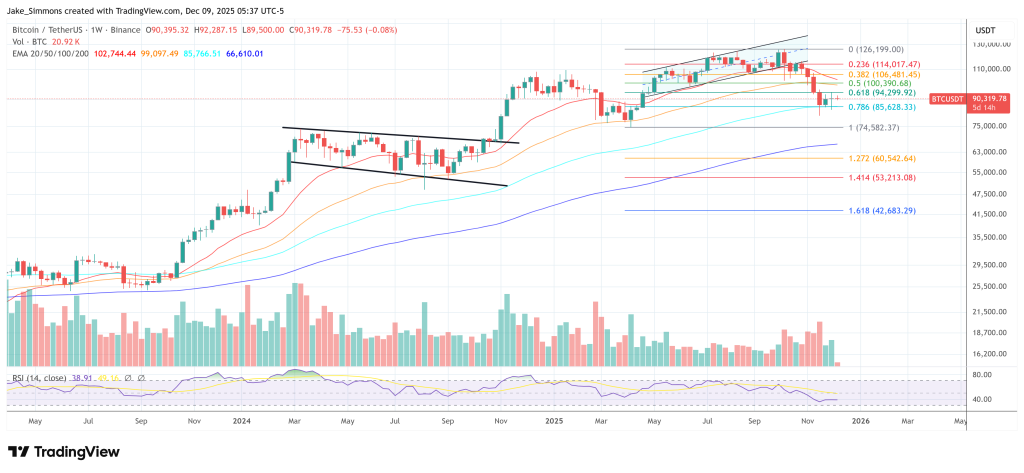
Reality forced an adjustment. Bitcoin did break to new highs on the back of ETF demand, validating Bernstein’s structural call that regulated spot products would be a decisive catalyst. However, price action has fallen short of the earlier timing: the market topped out in the mid-$120,000s rather than the $200,000 band originally envisaged for 2025, and a roughly 30% drawdown followed.

Related Reading: Bitcoin To Hit $50 Million By 2041, Says EMJ Capital CEO

What changed is not the end-state, but the path. Bernstein now argues that the four-year template has been superseded by a longer, ETF-anchored bull cycle. The critical datapoint underpinning this view is behavior in the recent correction: despite a near one-third price decline, spot Bitcoin ETFs have seen only about 5% net outflows, which the firm interprets as evidence of “sticky” institutional capital rather than the reflexive retail capitulation that defined previous tops.

In the new framework, earlier targets are effectively rescheduled rather than abandoned. The mid-2020s six-figure region is shifted out by roughly one to two years, with $150,000 now penciled in for 2026 and a potential cycle peak near $200,000 in 2027, while the 2033 $1 million objective is left unchanged.

In that sense, Bernstein’s track record is mixed but internally consistent. The firm has been directionally right on the drivers—ETF adoption, institutionalization, and supply absorption—but too aggressive on the speed at which those forces would translate into price. The latest note formalizes that recognition: same destination, slower ascent, and a Bitcoin market that Bernstein now sees as governed less by halvings and more by the behavior of large, ETF-mediated capital pools over the rest of the decade.

At press time, BTC traded at $90,319.

Bitcoin price
Disclaimer: The articles reposted on this site are sourced from public platforms and are provided for informational purposes only. They do not necessarily reflect the views of MEXC. All rights remain with the original authors. If you believe any content infringes on third-party rights, please contact [email protected] for removal. MEXC makes no guarantees regarding the accuracy, completeness, or timeliness of the content and is not responsible for any actions taken based on the information provided. The content does not constitute financial, legal, or other professional advice, nor should it be considered a recommendation or endorsement by MEXC.

You May Also Like

‘Already seen the low?’ – Inside Cathie Wood’s bet on a new Bitcoin cycle
‘Already seen the low?’ – Inside Cathie Wood’s bet on a new Bitcoin cycle

The post ‘Already seen the low?’ – Inside Cathie Wood’s bet on a new Bitcoin cycle appeared on BitcoinEthereumNews.com. Bitcoin has rarely looked more fragile, and many analysts are already referring to this as the worst fourth quarter on record, marked by a massive leverage wipeout and a steep drop from its all-time highs. For over a decade, Bitcoin [BTC] has followed a harsh, predictable pattern: a Halving event, a commendable rally to new highs, and then a brutal 75–90% crash that resets the entire market. This cycle shaped the crypto world and created the “crypto winter” mentality that traders have come to expect. Cathie Wood challenges the four-year cycle But according to Cathie Wood, CEO and CIO of ARK Invest, those old rules no longer apply. Speaking with Fox Business, Wood made a profound declaration: institutional adoption is actively “disrupting” the traditional Bitcoin cycle. Wood noted that growing participation in U.S. Spot Bitcoin ETFs had started to change how BTC absorbed volatility. She pointed to a steady decline in its two-year volatility trend over the past five years, adding fuel to the idea of a maturing asset. Why Bitcoin’s old pattern may be fading Wood’s view challenges over a decade of beliefs built around Bitcoin’s strict, predictable four-year cycle. The evidence for this cycle is compelling.  For instance, the 2012 Halving saw Bitcoin surge from under $10 to a peak of roughly $1,100; the 2016 Halving fueled a climb from $400 to nearly $20,000; and the 2020 Halving propelled the asset from $8,500 to a record high of around $69,000. Each of these explosive rallies was followed by a painful, defining drawdown of 70% to 85%, resetting the stage for the next run. This predictable pattern, last triggered by the 20th April 2024, Halving, has historically been the sole script for investors. Yet, this time, the narrative feels disjointed and disruptive. What is Wood so concerned about? Wood…
Share
BitcoinEthereumNews2025/12/11 19:15
The Critical Security Play You Can’t Miss in the AI Era

The Critical Security Play You Can’t Miss in the AI Era

The post The Critical Security Play You Can’t Miss in the AI Era appeared on BitcoinEthereumNews.com. The Watershed Moment That Changed Blockchain Security Forever Singapore – Blockman PR – December 2025 marked a turning point. Anthropic’s research team published findings that sent shockwaves through crypto: AI systems could successfully exploit smart contract vulnerabilities with 55.88% accuracy, simulating $4.6 million in potential theft from real-world contracts. The implications were existential. If AI could systematically identify and exploit vulnerabilities at scale, the entire blockchain ecosystem—processing over $1 trillion in transactions annually—faced an unprecedented threat. Traditional security tools couldn’t keep pace. Human auditors, already stretched thin reviewing less than 20% of deployed contracts, had no chance against autonomous AI attackers. But here’s what most people missed: Anthropic’s breakthrough wasn’t just validation of the threat. It was validation of the solution space. And one company had already been building that solution for six months—and winning. The Defense Was Already Operational While Anthropic demonstrated AI could break smart contracts in simulation, AgentLISA had been defending them in production. By the time Anthropic’s paper dropped, AgentLISA’s multi-agent system had detected over $7.3 million in actual vulnerabilities across real protocols managing billions in assets. The asymmetry is critical: Anthropic proved the threat is real and AI-powered. AgentLISA proved the defense is real, AI-powered, and already operational at scale. This matters because Anthropic’s research exposed something fundamental: the AI security race will be won by whoever controls the training data. And AgentLISA just lapped the entire field. LISA-Bench: The Data Moat Nobody Saw Coming https://github.com/agentlisa/bench Anthropic’s team used SCONE-bench—a dataset of 413 vulnerable smart contracts—to train their attack models. Solid methodology, respectable work. But fundamentally constrained by data scarcity. AgentLISA’s response was devastating: LISA-Bench, containing 23,959 professionally verified vulnerability records spanning 2016-2024—the largest curated smart contract vulnerability dataset ever assembled. It’s not just 60 times larger than SCONE-bench. It includes 10,185 code-complete vulnerability cases…
Share
BitcoinEthereumNews2025/12/11 19:01