House of DOGE announced a NASDAQ merger and surpassed 730 million DOGE in treasury holdings, but DOGE price action remains weak at $0.127 with bearish technicalsHouse of DOGE announced a NASDAQ merger and surpassed 730 million DOGE in treasury holdings, but DOGE price action remains weak at $0.127 with bearish technicals

House of DOGE Issues 2025 Shareholder Letter: 730M Treasury, NASDAQ Listing, Payments Launch

Dogecoin DOGE $0.12 24h volatility: 3.3% Market cap: $18.48 B Vol. 24h: $1.62 B price found support near $0.12 on Dec. 22, buoyed by the bullish tone of House of DOGE’s 2025 shareholder letter.

The treasury and corporate arm of the Dogecoin Foundation outlined its expansion into regulated finance, payments, and sports partnerships ahead of a planned NASDAQ listing in early 2026.

House of DOGE Expands Treasury, Targets NASDAQ Listing

According to the shareholder update, House of DOGE has signed a definitive merger agreement with Brag House Holdings (NASDAQ: TBH), positioning it to become one of the first publicly traded Dogecoin-focused corporations.

The firm confirmed its Official Dogecoin Treasury has surpassed 730 million DOGE, managed under a 10-year asset agreement with CleanCore Solutions (NYSE: ZONE), ranking it among the largest institutional holders of Dogecoin globally.

CEO Marco Margiotta highlighted that 2025 marked a year of “deliberate, foundational progress,” emphasizing that 2026 will focus on execution and commercialization. The company’s roadmap includes launching a rewards debit card, an embeddable Dogecoin wallet, and merchant acceptance tools to drive real-world adoption.

House of DOGE is also looking to expand institutional access through partnerships with 21Shares, enabling ETP and ETF exposure to Dogecoin across European and US markets.

The firm’s sports investments, in the Italian football clubs US Triestina Calcio 1918 and HC Sierre also aim to integrate Dogecoin into fan engagement, ticketing, and tokenization initiatives.

Despite the strong fundamentals, Dogecoin continues to trade 2.5% lower at $0.127, with CoinMarketCap data showing a 29% rise in daily volumes, signaling persistent sell-side activity. Bitcoin BTC $84 798 24h volatility: 1.0% Market cap: $1.69 T Vol. 24h: $55.38 B inability to reclaim $90,000 has weighed on memecoins, keeping speculative demand subdued.

Dogecoin Price Forecast: Can DOGE Reclaim $0.14 or Slip Below $0.12?

Dogecoin’s daily chart shows a clear bearish pennant formation, signaling continued downside pressure after repeated failures to break the descending resistance line near $0.14. The pattern has unfolded under the upper Bollinger Band (BB) resistance at $0.154, with prices now consolidating near the lower BB at $0.124.

The Relative Strength Index (RSI) sits at 33.09, hovering in oversold territory. This reflects exhaustion among short-term sellers but has yet to trigger meaningful accumulation signals. Historically, RSI levels near 30 often precede mild bounces, especially when accompanied by rising volume as observed on Dec. 19.
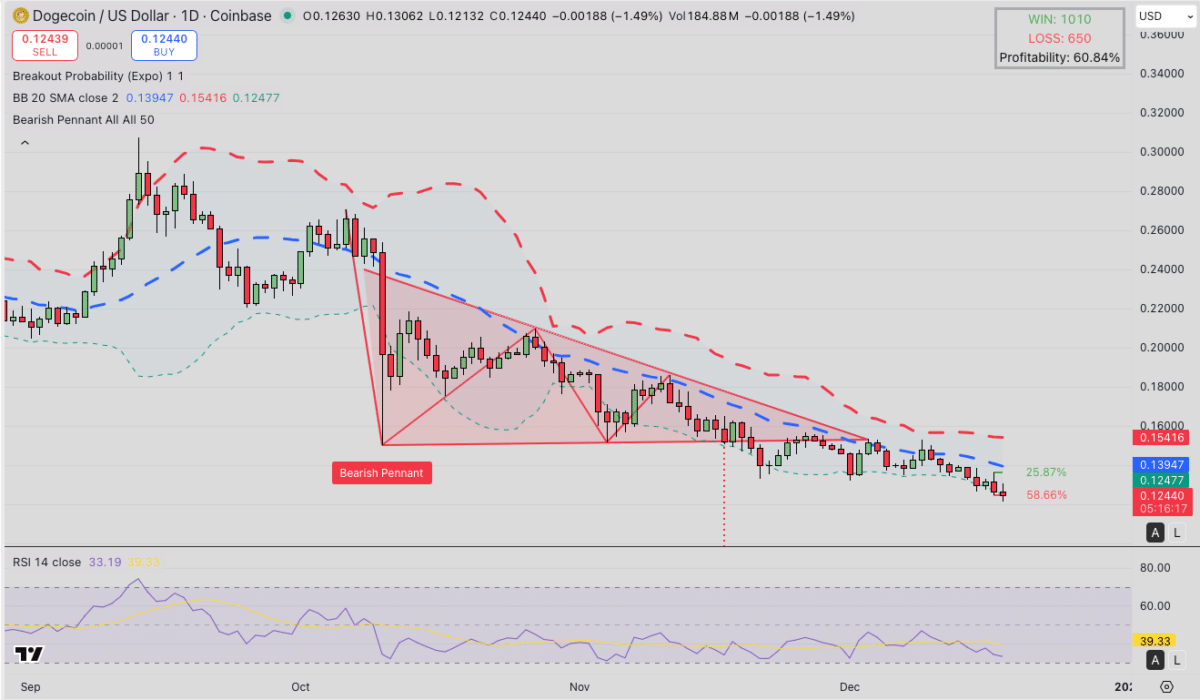
Dogecoin (DOGE) Technical Price Analysis, Dec. 18, 2025 | Source: TradingView

Dogecoin (DOGE) Technical Price Analysis, Dec. 18, 2025 | Source: TradingView

If buyers defend the $0.12 support, a short-term recovery could lift DOGE toward $0.135, aligning with the midline of the Bollinger Band and the 20-day SMA at $0.139.

A decisive breakout above $0.14 would invalidate the bearish pennant, exposing resistance at $0.16, the level required to confirm a trend reversal.

On the downside, a daily close below $0.12 could accelerate a drop toward $0.10, the measured move target from the pennant breakdown. With 58.64% downside probability, Dogecoin remains at risk of setting new weekly lows, unless macro sentiment improves.

next

The post House of DOGE Issues 2025 Shareholder Letter: 730M Treasury, NASDAQ Listing, Payments Launch appeared first on Coinspeaker.

Market Opportunity
Housecoin Logo
Housecoin Price(HOUSE)
$0,001823
$0,001823$0,001823
-14,97%
USD
Housecoin (HOUSE) Live Price Chart
Disclaimer: The articles reposted on this site are sourced from public platforms and are provided for informational purposes only. They do not necessarily reflect the views of MEXC. All rights remain with the original authors. If you believe any content infringes on third-party rights, please contact [email protected] for removal. MEXC makes no guarantees regarding the accuracy, completeness, or timeliness of the content and is not responsible for any actions taken based on the information provided. The content does not constitute financial, legal, or other professional advice, nor should it be considered a recommendation or endorsement by MEXC.

You May Also Like

Cashing In On University Patents Means Giving Up On Our Innovation Future

Cashing In On University Patents Means Giving Up On Our Innovation Future

The post Cashing In On University Patents Means Giving Up On Our Innovation Future appeared on BitcoinEthereumNews.com. “It’s a raid on American innovation that would deliver pennies to the Treasury while kneecapping the very engine of our economic and medical progress,” writes Pipes. Getty Images Washington is addicted to taxing success. Now, Commerce Secretary Howard Lutnick is floating a plan to skim half the patent earnings from inventions developed at universities with federal funding. It’s being sold as a way to shore up programs like Social Security. In reality, it’s a raid on American innovation that would deliver pennies to the Treasury while kneecapping the very engine of our economic and medical progress. Yes, taxpayer dollars support early-stage research. But the real payoff comes later—in the jobs created, cures discovered, and industries launched when universities and private industry turn those discoveries into real products. By comparison, the sums at stake in patent licensing are trivial. Universities collectively earn only about $3.6 billion annually in patent income—less than the federal government spends on Social Security in a single day. Even confiscating half would barely register against a $6 trillion federal budget. And yet the damage from such a policy would be anything but trivial. The true return on taxpayer investment isn’t in licensing checks sent to Washington, but in the downstream economic activity that federally supported research unleashes. Thanks to the bipartisan Bayh-Dole Act of 1980, universities and private industry have powerful incentives to translate early-stage discoveries into real-world products. Before Bayh-Dole, the government hoarded patents from federally funded research, and fewer than 5% were ever licensed. Once universities could own and license their own inventions, innovation exploded. The result has been one of the best returns on investment in government history. Since 1996, university research has added nearly $2 trillion to U.S. industrial output, supported 6.5 million jobs, and launched more than 19,000 startups. Those companies pay…
Share
BitcoinEthereumNews2025/09/18 03:26
Trump Reviews Candidates to Succeed Fed Chair Powell

Trump Reviews Candidates to Succeed Fed Chair Powell

The post Trump Reviews Candidates to Succeed Fed Chair Powell appeared on BitcoinEthereumNews.com. Key Points: Trump evaluates Fed Chair candidates, considering
Share
BitcoinEthereumNews2025/12/19 08:34
Will XRP Price Increase In September 2025?

Will XRP Price Increase In September 2025?

Ripple XRP is a cryptocurrency that primarily focuses on building a decentralised payments network to facilitate low-cost and cross-border transactions. It’s a native digital currency of the Ripple network, which works as a blockchain called the XRP Ledger (XRPL). It utilised a shared, distributed ledger to track account balances and transactions. What Do XRP Charts Reveal? […]
Share
Tronweekly2025/09/18 00:00