Ripple has sent a new market-structure letter to the SEC’s Crypto Task Force, urging the agency to draw a hard line between a securities offering and the underlyingRipple has sent a new market-structure letter to the SEC’s Crypto Task Force, urging the agency to draw a hard line between a securities offering and the underlying

Ripple Sends New Letter To The SEC: What It Could Mean For XRP

Ripple has sent a new market-structure letter to the SEC’s Crypto Task Force, urging the agency to draw a hard line between a securities offering and the underlying token that may later trade in secondary markets, a framing that could matter for how XRP (post SEC lawsuit) and other tokens are treated in disclosure and jurisdiction debates.

In the January 9, 2026 submission, signed by Chief Legal Officer Stuart Alderoty, General Counsel Sameer Dhond, and Deputy General Counsel Deborah McCrimmon, Ripple positions its comments as input to ongoing Commission rulemaking or guidance, explicitly tying its argument to parallel legislative efforts on Capitol Hill.

The company references earlier letters from March 21, 2025 and May 27, 2025, and points to the House’s CLARITY Act of 2025 and Senate discussion drafts as evidence that classification choices will cascade into “jurisdiction, disclosures, and secondary-market treatment.”

Ripple Presses SEC To Cement XRP’s Post-Lawsuit Status

Ripple’s core thesis is that regulators should move away from “decentralization” as a legal metric because it is “not a binary state” and creates “intolerable uncertainty,” including both “false negative” and “false positive” outcomes.

One of Ripple’s key concerns is that an asset could be treated as stuck in a securities regime simply because an entity still holds inventory or continues contributing to development, a point with obvious parallels to Ripple. The company still holds a large chunk of all XRP in their escrow while developer arm RippleX contributes heavily to the development of the XRP Ledger.

Instead, Ripple pushes the SEC to ground jurisdiction in “legal rights and obligations,” emphasizing enforceable promises rather than market narratives about ongoing efforts. The letter argues that regulatory theories focusing on “efforts of others” risk collapsing the multi-part Howey analysis into a single factor and, in Ripple’s view, sweeping too broadly.

The most consequential section is Ripple’s argument that the SEC’s jurisdiction should be time-bound to the “lifespan of the obligation,” rather than treating the asset as permanently labeled. In a passage that goes directly to secondary-market implications, Ripple writes:

That framing matters for XRP and draws parallels to the SEC lawsuit: whether secondary-market trading of a token can remain subject to securities-law oversight long after any initial distribution, marketing, or development-era statements. Ripple explicitly rejects the idea that active secondary trading is itself a jurisdictional hook, comparing high-velocity crypto markets to spot commodities like gold and silver and even secondary markets for consumer devices.

Ripple also spends meaningful time on the “capital raising” boundary, arguing for privity as a bright line that distinguishes primary distributions from exchange trading where counterparties are unknown and the issuer is “merely as another market actor.”

In that context, the letter warns that treating every issuer sale as a perpetual capital raise creates “perverse outcomes,” including what it calls a “Zombie Promise” and “Operational Paralysis”: language that, while generalized, clearly speaks to concerns around issuer-held token inventories and the compliance burdens that could attach to treasury management and sales practices.

Separately, Ripple endorses “fit-for purpose” disclosures in cases where securities regulation is actually warranted, rather than forcing “full corporate registration designed for traditional equity.” For XRP holders and market participants, that is a directional signal: Ripple is arguing for a regime where disclosure triggers attach to specific promises or specific forms of ongoing control, not to the token as an object indefinitely.

The timing is also notable. Ripple dated the letter January 9, 2026, less than a week before a January 15 markup on comprehensive digital-asset market structure legislation in the US Senate Banking Committee, an approaching deadline that could shape how classification language, jurisdictional lines, and disclosure concepts harden into legislative text.

At press time, XRP traded at $2.05.
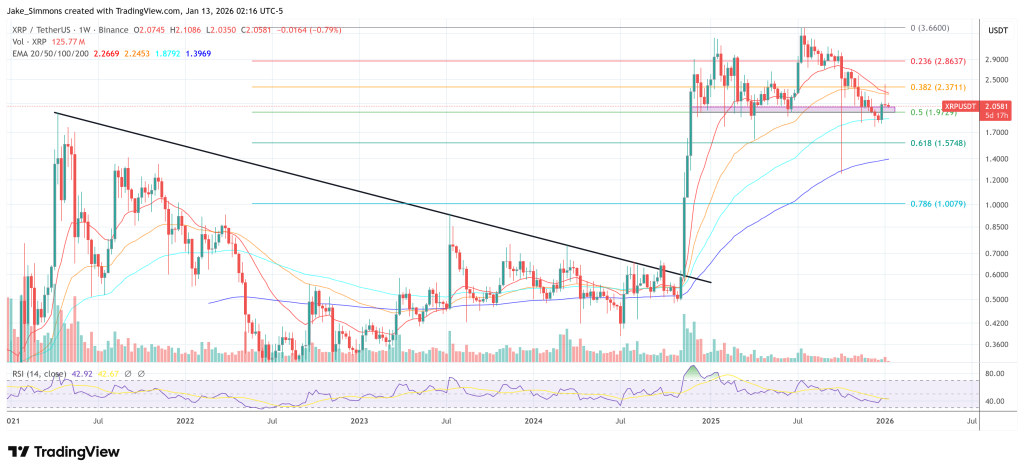
XRP price chart
Market Opportunity
XRP Logo
XRP Price(XRP)
$2.0844
$2.0844$2.0844
-0.49%
USD
XRP (XRP) Live Price Chart
Disclaimer: The articles reposted on this site are sourced from public platforms and are provided for informational purposes only. They do not necessarily reflect the views of MEXC. All rights remain with the original authors. If you believe any content infringes on third-party rights, please contact [email protected] for removal. MEXC makes no guarantees regarding the accuracy, completeness, or timeliness of the content and is not responsible for any actions taken based on the information provided. The content does not constitute financial, legal, or other professional advice, nor should it be considered a recommendation or endorsement by MEXC.

You May Also Like

American Bitcoin’s $5B Nasdaq Debut Puts Trump-Backed Miner in Crypto Spotlight

American Bitcoin’s $5B Nasdaq Debut Puts Trump-Backed Miner in Crypto Spotlight

The post American Bitcoin’s $5B Nasdaq Debut Puts Trump-Backed Miner in Crypto Spotlight appeared on BitcoinEthereumNews.com. Key Takeaways: American Bitcoin (ABTC) surged nearly 85% on its Nasdaq debut, briefly reaching a $5B valuation. The Trump family, alongside Hut 8 Mining, controls 98% of the newly merged crypto-mining entity. Eric Trump called Bitcoin “modern-day gold,” predicting it could reach $1 million per coin. American Bitcoin, a fast-rising crypto mining firm with strong political and institutional backing, has officially entered Wall Street. After merging with Gryphon Digital Mining, the company made its Nasdaq debut under the ticker ABTC, instantly drawing global attention to both its stock performance and its bold vision for Bitcoin’s future. Read More: Trump-Backed Crypto Firm Eyes Asia for Bold Bitcoin Expansion Nasdaq Debut: An Explosive First Day ABTC’s first day of trading proved as dramatic as expected. Shares surged almost 85% at the open, touching a peak of $14 before settling at lower levels by the close. That initial spike valued the company around $5 billion, positioning it as one of 2025’s most-watched listings. At the last session, ABTC has been trading at $7.28 per share, which is a small positive 2.97% per day. Although the price has decelerated since opening highs, analysts note that the company has been off to a strong start and early investor activity is a hard-to-find feat in a newly-launched crypto mining business. According to market watchers, the listing comes at a time of new momentum in the digital asset markets. With Bitcoin trading above $110,000 this quarter, American Bitcoin’s entry comes at a time when both institutional investors and retail traders are showing heightened interest in exposure to Bitcoin-linked equities. Ownership Structure: Trump Family and Hut 8 at the Helm Its management and ownership set up has increased the visibility of the company. The Trump family and the Canadian mining giant Hut 8 Mining jointly own 98 percent…
Share
BitcoinEthereumNews2025/09/18 01:33
What Crypto To Buy Now in 2026 When Mainstream Finance Gets Closer to Crypto: DeepSnitch AI Has the Best of Both Worlds
What Crypto To Buy Now in 2026 When Mainstream Finance Gets Closer to Crypto: DeepSnitch AI Has the Best of Both Worlds

Since the start of the new year, there’s been a mood change in the crypto space. 2025’s end was a bit of a downer, with bears seeming in control, but 2026 changed
Share
Blockonomi2026/01/13 20:15
Fed Makes First Rate Cut of the Year, Lowers Rates by 25 Bps

Fed Makes First Rate Cut of the Year, Lowers Rates by 25 Bps

The post Fed Makes First Rate Cut of the Year, Lowers Rates by 25 Bps appeared on BitcoinEthereumNews.com. The Federal Reserve has made its first Fed rate cut this year following today’s FOMC meeting, lowering interest rates by 25 basis points (bps). This comes in line with expectations, while the crypto market awaits Fed Chair Jerome Powell’s speech for guidance on the committee’s stance moving forward. FOMC Makes First Fed Rate Cut This Year With 25 Bps Cut In a press release, the committee announced that it has decided to lower the target range for the federal funds rate by 25 bps from between 4.25% and 4.5% to 4% and 4.25%. This comes in line with expectations as market participants were pricing in a 25 bps cut, as against a 50 bps cut. This marks the first Fed rate cut this year, with the last cut before this coming last year in December. Notably, the Fed also made the first cut last year in September, although it was a 50 bps cut back then. All Fed officials voted in favor of a 25 bps cut except Stephen Miran, who dissented in favor of a 50 bps cut. This rate cut decision comes amid concerns that the labor market may be softening, with recent U.S. jobs data pointing to a weak labor market. The committee noted in the release that job gains have slowed, and that the unemployment rate has edged up but remains low. They added that inflation has moved up and remains somewhat elevated. Fed Chair Jerome Powell had also already signaled at the Jackson Hole Conference that they were likely to lower interest rates with the downside risk in the labor market rising. The committee reiterated this in the release that downside risks to employment have risen. Before the Fed rate cut decision, experts weighed in on whether the FOMC should make a 25 bps cut or…
Share
BitcoinEthereumNews2025/09/18 04:36
