Billionaire scrap-metal entrepreneur Adam Weitsman continues expanding his involvement in the non-fungible token space through high-volume acquisitions and intellectualBillionaire scrap-metal entrepreneur Adam Weitsman continues expanding his involvement in the non-fungible token space through high-volume acquisitions and intellectual

XRP ETFs Post Record Outflows as Ripple Extends Price Slide

XRP price faces heightened downside risks following massive outflows from US Spot XRP exchange-traded funds (ETFs) amid risk-off sentiment in the broader crypto market.

Rising US and Japan bond yields signal macroeconomic stress, dragging the total crypto market capitalization 32% below its October 2025 peak.

BTC, ETH, and XRP retested their lowest levels in more than two weeks after crypto and stock markets digested US President Donald Trump’s fresh round of tariff threats.

The potential tariffs are an attempt by the administration to convince Denmark to reconsider its control of Greenland.

The S&P 500 index fell 1.9%, while gold prices surged to a new all-time high of around $4,885/ounce, and the crypto market capitalization dropped to $3 trillion, down from nearly $3.2 trillion, according to Coingecko data.

XRP dropped nearly 1% in the last 24 hours to trade at $1.90 as of 4:39 a.m. EST, with an intraday low of around $1.89.

Spot XRP ETFs Records $53.32 Million in Net Outflows

According to Coinglass data, spot XRP ETFs recorded $53.32 million in net outflows on Tuesday, January 20, marking their second-ever daily capital outflow and the largest since they began trading in November 2025.

The outflow was from Grayscale’s GXRP ETF, which recorded a total outflow of $55.39 million. Meanwhile, Franklin’s XRPZ recorded $2.07 million in inflows.

Following the latest outflow, total net inflows since launch now stand at $1.22 billion.

The recent bearish spell was not unique to XRP, as most other crypto ETFs also saw outflows. Specifically, the BTC ETFs recorded $479.70 million in outflows, while the ETH ETFs recorded $230 million.

Can XRP Stabilize or Is More Downside Ahead?

XRP price is currently trading around $1.90–$2.00, sitting directly on top of the 200-day Simple Moving Average (SMA) near $1.90, which has become a critical long-term support level. The price remains well below the 50-day SMA at $2.39, highlighting persistent medium-term bearish pressure.

After peaking near the $3.60–$3.70 region, XRP entered a prolonged corrective phase, forming a falling channel pattern.

Despite this, XRP has so far managed to defend the $1.85–$1.90 zone, an area that also aligns with a major Fibonacci extension level from the prior advance.

The 50-day SMA remains downward-sloping, signaling that trend momentum has not yet shifted in favor of the bulls. As long as the price of XRP trades below this SMA.

Overhead, the $2.20–$2.40 region stands out as a heavy resistance band, combining the descending channel top and the 50-day SMA.

XRP’s Relative Strength Index (RSI) is currently hovering around 41, below the neutral 50 level. This suggests weak momentum, though RSI is not yet deeply oversold.
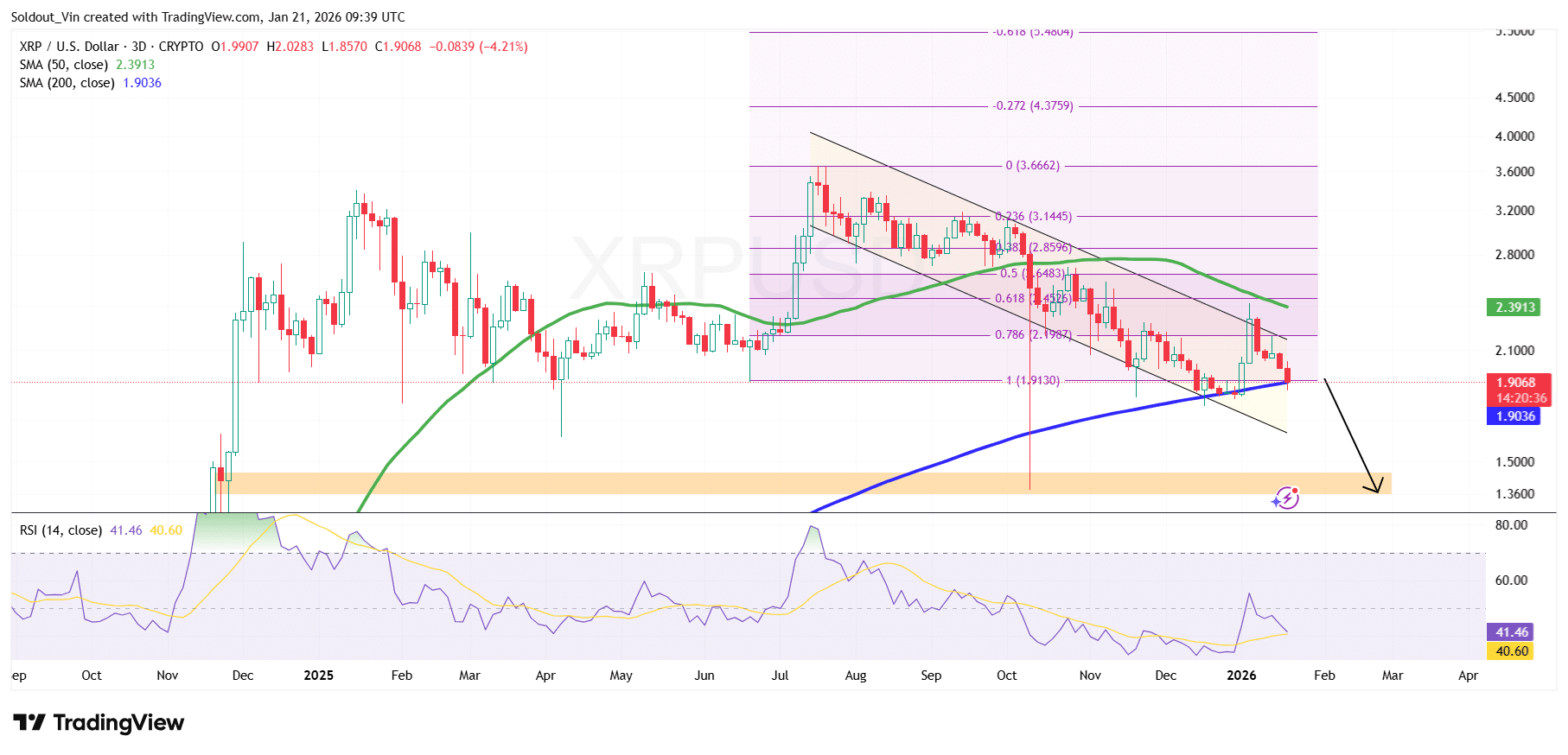
XRP/USD Chart Analysis Source: TradingViewXRP/USD Chart Analysis Source: TradingView

The higher-timeframe XRP/USD chart suggests the Ripple token may attempt a short-term stabilization above the $1.85–$1.90 support zone, given the confluence with the 200-day SMA. A sustained hold here could allow for another corrective move toward $2.10–$2.30, where prior breakdown levels and channel resistance converge.

A decisive daily or multi-day close above the $2.30–$2.40 region would be required to weaken the bearish structure.

On the downside, a clean break below the 200-day SMA and $1.85 support would significantly change the bearish structure. As a result, XRP could slide toward the $ 1.35–$ 1.50 demand zone.

Market Opportunity
XRP Logo
XRP Price(XRP)
$1.9542
$1.9542$1.9542
-0.19%
USD
XRP (XRP) Live Price Chart
Disclaimer: The articles reposted on this site are sourced from public platforms and are provided for informational purposes only. They do not necessarily reflect the views of MEXC. All rights remain with the original authors. If you believe any content infringes on third-party rights, please contact [email protected] for removal. MEXC makes no guarantees regarding the accuracy, completeness, or timeliness of the content and is not responsible for any actions taken based on the information provided. The content does not constitute financial, legal, or other professional advice, nor should it be considered a recommendation or endorsement by MEXC.

You May Also Like

Shiba Inu Faces Growing Risks as Leadership Instability Concerns Holders

Shiba Inu Faces Growing Risks as Leadership Instability Concerns Holders

TLDR Shiba Inu faces growing risks due to leadership instability and the absence of its lead developer, Shytoshi Kusama. The lack of identifiable leadership raises trust issues, hindering Shiba Inu’s ability to attract institutional investors. Shibarium’s transaction volume has significantly declined, sparking concerns about its ability to support decentralized finance (DeFi) growth. A recent $3 [...] The post Shiba Inu Faces Growing Risks as Leadership Instability Concerns Holders appeared first on CoinCentral.
Share
Coincentral2025/09/18 06:14
Cashing In On University Patents Means Giving Up On Our Innovation Future

Cashing In On University Patents Means Giving Up On Our Innovation Future

The post Cashing In On University Patents Means Giving Up On Our Innovation Future appeared on BitcoinEthereumNews.com. “It’s a raid on American innovation that would deliver pennies to the Treasury while kneecapping the very engine of our economic and medical progress,” writes Pipes. Getty Images Washington is addicted to taxing success. Now, Commerce Secretary Howard Lutnick is floating a plan to skim half the patent earnings from inventions developed at universities with federal funding. It’s being sold as a way to shore up programs like Social Security. In reality, it’s a raid on American innovation that would deliver pennies to the Treasury while kneecapping the very engine of our economic and medical progress. Yes, taxpayer dollars support early-stage research. But the real payoff comes later—in the jobs created, cures discovered, and industries launched when universities and private industry turn those discoveries into real products. By comparison, the sums at stake in patent licensing are trivial. Universities collectively earn only about $3.6 billion annually in patent income—less than the federal government spends on Social Security in a single day. Even confiscating half would barely register against a $6 trillion federal budget. And yet the damage from such a policy would be anything but trivial. The true return on taxpayer investment isn’t in licensing checks sent to Washington, but in the downstream economic activity that federally supported research unleashes. Thanks to the bipartisan Bayh-Dole Act of 1980, universities and private industry have powerful incentives to translate early-stage discoveries into real-world products. Before Bayh-Dole, the government hoarded patents from federally funded research, and fewer than 5% were ever licensed. Once universities could own and license their own inventions, innovation exploded. The result has been one of the best returns on investment in government history. Since 1996, university research has added nearly $2 trillion to U.S. industrial output, supported 6.5 million jobs, and launched more than 19,000 startups. Those companies pay…
Share
BitcoinEthereumNews2025/09/18 03:26
Iran’s Central Bank Spends $500M on Crypto Amid Rial Crisis

Iran’s Central Bank Spends $500M on Crypto Amid Rial Crisis

Iran's Central Bank has reportedly acquired more than $500 million in cryptocurrency assets over the past year to mitigate the ongoing currency crisis.
Share
coinlineup2026/01/22 08:59