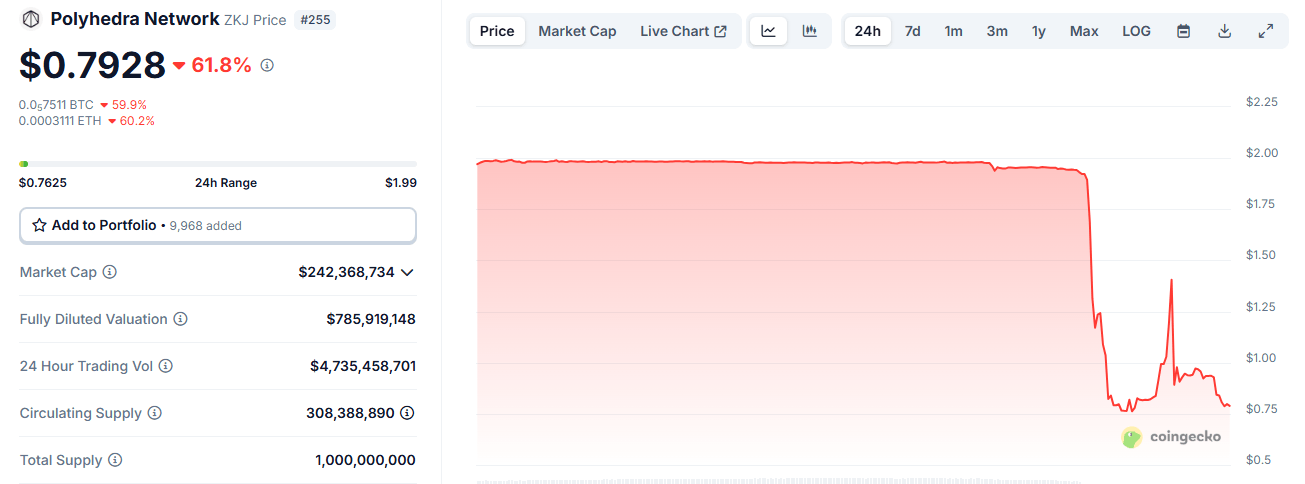
On June 15, ZKJ, the native token of Polyhedra Network, suffered a sudden and steep collapse, plunging more than 60% from $1.98 to a record low of $0.7625 in just under two hours. ZKJ Revival Short-Lived On June 15, ZKJ, the native token of Polyhedra Network, suffered a flash crash, plummeting by more than 60% […]On June 15, ZKJ, the native token of Polyhedra Network, suffered a sudden and steep collapse, plunging more than 60% from $1.98 to a record low of $0.7625 in just under two hours. ZKJ Revival Short-Lived On June 15, ZKJ, the native token of Polyhedra Network, suffered a flash crash, plummeting by more than 60% […]

ZKJ Token Plummets More Than 60% in Flash Crash Amid Rug-Pull Allegations

2025/06/16 05:40

On June 15, ZKJ, the native token of Polyhedra Network, suffered a sudden and steep collapse, plunging more than 60% from $1.98 to a record low of $0.7625 in just under two hours.

ZKJ Revival Short-Lived

On June 15, ZKJ, the native token of Polyhedra Network, suffered a flash crash, plummeting by more than 60% in less than two hours. What began as a sudden drop from $1.98 cascaded to an all-time low of $0.7625, according to Coingecko data. While the token showed a fleeting sign of recovery, briefly surging to $1.41, this rally proved short-lived. At the time of writing ( June 15, 12:40 p.m. EST), the Polyhedra Network native token had retreated once more, languishing just below the $0.80 mark.
ZKJ Token Plummets More Than 60% in Flash Crash Amid Rug-Pull Allegations

Coinmarketcap data painted an even bleaker picture, indicating a staggering 80% freefall for Polyhedra Network’s token, which nosedived from approximately $1.94 to a jarring $0.33. This plunge decimated the token’s market capitalization, bringing it down to a meager $94.76 million at the time of writing.

The collapse was particularly striking given ZKJ’s prior stability. For more than 30 days, the token had traded within a narrow band of $2.05 and $1.98, establishing itself as one of the less volatile tokens in a notoriously unpredictable market.
ZKJ Token Plummets More Than 60% in Flash Crash Amid Rug-Pull Allegations

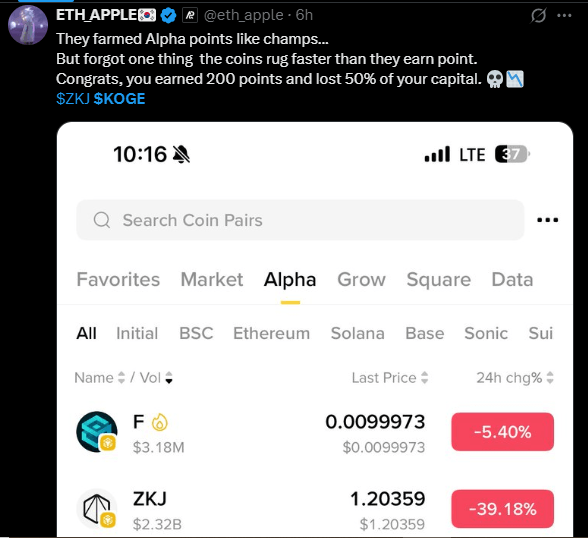
Meanwhile, the synchronized crash of ZKJ and KOGE sparked widespread speculation, with one prominent X user, ETH APPLE, pointing to a potentially “long-planned harvesting operation” as the cause. KOGE, mirroring Polyhedra Network’s native token, experienced its own plunge following the alleged draining of its liquidity pool.

“The issue began when the KOGE pool ran out of USDT, leaving LPs unable to exit positions,” stated ETH APPLE. “This led to a mass sell-off of KOGE into ZKJ, causing both tokens to crash. The situation worsened as it was revealed that the KOGE team hadn’t added any USDT to the pool.”

The alleged draining of liquidity has in turn fueled rug-pull accusations from the distressed community. Although ZKJ was reportedly “actively defending its USDT pool,” it ultimately found itself caught in the crossfire, its value dragged down by the unfolding chaos, as further detailed by ETH APPLE.


Disclaimer: The articles reposted on this site are sourced from public platforms and are provided for informational purposes only. They do not necessarily reflect the views of MEXC. All rights remain with the original authors. If you believe any content infringes on third-party rights, please contact [email protected] for removal. MEXC makes no guarantees regarding the accuracy, completeness, or timeliness of the content and is not responsible for any actions taken based on the information provided. The content does not constitute financial, legal, or other professional advice, nor should it be considered a recommendation or endorsement by MEXC.

You May Also Like

Tokenized Assets Shift From Wrappers to Building Blocks in DeFi

Tokenized Assets Shift From Wrappers to Building Blocks in DeFi

The post Tokenized Assets Shift From Wrappers to Building Blocks in DeFi appeared on BitcoinEthereumNews.com. RWAs are rapidly moving on-chain, unlocking new opportunities for investors and DeFi protocols, according to a new report from Dune and RWAxyz. Tokenized real-world assets (RWAs) are moving beyond digital versions of traditional securities to become key building blocks of decentralized finance (DeFi), according to the 2025 RWA Report from Dune and RWAxyz. The report notes that Treasuries, bonds, credit, and equities are now being used in DeFi as collateral, trading instruments, and yield products. This marks tokenization’s “real breakthrough” – composability, or the ability to combine and reuse assets across different protocols. Projects are already showing how this works in practice. Asset manager Maple Finance’s syrupUSDC, for example, has grown to $2.5 billion, with more than 30% placed in DeFi apps like Spark ($570 million). Centrifuge’s new deJAAA token, a wrapper for Janus Henderson’s AAA CLO fund, is already trading on Aerodrome, Coinbase and other exchanges, with Stellar planned next. Meanwhile, Aave’s Horizon RWA Market now lets institutional users post tokenized Treasuries and CLOs as collateral. This trend underscores a bigger shift: RWAs are no longer just copies of traditional assets; instead, they are becoming core parts of on-chain finance, powering lending, liquidity, and yield, and helping to close the gap between traditional finance (TradFi) and DeFi. “RWAs have crossed the chasm from experimentation to execution,” Sid Powell, CEO of Maple Finance, says in the report. “Our growth to $3.5B AUM reflects a broader shift: traditional financial services are adopting crypto assets while institutions seek exposure to on-chain markets.” Investor demand for higher returns and more diversified options is mainly driving this growth. Tokenized Treasuries proved there is strong demand, with $7.3 billion issued by September 2025 – up 85% year-to-date. The growth was led by BlackRock, WisdomTree, Ondo, and Centrifuge’s JTRSY (Janus Henderson Anemoy Treasury Fund). Spark’s $1…
Share
BitcoinEthereumNews2025/09/18 06:10