This article applies a free and fair economy model to analyze pure exchange economies and markets with transferable payoff.This article applies a free and fair economy model to analyze pure exchange economies and markets with transferable payoff.

Game Theory and Exchange Economies: A New Model for Pure Exchange and Transferable Payoff

2025/09/17 23:30
3 min read
For feedback or concerns regarding this content, please contact us at [email protected]

Abstract and 1. Introduction

  1. A free and fair economy: definition, existence and uniqueness

    2.1 A free economy

    2.2 A free and fair economy

  2. Equilibrium existence in a free and fair economy

    3.1 A free and fair economy as a strategic form game

    3.2 Existence of an equilibrium

  3. Equilibrium efficiency in a free and fair economy

  4. A free economy with social justice and inclusion

    5.1 Equilibrium existence and efficiency in a free economy with social justice

    5.2 Choosing a reference point to achieve equilibrium efficiency

  5. Some applications

    6.1 Teamwork: surplus distribution in a firm

    6.2 Contagion and self-enforcing lockdown in a networked economy

    6.3 Bias in academic publishing

    6.4 Exchange economies

  6. Contributions to the closely related literature

  7. Conclusion and References

Appendix

6.4 Exchange economies

In this section, we apply our theory to pure exchange economies (Section 6.4.1) and markets with transferable payoff (Section 6.4.2).

\ 6.4.1 Pure exchange economies

\
\
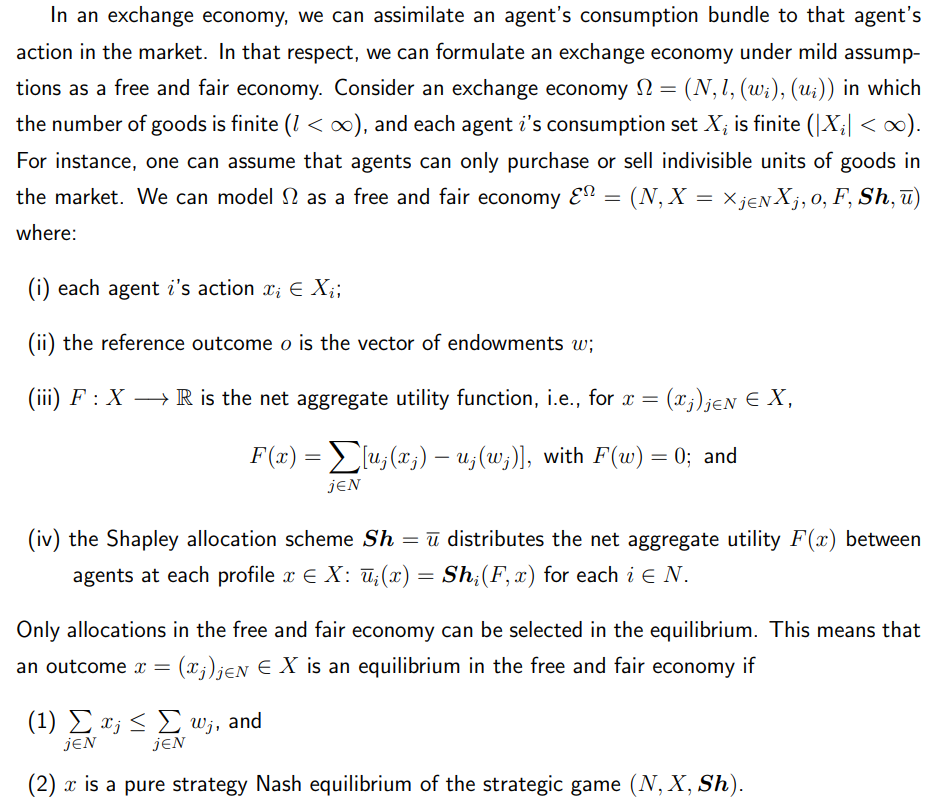
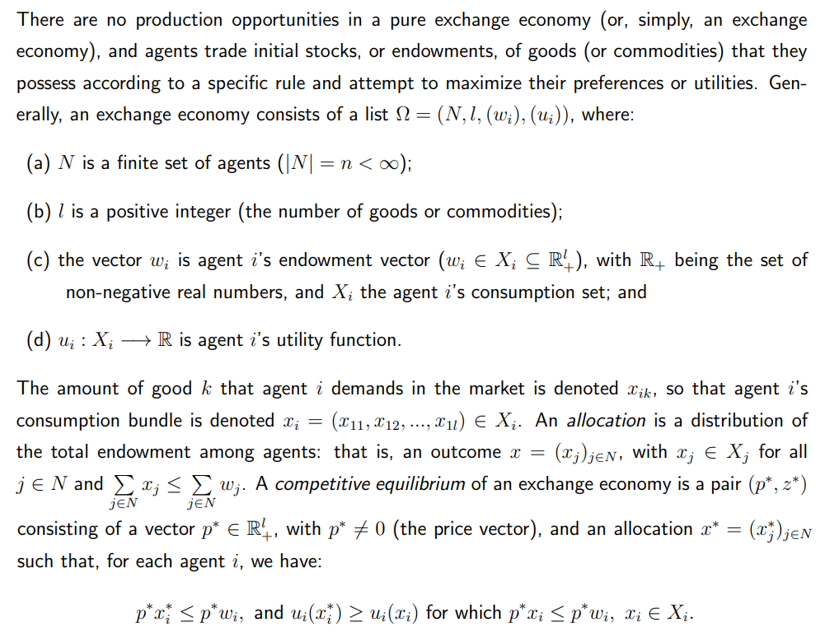
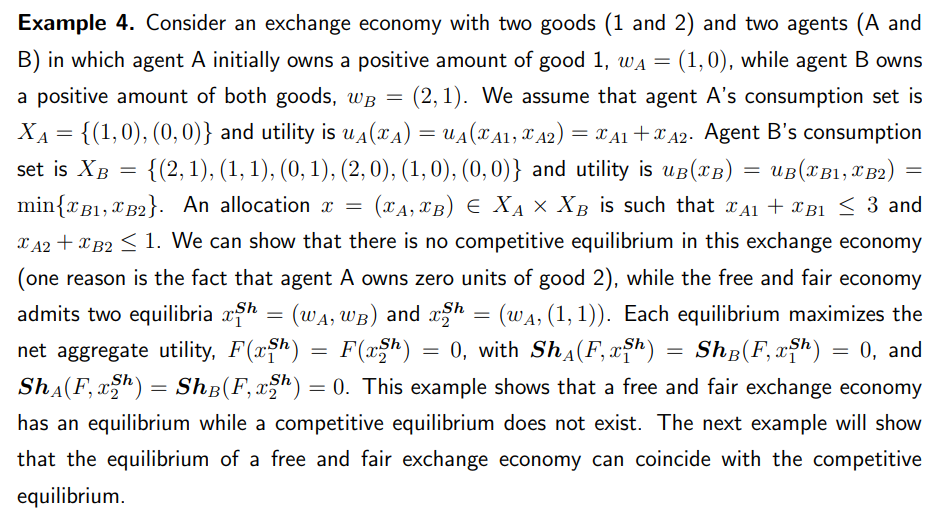
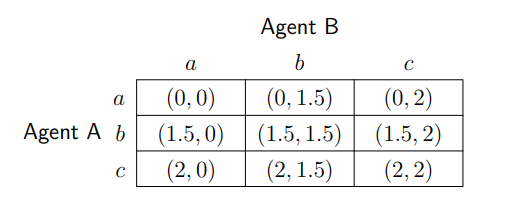
\ Our model differs from the exchange economy in at least two important respects. First, the incentive mechanism is different. Second, the equilibrium prediction from free exchanges between agents in both economies is different in general. A competitive equilibrium exists in an exchange economy when some assumptions exist on agents’ utilities and endowments. For instance, when utilities are continuous, strictly increasing, and quasi-concave and each agent initially owns a positive amount of each good in the market, a competitive equilibrium exists, and many equilibria might arise. However, under such assumptions on agents’ utilities, the net aggregate utility function F is strictly increasing, and thanks to Theorem 2, the free and fair economy admits a unique equilibrium. Additionally, it is not necessary to impose any assumptions on utilities and endowments to guarantee the existence of an equilibrium in a free and fair economy. We illustrate these points in the following examples.

\
\
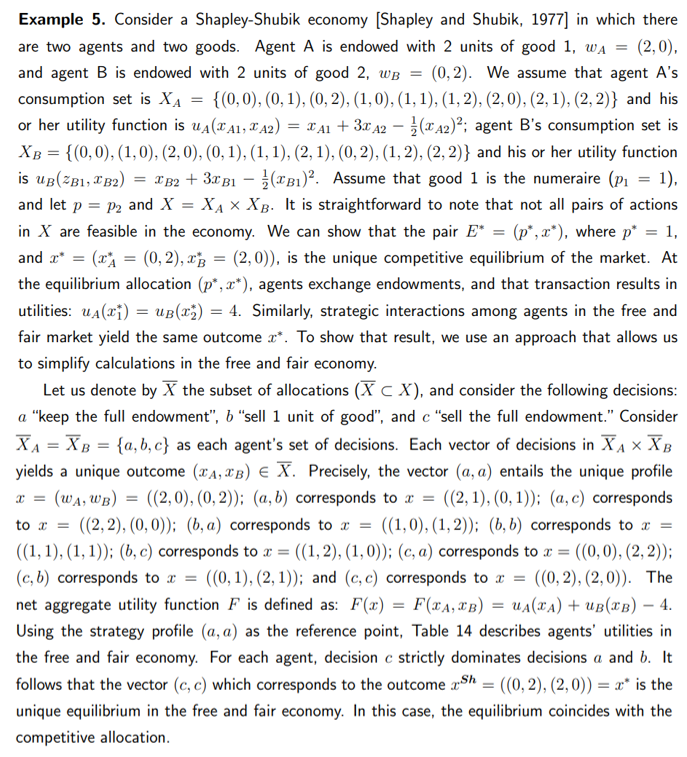
\ Table 14: Utilities in the free and fair economy
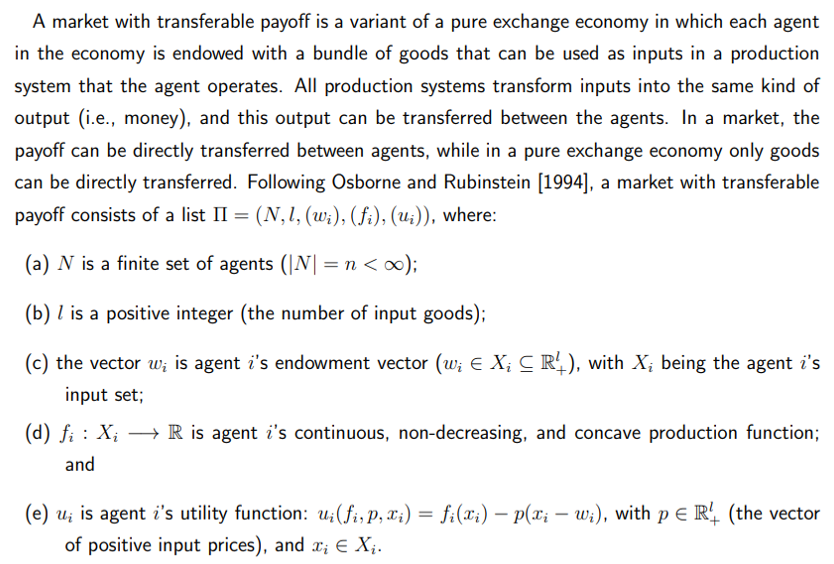
\ 6.4.2 Markets with transferable payoff

\
\
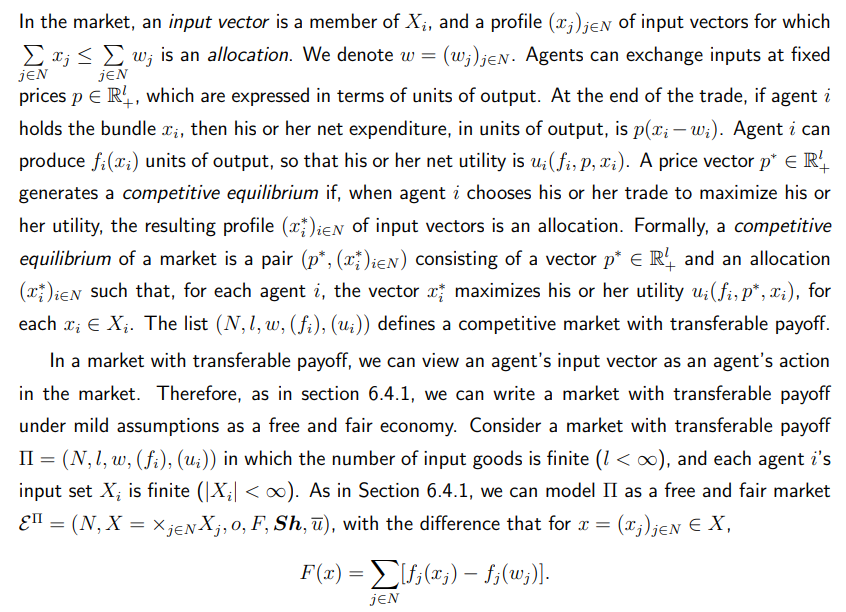
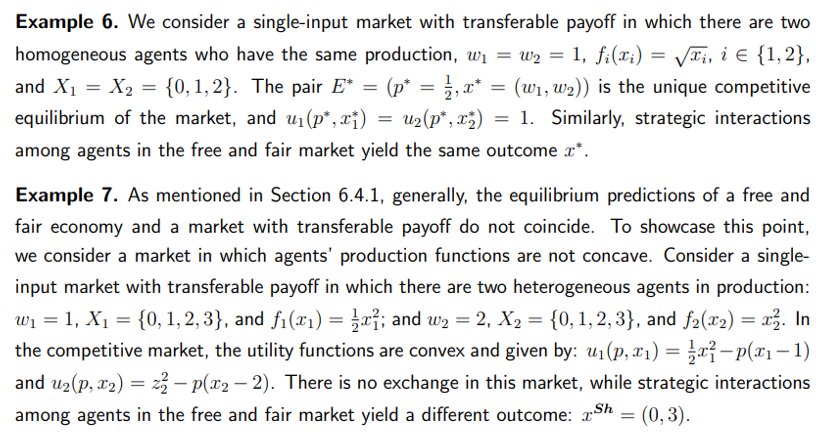
\ As in the analysis in section 6.4.1 below, we provide examples that show similarities (Example 6) and differences (Example 7) between the predictions of free and fair markets and markets with transferable payoff.

\
\

:::info Authors:

(1) Ghislain H. Demeze-Jouatsa, Center for Mathematical Economics, University of Bielefeld (demeze [email protected]);

(2) Roland Pongou, Department of Economics, University of Ottawa ([email protected]);

(3) Jean-Baptiste Tondji, Department of Economics and Finance, The University of Texas Rio Grande Valley ([email protected]).

:::


:::info This paper is available on arxiv under CC BY 4.0 DEED license.

:::

\

Market Opportunity
SQUID MEME Logo
SQUID MEME Price(GAME)
$33.4922
$33.4922$33.4922
-1.74%
USD
SQUID MEME (GAME) Live Price Chart
Disclaimer: The articles reposted on this site are sourced from public platforms and are provided for informational purposes only. They do not necessarily reflect the views of MEXC. All rights remain with the original authors. If you believe any content infringes on third-party rights, please contact [email protected] for removal. MEXC makes no guarantees regarding the accuracy, completeness, or timeliness of the content and is not responsible for any actions taken based on the information provided. The content does not constitute financial, legal, or other professional advice, nor should it be considered a recommendation or endorsement by MEXC.

You May Also Like

Fed Decides On Interest Rates Today—Here’s What To Watch For

Fed Decides On Interest Rates Today—Here’s What To Watch For

The post Fed Decides On Interest Rates Today—Here’s What To Watch For appeared on BitcoinEthereumNews.com. Topline The Federal Reserve on Wednesday will conclude a two-day policymaking meeting and release a decision on whether to lower interest rates—following months of pressure and criticism from President Donald Trump—and potentially signal whether additional cuts are on the way. President Donald Trump has urged the central bank to “CUT INTEREST RATES, NOW, AND BIGGER” than they might plan to. Getty Images Key Facts The central bank is poised to cut interest rates by at least a quarter-point, down from the 4.25% to 4.5% range where they have been held since December to between 4% and 4.25%, as Wall Street has placed 100% odds of a rate cut, according to CME’s FedWatch, with higher odds (94%) on a quarter-point cut than a half-point (6%) reduction. Fed governors Christopher Waller and Michelle Bowman, both Trump appointees, voted in July for a quarter-point reduction to rates, and they may dissent again in favor of a large cut alongside Stephen Miran, Trump’s Council of Economic Advisers’ chair, who was sworn in at the meeting’s start on Tuesday. It’s unclear whether other policymakers, including Kansas City Fed President Jeffrey Schmid and St. Louis Fed President Alberto Musalem, will favor larger cuts or opt for no reduction. Fed Chair Jerome Powell said in his Jackson Hole, Wyoming, address last month the central bank would likely consider a looser monetary policy, noting the “shifting balance of risks” on the U.S. economy “may warrant adjusting our policy stance.” David Mericle, an economist for Goldman Sachs, wrote in a note the “key question” for the Fed’s meeting is whether policymakers signal “this is likely the first in a series of consecutive cuts” as the central bank is anticipated to “acknowledge the softening in the labor market,” though they may not “nod to an October cut.” Mericle said he…
Share
BitcoinEthereumNews2025/09/18 00:23
RWAs Will Run on Two Blockchain Rails, Says Redstone Co-Founder

RWAs Will Run on Two Blockchain Rails, Says Redstone Co-Founder

The post RWAs Will Run on Two Blockchain Rails, Says Redstone Co-Founder appeared on BitcoinEthereumNews.com. Institutional adoption of real-world assets (RWAs)
Share
BitcoinEthereumNews2026/03/10 12:01
Music body ICMP laments “wilful” theft of artists’ work

Music body ICMP laments “wilful” theft of artists’ work

The post Music body ICMP laments “wilful” theft of artists’ work appeared on BitcoinEthereumNews.com. A major music industry group, ICMP, has lamented the use of artists’ work by AI companies, calling them guilty of “wilful” copyright infringement, as the battle between the tech firms and the arts industry continues. The Brussels-based group known as the International Confederation of Music Publishers (ICMP) comprises major record labels and other music industry professionals. Their voice adds to many others within the arts industry that have expressed displeasure at AI firms for using their creative work to train their systems without permission. ICMP accuses AI firms of deliberate copyright infringement ICMP director general John Phelan told AFP that big tech firms and AI-specific companies were involved in what he termed “the largest copyright infringement exercise that has been seen.” He cited the likes of OpenAI, Suno, Udio, and Mistral as some of the culprits. The ICMP carried out an investigation for nearly two years to ascertain how generative AI firms were using material by creatives to enrich themselves. The Brussels-based group is one of a number of industry bodies that span across news media and publishing to target the fast-growing AI sector over its use of content without paying any royalties. Suno and Udio, who are AI music generators, can produce tracks with voices, melodies, and musical styles that echo those of the original artists such as the Beatles, Depeche Mode, Mariah Carey, and the Beach boys. “What is legal or illegal is how the technologies are used. That means the corporate decisions made by the chief executives of companies matter immensely and should comply with the law,” Phelan told AFP. “What we see is they are engaged in wilful, commercial-scale copyright infringement.” Phelan. In June last year, a US trade group, the Recording Industry Association of America, filed a lawsuit against Suno and Udio. However, an exception…
Share
BitcoinEthereumNews2025/09/18 04:41





