This section analyzes PEAR's effectiveness by calculating consensus across six recognized explainer agreement measures, including as pairwise rank agreement, rank correlation, and feature agreement. PEAR training not only increases agreement between the explainers utilized in the loss (Grad and IntGrad), but it also makes significant progress in generalizing to explainers that are not visible, such LIME and SHAP.This section analyzes PEAR's effectiveness by calculating consensus across six recognized explainer agreement measures, including as pairwise rank agreement, rank correlation, and feature agreement. PEAR training not only increases agreement between the explainers utilized in the loss (Grad and IntGrad), but it also makes significant progress in generalizing to explainers that are not visible, such LIME and SHAP.

The Trade-Off Between Accuracy and Agreement in AI Models

2025/09/21 13:47

Abstract and 1. Introduction

1.1 Post Hoc Explanation

1.2 The Disagreement Problem

1.3 Encouraging Explanation Consensus

  1. Related Work

  2. Pear: Post HOC Explainer Agreement Regularizer

  3. The Efficacy of Consensus Training

    4.1 Agreement Metrics

    4.2 Improving Consensus Metrics

    [4.3 Consistency At What Cost?]()

    4.4 Are the Explanations Still Valuable?

    4.5 Consensus and Linearity

    4.6 Two Loss Terms

  4. Discussion

    5.1 Future Work

    5.2 Conclusion, Acknowledgements, and References

Appendix

4.1 Agreement Metrics

In their work on the disagreement problem, Krishna et al. [15] introduce six metrics to measure the amount of agreement between post hoc feature attributions. Let [𝐸1(𝑥)]𝑖 , [𝐸2(𝑥)]𝑖 be the attribution scores from explainers for the 𝑖-th feature of an input 𝑥. A feature’s rank is its index when features are ordered by the absolute value of their attribution scores. A feature is considered in the top-𝑘 most important features if its rank is in the top-𝑘. For example, if the importance scores for a point 𝑥 = [𝑥1, 𝑥2, 𝑥3, 𝑥4], output by one explainer are 𝐸1(𝑥) = [0.1, −0.9, 0.3, −0.2], then the most important feature is 𝑥2 and its rank is 1 (for this explainer).

\ Feature Agreement counts the number of features 𝑥𝑖 such that [𝐸1(𝑥)]𝑖 and [𝐸2(𝑥)]𝑖 are both in the top-𝑘. Rank Agreement counts the number of features in the top-𝑘 with the same rank in 𝐸1(𝑥) and 𝐸2(𝑥). Sign Agreement counts the number of features in the top-𝑘 such that [𝐸1(𝑥)]𝑖 and [𝐸2(𝑥)]𝑖 have the same sign. Signed Rank Agreement counts the number of features in the top-𝑘 such that [𝐸1(𝑥)]𝑖 and [𝐸2(𝑥)]𝑖 agree on both sign and rank. Rank Correlation is the correlation between 𝐸1(𝑥) and 𝐸2(𝑥) (on all features, not just in the top-𝑘), and is often referred to as the Spearman correlation coefficient. Lastly, Pairwise Rank Agreement counts the number of pairs of features (𝑥𝑖 , 𝑥𝑗) such that 𝐸1 and 𝐸2 agree on whether 𝑥𝑖 or 𝑥𝑗 is more important. All of these metrics are formalized as fractions and thus range from 0 to 1, except Rank Correlation, which is a correlation measurement and ranges from −1 to +1. Their formal definitions are provided in Appendix A.3.

\ In the results that follow, we use all of the metrics defined above and reference which one is used where appropriate. When we evaluate a metric to measure the agreement between each pair of explainers, we average the metric over the test data to measure agreement. Both agreement and accuracy measurements are averaged over several trials (see Appendices A.6 and A.5 for error bars).

4.2 Improving Consensus Metrics

The intention of our consensus loss term is to improve agreement metrics. While the objective function explicitly includes only two explainers, we show generalization to unseen explainers as well as to the unseen test data. For example, we train for agreement between Grad and IntGrad and observe an increase in consensus between LIME and SHAP.

\ To evaluate the improvement in agreement metrics when using our consensus loss term, we compute explanations from each explainer on models trained naturally and on models trained with our consensus loss parameter using 𝜆 = 0.5.

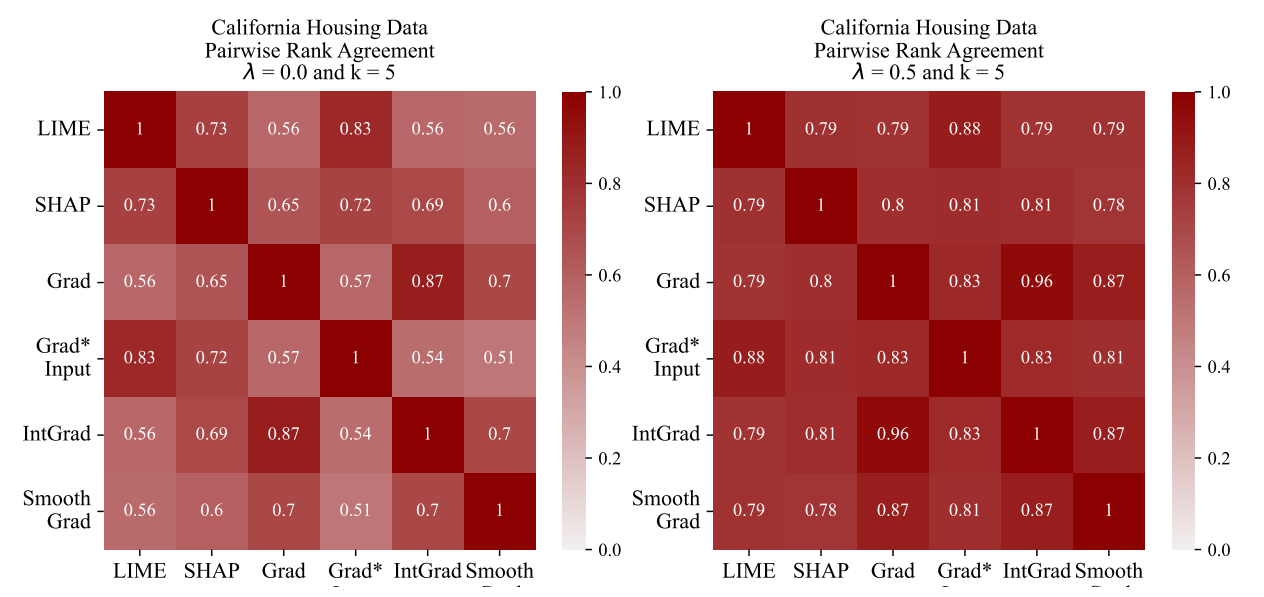
\ In Figure 4, using a visualization tool developed by Krishna et al. [15], we show how we evaluate the change in an agreement metric (pairwise rank agreement) between all pairs of explainers on the California Housing data.

\ Hypothesis: We can increase consensus by deliberately training for post hoc explainer agreement.

\ Through our experiments, we observe improved agreement metrics on unseen data and on unseen pairs of explainers. In Figure 4 we show a representative example where Pairwise Rank Agreement between Grad and IntGrad improve from 87% to 96% on unseen data. Moreover, we can look at two other explainers and see that agreement between SmoothGrad and LIME improves from 56% to 79%. This shows both generalization to unseen data and to explainers other than those explicitly used in the loss term. In Appendix A.5, we see more saturated disagreement matrices across all of our datasets and all six agreement metrics.

4.3 Consistency At What Cost?

While training for consensus works to boost agreement, a question remains: How accurate are these models?

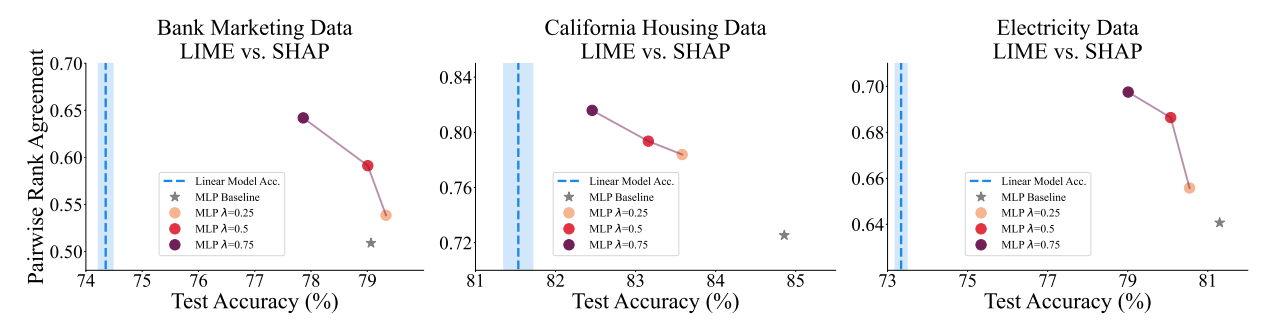
\ To address this question, we first point out that there is a tradeoff here, i.e., more consensus comes at the cost of accuracy. With this in mind we posit that there is a Pareto frontier on the accuracy-agreement axes. While we cannot assert that our models are on the Pareto frontier, we plot trade-off curves which represent the trajectory through accuracy-agreement space that is carved out by changing 𝜆.

\ Hypothesis: We can increase consensus with an acceptable drop in accuracy

\ While this hypothesis is phrased as a subjective claim, in reality we define acceptable performance as better than a linear model as explained at the beginning of Section 4. We see across all three datasets that increasing the consensus loss weight 𝜆 leads to higher pairwise rank agreement between LIME and SHAP. Moreover, even with high values of 𝜆, the accuracy stays well above linear models indicating that the loss in performance is acceptable. Therefore this experiment supports the hypothesis.

\ The results plotted in Figure 5 demonstrate that a practitioner concerned with agreement can tune 𝜆 to meet their needs of accuracy and agreement. This figure serves in part to illuminate why our

\ Figure 4: When models are trained naturally, we see disagreement among post hoc explainers (left). However, when trained with our loss function, we see a boost in agreement with only a small cost in accuracy (right). This can be observed visually by the increase in saturation or in more detail by comparing the numbers in corresponding squares.
\ Figure 5: The trade-off curves of consensus and accuracy. Increasing the consensus comes with a drop in accuracy and the trade-off is such that we can achieve more agreement and still outperform linear baselines. Moreover, as we vary the 𝜆 value, we move along the trade-off curve. In all three plots we measure agreement with the pairwise rank agreement metric and we show that increased consensus comes with a drop in accuracy, but all of our models are still more accurate than the linear baseline, indicated by the vertical dashed line (the shaded region shows ± one standard error).

\ hyperparameter choice is sensible—𝜆 gives us control to slide along the trade-off curve, making post hoc explanation disagreement more of a controllable model parameter so that practitioners have more flexibility to make context-specific model design decisions.

\

:::info Authors:

(1) Avi Schwarzschild, University of Maryland, College Park, Maryland, USA and Work completed while working at Arthur (avi1umd.edu);

(2) Max Cembalest, Arthur, New York City, New York, USA;

(3) Karthik Rao, Arthur, New York City, New York, USA;

(4) Keegan Hines, Arthur, New York City, New York, USA;

(5) John Dickerson†, Arthur, New York City, New York, USA ([email protected]).

:::


:::info This paper is available on arxiv under CC BY 4.0 DEED license.

:::

\

Disclaimer: The articles reposted on this site are sourced from public platforms and are provided for informational purposes only. They do not necessarily reflect the views of MEXC. All rights remain with the original authors. If you believe any content infringes on third-party rights, please contact [email protected] for removal. MEXC makes no guarantees regarding the accuracy, completeness, or timeliness of the content and is not responsible for any actions taken based on the information provided. The content does not constitute financial, legal, or other professional advice, nor should it be considered a recommendation or endorsement by MEXC.

You May Also Like

Solana Price Stalls as Validator and Address Counts Collapse

Solana Price Stalls as Validator and Address Counts Collapse

The post Solana Price Stalls as Validator and Address Counts Collapse  appeared on BitcoinEthereumNews.com. Since mid-November, the Solana price has been resonating within a narrow consolidation of $145 and $125. Solana’s validator count collapsed from 2,500 to ~800 over two years, raising questions about economic sustainability. The number of active addresses on the Solana network recorded a sharp decline from 9.08 million in January 2025 to 3.75 million now, indicating a drop in user participation. On Tuesday, the crypto market witnessed a notable spike in buying pressure, leading major assets like Bitcoin, Ethereum, and Solana to a fresh recovery. However, the Solana price faced renewed selling at $145, evidenced by a long-wick rejection in the daily candle. The headwinds can be linked to networks facing scrutiny following a notable decline in active validators and active addresses.  Validator Exodus Exposes Economic Pressure on Solana Operators The layer-1 blockchain Solana has witnessed a sharp decline in the number of its validators from 2,500 in early 2023 to around 800 in late 2025, according to Solanacompass data. The collapse has caused an ecosystem divide between opposing camps. One side lauds the trend, arguing that the exodus comprises nearly exclusively unreal identities and poor-quality nodes that were gaming rewards without providing real hardware and uptime. In their view, narrowing the list down to a smaller number of committed validators strengthened the network rather than cooled it down. Infrastructure providers that work directly with node operators have a different story to tell. Teams like Layer 33, which is a collective of 25 independent Solana validators, say, “We personally know the teams shutting down. It is not mostly Sybils.” These operators cited increasing server costs, thin staking yields because of commission cuts, and increasing complexity of keeping nodes profitable as reasons for shutting down. Both sides agree on one thing: raw validator numbers don’t tell us much in and of…
Share
BitcoinEthereumNews2025/12/10 12:05
Surges to $94K One Day Ahead of Expected Fed Rate Cut

Surges to $94K One Day Ahead of Expected Fed Rate Cut

The post Surges to $94K One Day Ahead of Expected Fed Rate Cut appeared on BitcoinEthereumNews.com. What started as a slow U.S. morning on crypto markets has taken a quick turn, with bitcoin BTC$92,531.15 re-taking the $94,000 level. Hovering just above $90,000 earlier in the day, the largest crypto surged back to $94,000 minutes after 16:00 UTC, gaining more than $3,000 in less than an hour and up 4% over the past 24 hours. Ethereum’s ether ETH$3,125.08 jumped 5% during the same period, while native tokens of ADA$0.4648 and Chainlink LINK$14.25 climbed even more. The action went down while silver climbed to fresh record highs above $60 per ounce. While broader equity markets remained flat, crypto stocks followed bitcoin’s advance. Digital asset investment firm Galaxy (GLXY) and bitcoin miner CleanSpark (CLSK) led with gains of more than 10%, while Coinbase (COIN), Strategy (MSTR) and BitMine (BMNR) were up 4%-6%. While there was no single obvious catalyst for the quick move higher, BTC for weeks has been mostly selling off alongside the open of U.S. markets. Today’s change of pattern could point to seller exhaustion. Vetle Lunde, lead analyst at K33 Research, pointed to “deeply defensive” positioning on crypto derivatives markets with investors concerned about further weakness, and crowded positioning possibly contributing to the quick snapback. Further signs of bear market capitulation also emerged on Tuesday with Standard Chartered bull Geoff Kendrick slashing his outlook for the price of bitcoin for the next several years. The Coinbase bitcoin premium, which shows the BTC spot price difference on U.S.-centric exchange Coinbase and offshore exchange Binance, has also turned positive over the past few days, signaling U.S. investor demand making a comeback. Looking deeper into market structure, BTC’s daily price gain outpaced the rise in open interest on the derivatives market, suggesting that spot demand is fueling the rally instead of leverage. The Federal Reserve is expected to lower…
Share
BitcoinEthereumNews2025/12/10 11:51