Polkadot (DOT) is preparing to launch a new stablecoin, pUSD, through the RFC-155 proposal. The Polkadot community is championing pUSD as a key solution to unleash its DeFi potential, cut dependence on USDT/USDC, and boost ecosystem autonomy. However, some are concerned that they might repeat past mistakes. pUSD is an over-collateralized stablecoin fully backed by DOT, deployed on Asset Hub, and using the Honzon protocol developed by Acala. Acala is the former issuer of aUSD, a stablecoin project that failed disastrously. Can pUSD Stablecoin Avoid the Same Fate as aUSD? Reusing Honzon – the framework Acala previously relied on to issue aUSD is raising concerns. That incident eroded trust in the Acala team, with some even accusing them of “blaming a hack” while failing to compensate users adequately. “Acala’s stablecoin (aUSD) launch was a complete disaster and it really killed my trust in the team. I don’t see myself supporting their project anymore. What I’d love to see is a proper, reliable, native solution. Honestly, it’s frustrating that with all the talent in the Polkadot/Substrate space, nobody has managed to build something better yet.” – A community member shared. Approval rate of the proposal at the time of writing. Source: Polkadot Even those who support Polkadot launching its native stablecoin still see Honzon and Acala as lessons that cannot be ignored. They propose the project should “move forward independently from the Acala team.” In addition, they call for the Technical Council to take clear responsibility for governance. “With these assurances, I would be prepared to vote AYE. Without them, the risk of repeating past mistakes is too great.” Another member noted. Too Many Risks Setting aside concerns about Honzon and the Acala team, Polkadot’s pUSD also faces skepticism within the community. One primary reason is the structure that DOT solely backs it. While the exact overcollateralization ratio remains unclear, this could trigger liquidation cascades and add selling pressure on the token. Although the pUSD model is safer than Terra’s UST because it is overcollateralized, relying only on DOT as collateral introduces significant risks. Previously, MakerDAO’s DAI also started as ETH-only collateral. But today, MakerDAO supports Multi-Collateral DAI (MCD). They allow users to back DAI with crypto assets such as ETH, WBTC, LINK, UNI, stETH, and even Real World Assets (RWAs) like US Treasuries. “Backed only by DOT, which could trigger liquidation cascades and add additional selling pressure on the token. Remember the notorious DAI depeg in 2020, which forced MakerDAO to diversify its collateral.” A user on X commented. Additionally, another X user pointed out that the Polkadot ecosystem already has more advanced native solutions like HOLLAR. The Hydration runtime builds this stablecoin, optimizes it for appchains, and positions it as superior to the legacy aUSD architecture. Therefore, many argue that instead of repeating a “regular” EVM model, Polkadot should leverage its unique strengths. This would enable the creation of a stable, secure solution worthy of its ecosystem’s potential. pUSD is undoubtedly a strategic move by Polkadot to unlock DeFi potential. It could bring significant benefits if it proves secure and sees widespread adoption in the ecosystem. However, the ghost of aUSD’s failure continues to cast doubt within the community. To avoid repeating the same mistakes, Polkadot must work to dispel those lingering concerns. The fact that the DOT supply is capped at 2.1 billion, as reported by BeInCrypto, could help fuel the ecosystem’s growth.Polkadot (DOT) is preparing to launch a new stablecoin, pUSD, through the RFC-155 proposal. The Polkadot community is championing pUSD as a key solution to unleash its DeFi potential, cut dependence on USDT/USDC, and boost ecosystem autonomy. However, some are concerned that they might repeat past mistakes. pUSD is an over-collateralized stablecoin fully backed by DOT, deployed on Asset Hub, and using the Honzon protocol developed by Acala. Acala is the former issuer of aUSD, a stablecoin project that failed disastrously. Can pUSD Stablecoin Avoid the Same Fate as aUSD? Reusing Honzon – the framework Acala previously relied on to issue aUSD is raising concerns. That incident eroded trust in the Acala team, with some even accusing them of “blaming a hack” while failing to compensate users adequately. “Acala’s stablecoin (aUSD) launch was a complete disaster and it really killed my trust in the team. I don’t see myself supporting their project anymore. What I’d love to see is a proper, reliable, native solution. Honestly, it’s frustrating that with all the talent in the Polkadot/Substrate space, nobody has managed to build something better yet.” – A community member shared. Approval rate of the proposal at the time of writing. Source: Polkadot Even those who support Polkadot launching its native stablecoin still see Honzon and Acala as lessons that cannot be ignored. They propose the project should “move forward independently from the Acala team.” In addition, they call for the Technical Council to take clear responsibility for governance. “With these assurances, I would be prepared to vote AYE. Without them, the risk of repeating past mistakes is too great.” Another member noted. Too Many Risks Setting aside concerns about Honzon and the Acala team, Polkadot’s pUSD also faces skepticism within the community. One primary reason is the structure that DOT solely backs it. While the exact overcollateralization ratio remains unclear, this could trigger liquidation cascades and add selling pressure on the token. Although the pUSD model is safer than Terra’s UST because it is overcollateralized, relying only on DOT as collateral introduces significant risks. Previously, MakerDAO’s DAI also started as ETH-only collateral. But today, MakerDAO supports Multi-Collateral DAI (MCD). They allow users to back DAI with crypto assets such as ETH, WBTC, LINK, UNI, stETH, and even Real World Assets (RWAs) like US Treasuries. “Backed only by DOT, which could trigger liquidation cascades and add additional selling pressure on the token. Remember the notorious DAI depeg in 2020, which forced MakerDAO to diversify its collateral.” A user on X commented. Additionally, another X user pointed out that the Polkadot ecosystem already has more advanced native solutions like HOLLAR. The Hydration runtime builds this stablecoin, optimizes it for appchains, and positions it as superior to the legacy aUSD architecture. Therefore, many argue that instead of repeating a “regular” EVM model, Polkadot should leverage its unique strengths. This would enable the creation of a stable, secure solution worthy of its ecosystem’s potential. pUSD is undoubtedly a strategic move by Polkadot to unlock DeFi potential. It could bring significant benefits if it proves secure and sees widespread adoption in the ecosystem. However, the ghost of aUSD’s failure continues to cast doubt within the community. To avoid repeating the same mistakes, Polkadot must work to dispel those lingering concerns. The fact that the DOT supply is capped at 2.1 billion, as reported by BeInCrypto, could help fuel the ecosystem’s growth.

Polkadot Bets on pUSD Stablecoin — But Can It Escape aUSD’s Shadow?

2025/09/29 11:00

Polkadot (DOT) is preparing to launch a new stablecoin, pUSD, through the RFC-155 proposal. The Polkadot community is championing pUSD as a key solution to unleash its DeFi potential, cut dependence on USDT/USDC, and boost ecosystem autonomy.

However, some are concerned that they might repeat past mistakes. pUSD is an over-collateralized stablecoin fully backed by DOT, deployed on Asset Hub, and using the Honzon protocol developed by Acala. Acala is the former issuer of aUSD, a stablecoin project that failed disastrously.

Can pUSD Stablecoin Avoid the Same Fate as aUSD?

Reusing Honzon – the framework Acala previously relied on to issue aUSD is raising concerns. That incident eroded trust in the Acala team, with some even accusing them of “blaming a hack” while failing to compensate users adequately.
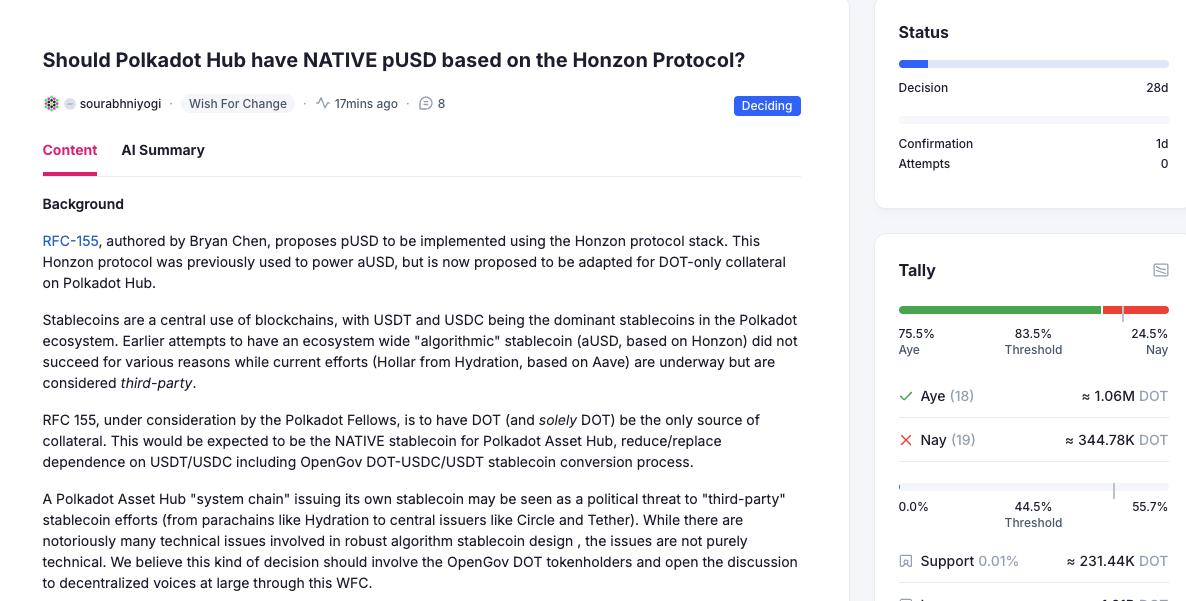
Approval rate of the proposal at the time of writing. Source: PolkadotApproval rate of the proposal at the time of writing. Source: Polkadot

Even those who support Polkadot launching its native stablecoin still see Honzon and Acala as lessons that cannot be ignored. They propose the project should “move forward independently from the Acala team.” In addition, they call for the Technical Council to take clear responsibility for governance.

Too Many Risks

Setting aside concerns about Honzon and the Acala team, Polkadot’s pUSD also faces skepticism within the community. One primary reason is the structure that DOT solely backs it.

While the exact overcollateralization ratio remains unclear, this could trigger liquidation cascades and add selling pressure on the token. Although the pUSD model is safer than Terra’s UST because it is overcollateralized, relying only on DOT as collateral introduces significant risks.

Previously, MakerDAO’s DAI also started as ETH-only collateral. But today, MakerDAO supports Multi-Collateral DAI (MCD). They allow users to back DAI with crypto assets such as ETH, WBTC, LINK, UNI, stETH, and even Real World Assets (RWAs) like US Treasuries.

Additionally, another X user pointed out that the Polkadot ecosystem already has more advanced native solutions like HOLLAR. The Hydration runtime builds this stablecoin, optimizes it for appchains, and positions it as superior to the legacy aUSD architecture. Therefore, many argue that instead of repeating a “regular” EVM model, Polkadot should leverage its unique strengths. This would enable the creation of a stable, secure solution worthy of its ecosystem’s potential.

pUSD is undoubtedly a strategic move by Polkadot to unlock DeFi potential. It could bring significant benefits if it proves secure and sees widespread adoption in the ecosystem. However, the ghost of aUSD’s failure continues to cast doubt within the community.

To avoid repeating the same mistakes, Polkadot must work to dispel those lingering concerns. The fact that the DOT supply is capped at 2.1 billion, as reported by BeInCrypto, could help fuel the ecosystem’s growth.

Disclaimer: The articles reposted on this site are sourced from public platforms and are provided for informational purposes only. They do not necessarily reflect the views of MEXC. All rights remain with the original authors. If you believe any content infringes on third-party rights, please contact [email protected] for removal. MEXC makes no guarantees regarding the accuracy, completeness, or timeliness of the content and is not responsible for any actions taken based on the information provided. The content does not constitute financial, legal, or other professional advice, nor should it be considered a recommendation or endorsement by MEXC.

You May Also Like

Ripple Buyers Step In at $2.00 Floor on BTC’s Hover Above $91K

Ripple Buyers Step In at $2.00 Floor on BTC’s Hover Above $91K

The post Ripple Buyers Step In at $2.00 Floor on BTC’s Hover Above $91K appeared on BitcoinEthereumNews.com. Token breaks above key support while volume surges 251% during psychological level defense at $2.00. News Background U.S. spot XRP ETFs continue pulling in uninterrupted inflows, with cumulative demand now exceeding $1 billion since launch — the fastest early adoption pace for any altcoin ETF. Institutional participation remains strong even as retail sentiment remains muted, contributing to market conditions where large players accumulate during weakness while short-term traders hesitate to re-enter. XRP’s macro environment remains dominated by capital rotation into regulated products, with ETF demand offsetting declining open interest in derivatives markets. Technical Analysis The defining moment of the session came during the $2.03 → $2.00 flush when volume spiked to 129.7M — 251% above the 24-hour average. This confirmed heavy selling pressure but, more importantly, marked the exact moment where institutional buyers absorbed liquidity at the psychological floor. The V-shaped rebound from $2.00 back into the $2.07–$2.08 range validates active demand at this level. XRP continues to form a series of higher lows on intraday charts, signaling early trend reacceleration. However, failure to break through the $2.08–$2.11 resistance cluster shows lingering supply overhead as the market awaits a decisive catalyst. Momentum indicators show bullish divergence forming, but volume needs to expand during upside moves rather than only during downside flushes to confirm a sustainable breakout. Price Action Summary XRP traded between $2.00 and $2.08 across the 24-hour window, with a sharp selloff testing the psychological floor before immediate absorption. Three intraday advances toward $2.08 failed to clear resistance, keeping price capped despite improving structure. Consolidation near $2.06–$2.08 into the session close signals stabilization above support, though broader range compression persists. What Traders Should Know The $2.00 level remains the most important line in the sand — both technically and psychologically. Institutional accumulation beneath this threshold hints at larger players…
Share
BitcoinEthereumNews2025/12/08 13:22
China Blocks Nvidia’s RTX Pro 6000D as Local Chips Rise

China Blocks Nvidia’s RTX Pro 6000D as Local Chips Rise

The post China Blocks Nvidia’s RTX Pro 6000D as Local Chips Rise appeared on BitcoinEthereumNews.com. China Blocks Nvidia’s RTX Pro 6000D as Local Chips Rise China’s internet regulator has ordered the country’s biggest technology firms, including Alibaba and ByteDance, to stop purchasing Nvidia’s RTX Pro 6000D GPUs. According to the Financial Times, the move shuts down the last major channel for mass supplies of American chips to the Chinese market. Why Beijing Halted Nvidia Purchases Chinese companies had planned to buy tens of thousands of RTX Pro 6000D accelerators and had already begun testing them in servers. But regulators intervened, halting the purchases and signaling stricter controls than earlier measures placed on Nvidia’s H20 chip. Image: Nvidia An audit compared Huawei and Cambricon processors, along with chips developed by Alibaba and Baidu, against Nvidia’s export-approved products. Regulators concluded that Chinese chips had reached performance levels comparable to the restricted U.S. models. This assessment pushed authorities to advise firms to rely more heavily on domestic processors, further tightening Nvidia’s already limited position in China. China’s Drive Toward Tech Independence The decision highlights Beijing’s focus on import substitution — developing self-sufficient chip production to reduce reliance on U.S. supplies. “The signal is now clear: all attention is focused on building a domestic ecosystem,” said a representative of a leading Chinese tech company. Nvidia had unveiled the RTX Pro 6000D in July 2025 during CEO Jensen Huang’s visit to Beijing, in an attempt to keep a foothold in China after Washington restricted exports of its most advanced chips. But momentum is shifting. Industry sources told the Financial Times that Chinese manufacturers plan to triple AI chip production next year to meet growing demand. They believe “domestic supply will now be sufficient without Nvidia.” What It Means for the Future With Huawei, Cambricon, Alibaba, and Baidu stepping up, China is positioning itself for long-term technological independence. Nvidia, meanwhile, faces…
Share
BitcoinEthereumNews2025/09/18 01:37