The cost model leverages SMT‑based solving (Z3) to achieve optimal decoding speed under CPU, I/O, and memory constraints.The cost model leverages SMT‑based solving (Z3) to achieve optimal decoding speed under CPU, I/O, and memory constraints.

How PowerInfer‑2 Turns Your Smartphone Into an AI Workstation

2025/11/04 03:56

Abstract and 1. Introduction

  1. Background and Motivation
  2. PowerInfer-2 Overview
  3. Neuron-Aware Runtime Inference
  4. Execution Plan Generation
  5. Implementation
  6. Evaluation
  7. Related Work
  8. Conclusion and References

5 Execution Plan Generation

Today’s smartphones are equipped with a variety of hardware specifications, such as differing CPU capabilities, I/O throughput, and DRAM sizes. Users deploying LLMs on these devices also have diverse objectives. Some may prioritize a balance between generation speed and memory usage, while others aim to maximize hardware utilization for increased speed. Additionally, the models themselves vary in weight numbers, structures, and sparsity levels. To manage this complexity, PowerInfer-2 includes an offline planner specifically designed to develop execution plans that optimally meet these varied requirements.

\

5.1 Execution Plan

\

5.2 Input Parameters

Table 2 also lists three categories of input parameters:

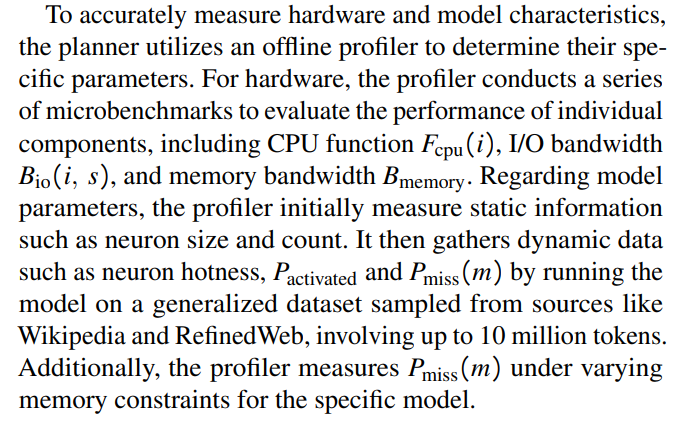
\ • Hardware: Parameters profiled from the hardware, such as CPU FLOPS, I/O throughput, and memory bandwidth.

\ • User: Parameters specified by the user, such as CPU constraints, memory limit, and lower bound of decoding speed.

\ • Model: Parameters about the model collected by an offline profiler, such as the size of the model, sparsity levels and caching characteristics, etc.

\
\

5.3 Cost Model

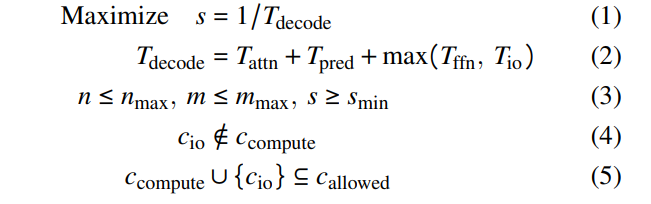
After collecting the input parameters, the planner uses a cost model to generate the execution plan. The goal is to maximize the generation speed s (as defined by Equation 1) while adhering to user-specified constraints (Formulas 3-5). The decoding speed s is inversely proportional to the time taken to decode one token (Equation 1), which is determined by the computation times for that token (Equation 2), as we efficiently overlap the computation and I/O operations. As we have defined the objective function and the constraints, the constructed model can be solved by mature SMT solvers. In our implementation, we utilize the Z3 solver [11] to solve the cost model.

\
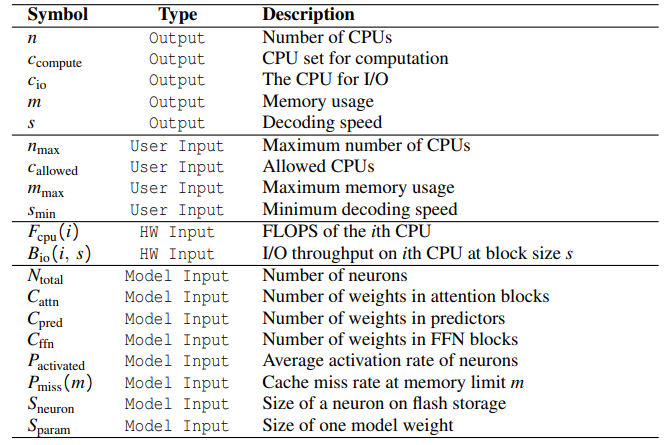
\ To compute the decoding time, we first model the times for computation. As we observed that memory opeartion is not a significant factor compared to the computation, we do not consider it in the computation time. Computation time (Equation 6) is primarily influenced by the attention blocks, predictors, and FFN blocks. The calculation involves dividing the computational workload of these components by the CPU flops (defined in Equation 7- 8). The flops of the selected CPU cores are specified in Equations 9.

\
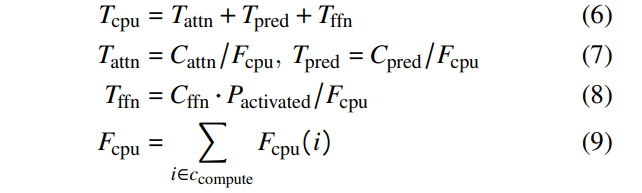
\ Table 2: Symbols used in execution planning.
\ As FFN block computation overlaps with neuron loading, the planner must also account for I/O transmission time. This is calculated by dividing the volume of neurons transferred from flash storage (Equation 10) by the I/O bandwidth. This transferred volume depends on both the activation rate and the cache miss rate.

\

\ Finally, the planner calculates the time to load neurons from memory, which relates to the weight sizes of attention blocks, predictors, and neurons activated at runtime. The memory time is determined by dividing the total weight of activated neurons for one token by the memory bandwidth (Equation 11).

\

6 Implementation

PowerInfer-2 is developed on top of PowerInfer [30], a stateof-the-art serving framework designed for sparsely-activated LLMs, by integrating an additional 12K lines of C++ code into PowerInfer [30]. These enhancements encompass several key areas, including the polymorphic neuron engine, neuron cache, flexible neuron loading, and neuron-cluster-level I/O pipeline.

\ Since PowerInfer-2 depends on privileged system APIs (e.g., mlock that locks pages in memory) that needs the root permission, we built it on the Android [5] platform. Even though there is no need to alter the system kernel, a rooted Android system still provides us with considerable flexibility in developing and debugging our system. Furthermore, PowerInfer-2 is inherently designed with no modifications to the kernel, making it easily portable to other operating systems, including iOS [14] platform.

\ The current implementation of PowerInfer-2 supports a diverse array of LLMs with varying model sizes, including Llama-2 family [27] (7B, 13B), TurboSparse-Mistral [31] (7B), and TurboSparse-Mixtral [31] (47B).

\ Table 3: Hardware specifications of smartphones we used in the evaluation. “DRAM” is the physical memory size. “Available” is the maximum memory size that can be occupied by an application.

\

:::info Authors:

(1) Zhenliang Xue, Co-first author from Institute of Parallel and Distributed Systems (IPADS), Shanghai Jiao Tong University;

(2) Yixin Song, Co-first author from Institute of Parallel and Distributed Systems (IPADS), Shanghai Jiao Tong University;

(3) Zeyu Mi, Institute of Parallel and Distributed Systems (IPADS), Shanghai Jiao Tong University ([email protected]);

(4) Le Chen, Institute of Parallel and Distributed Systems (IPADS), Shanghai Jiao Tong University;

(5) Yubin Xia, Institute of Parallel and Distributed Systems (IPADS), Shanghai Jiao Tong University;

(6) Haibo Chen, Institute of Parallel and Distributed Systems (IPADS), Shanghai Jiao Tong University.

:::


:::info This paper is available on arxiv under CC BY 4.0 license.

:::

\

Disclaimer: The articles reposted on this site are sourced from public platforms and are provided for informational purposes only. They do not necessarily reflect the views of MEXC. All rights remain with the original authors. If you believe any content infringes on third-party rights, please contact [email protected] for removal. MEXC makes no guarantees regarding the accuracy, completeness, or timeliness of the content and is not responsible for any actions taken based on the information provided. The content does not constitute financial, legal, or other professional advice, nor should it be considered a recommendation or endorsement by MEXC.

You May Also Like

“I Wasted 8 Years in Crypto”: A Builder’s Exit Note Goes Viral Across Asia

“I Wasted 8 Years in Crypto”: A Builder’s Exit Note Goes Viral Across Asia

The post “I Wasted 8 Years in Crypto”: A Builder’s Exit Note Goes Viral Across Asia appeared on BitcoinEthereumNews.com. “I am NOT building a new financial system. I built a casino.”This stark admission from Ken Chan, former co-founder of derivatives protocol Aevo, has been reverberating across Asian crypto communities this week. What began as a post on X has now crossed linguistic borders, been introduced to Chinese communities by local news media, and been widely shared among Korean traders, accumulating millions of views along the way. Sponsored Sponsored From Ayn Rand to Disillusionment: A Libertarian’s Journey Through Crypto Chan’s confession is not merely a critique—it is the unraveling of a personal ideology. He describes himself as a “starry-eyed libertarian” who donated to Gary Johnson’s 2016 presidential campaign after being radicalized by Ayn Rand’s novels. The cypherpunk ethos of Bitcoin spoke directly to this worldview. “Being able to walk across the border with a billion dollars in your head is and always will be a powerful idea to me,” he writes. Yet eight years of industry experience eroded that idealism. Chan recounts how the Layer 1 wars—the flood of capital into Aptos, Sui, Sei, ICP, and countless others—produced no meaningful progress toward a new financial system. Instead, it “literally torched everyone’s money” in pursuit of becoming the next Solana. His verdict is unsparing: “We do not need to build the Casino on Mars.” According to his LinkedIn profile, Chan departed Aevo in May this year. His personal website indicates he is now working on KENSAT, a personal satellite project. It is scheduled to launch aboard a Falcon 9 in June 2026. His confession arrives six months after his departure. It comes as AEVO token trades at roughly $45 million in fully diluted market cap—down approximately 99% from its peak. Chan’s central metaphor—that crypto has become “the biggest, online, multi-player 24/7 casino our generation has ever concocted”—cuts through technical complexity with…
Share
BitcoinEthereumNews2025/12/10 11:04
How A 130-Year-Old Course Reimagined The Golf Experience

How A 130-Year-Old Course Reimagined The Golf Experience

The post How A 130-Year-Old Course Reimagined The Golf Experience appeared on BitcoinEthereumNews.com. An aerial view of Storm King Golf Club, a reimagined golf experience that’s scheduled to open in 2026. Erik Matuszewski In the rolling hills of New York’s Hudson Valley, just 56 miles from Manhattan and minutes from West Point, a revolutionary new golf course is reimagining how golf can be played, experienced, and shared. Named after the nearby mountain that overlooks the property, Storm King Golf Club packs more variety and possibility in 63 acres than many courses four times its size, offering 40 distinct hole configurations, five different 9-hole routing options, and a 19-hole par 3 layout. “The idea was to create a unique place where people could experience golf in a way that’s fun and interesting to them,” said founder David Gang, a software executive who purchased the course about five years ago with a vision to reimagine golf and challenge convention along the way. Storm King is a far cry from the original facility that opened in 1894; today, it’s a wild looking, choose-your-own-adventure playground where golfers can craft their journey based on skill level, mood, or simple curiosity about what lies around the next bend. The facility boasts 12 green complexes totaling 225,000 square feet of putting surface, nearly four times that of an iconic property like Pebble Beach Golf Links, which has 63,000 square feet across all 18 holes. “Our brains have been wired for golf in a very traditional way forever,” says Gang, an avid golfer who co-founded Brightspot, a leading content management system. There are unusual design shapes and unique routing options at Storm King, which was built to focus on versatility, playability and sustainability. Erik Matuszewski “We think about 9 holes, 18 holes, par 3s, par 4s, and par 5s. They’re very set in our minds,” he added. “So, when you come…
Share
BitcoinEthereumNews2025/09/18 18:44