A cryptocurrency analyst has pointed out how the next XRP support may be $1.2 if the lower level of the asset’s Parallel Channel breaks down. XRP Is Currently Above A Parallel Channel’s Support Level In a new post on X, analyst Ali Martinez has shared a pattern that has been forming in the 3-day price of XRP. The pattern in question is a Parallel Channel, a type of consolidation channel in technical analysis (TA). Related Reading: Bitcoin Blasts To $92,000, Liquidating $182 Million In Shorts A Parallel Channel appears whenever an asset’s price consolidates between two parallel trendlines. The upper level of the pattern tends to be a source of resistance, while the lower one that of support. Together, the two lines keep the asset locked in the range between them. Either of the levels not holding up can imply a continuation of the trend in that direction. This breakout is bullish when the price breaks the upper level, while bearish in the case of the lower one. Based on how the channel is aligned relative to the graph axes, Parallel Channels can be divided into a few types. The Ascending Channel corresponds to the case when the channel has a positive slope. Similarly, the Descending Channel is the type where consolidation occurs to a net downside. The channel that XRP has been following over the past year falls in neither category, however, as it belongs to the third and simplest case: a Parallel Channel that’s also parallel to the time-axis. This pattern naturally signifies a phase of true sideways movement in the price. Now, here is the chart shared by Martinez that shows the Parallel Channel that the 3-day price of XRP is trading inside: As displayed in the above graph, the 3-day XRP price recently retested the Parallel Channel’s lower level situated at $2. The coin has since rebounded, indicating that support is holding for now. In the scenario that the coin returns to the level and a retest fails, the analyst has noted that the next level that stands out is the $1.2 level. This level and the support line are separated by the same distance as the height of the Parallel Channel. It now remains to be seen how XRP will develop in the near future and whether the rebound will continue to hold. Related Reading: Bitcoin Long-Term Holders See First Uptick Since April Lows: Bullish Sign? XRP isn’t the only cryptocurrency that has been following a Parallel Channel recently. As Martinez has pointed out in another X post, Ethereum‘s daily price has seemingly been trading inside such a pattern for a few years now. XRP Price XRP has shot up alongside the rest of the cryptocurrency sector as its price has recovered to $2.17. Featured image from Dall-E, charts from TradingView.comA cryptocurrency analyst has pointed out how the next XRP support may be $1.2 if the lower level of the asset’s Parallel Channel breaks down. XRP Is Currently Above A Parallel Channel’s Support Level In a new post on X, analyst Ali Martinez has shared a pattern that has been forming in the 3-day price of XRP. The pattern in question is a Parallel Channel, a type of consolidation channel in technical analysis (TA). Related Reading: Bitcoin Blasts To $92,000, Liquidating $182 Million In Shorts A Parallel Channel appears whenever an asset’s price consolidates between two parallel trendlines. The upper level of the pattern tends to be a source of resistance, while the lower one that of support. Together, the two lines keep the asset locked in the range between them. Either of the levels not holding up can imply a continuation of the trend in that direction. This breakout is bullish when the price breaks the upper level, while bearish in the case of the lower one. Based on how the channel is aligned relative to the graph axes, Parallel Channels can be divided into a few types. The Ascending Channel corresponds to the case when the channel has a positive slope. Similarly, the Descending Channel is the type where consolidation occurs to a net downside. The channel that XRP has been following over the past year falls in neither category, however, as it belongs to the third and simplest case: a Parallel Channel that’s also parallel to the time-axis. This pattern naturally signifies a phase of true sideways movement in the price. Now, here is the chart shared by Martinez that shows the Parallel Channel that the 3-day price of XRP is trading inside: As displayed in the above graph, the 3-day XRP price recently retested the Parallel Channel’s lower level situated at $2. The coin has since rebounded, indicating that support is holding for now. In the scenario that the coin returns to the level and a retest fails, the analyst has noted that the next level that stands out is the $1.2 level. This level and the support line are separated by the same distance as the height of the Parallel Channel. It now remains to be seen how XRP will develop in the near future and whether the rebound will continue to hold. Related Reading: Bitcoin Long-Term Holders See First Uptick Since April Lows: Bullish Sign? XRP isn’t the only cryptocurrency that has been following a Parallel Channel recently. As Martinez has pointed out in another X post, Ethereum‘s daily price has seemingly been trading inside such a pattern for a few years now. XRP Price XRP has shot up alongside the rest of the cryptocurrency sector as its price has recovered to $2.17. Featured image from Dall-E, charts from TradingView.com

Next Key XRP Level Could Be $1.2 If Current Support Fails, Says Analyst

2025/12/04 12:00

A cryptocurrency analyst has pointed out how the next XRP support may be $1.2 if the lower level of the asset’s Parallel Channel breaks down.

XRP Is Currently Above A Parallel Channel’s Support Level

In a new post on X, analyst Ali Martinez has shared a pattern that has been forming in the 3-day price of XRP. The pattern in question is a Parallel Channel, a type of consolidation channel in technical analysis (TA).

A Parallel Channel appears whenever an asset’s price consolidates between two parallel trendlines. The upper level of the pattern tends to be a source of resistance, while the lower one that of support. Together, the two lines keep the asset locked in the range between them.

Either of the levels not holding up can imply a continuation of the trend in that direction. This breakout is bullish when the price breaks the upper level, while bearish in the case of the lower one.

Based on how the channel is aligned relative to the graph axes, Parallel Channels can be divided into a few types. The Ascending Channel corresponds to the case when the channel has a positive slope. Similarly, the Descending Channel is the type where consolidation occurs to a net downside.

The channel that XRP has been following over the past year falls in neither category, however, as it belongs to the third and simplest case: a Parallel Channel that’s also parallel to the time-axis. This pattern naturally signifies a phase of true sideways movement in the price.

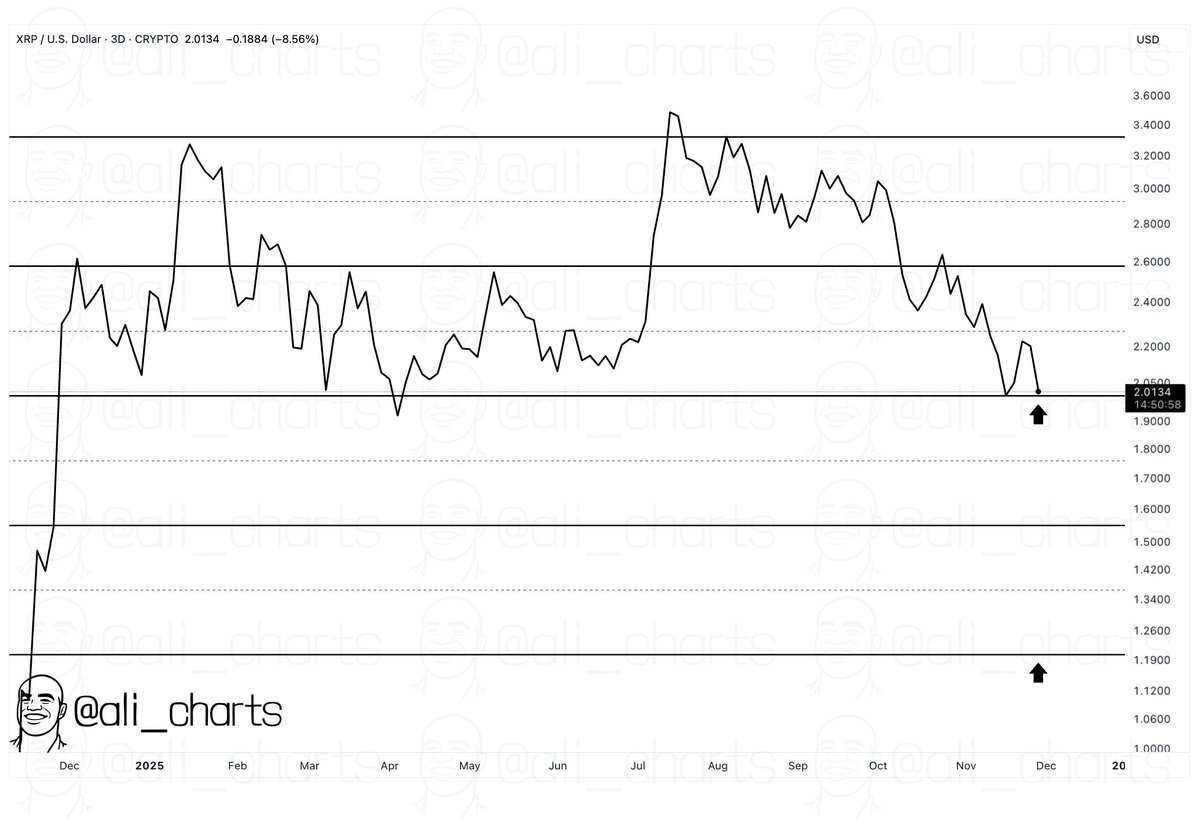
Now, here is the chart shared by Martinez that shows the Parallel Channel that the 3-day price of XRP is trading inside:
XRP Parallel Channel

As displayed in the above graph, the 3-day XRP price recently retested the Parallel Channel’s lower level situated at $2. The coin has since rebounded, indicating that support is holding for now.

In the scenario that the coin returns to the level and a retest fails, the analyst has noted that the next level that stands out is the $1.2 level. This level and the support line are separated by the same distance as the height of the Parallel Channel. It now remains to be seen how XRP will develop in the near future and whether the rebound will continue to hold.

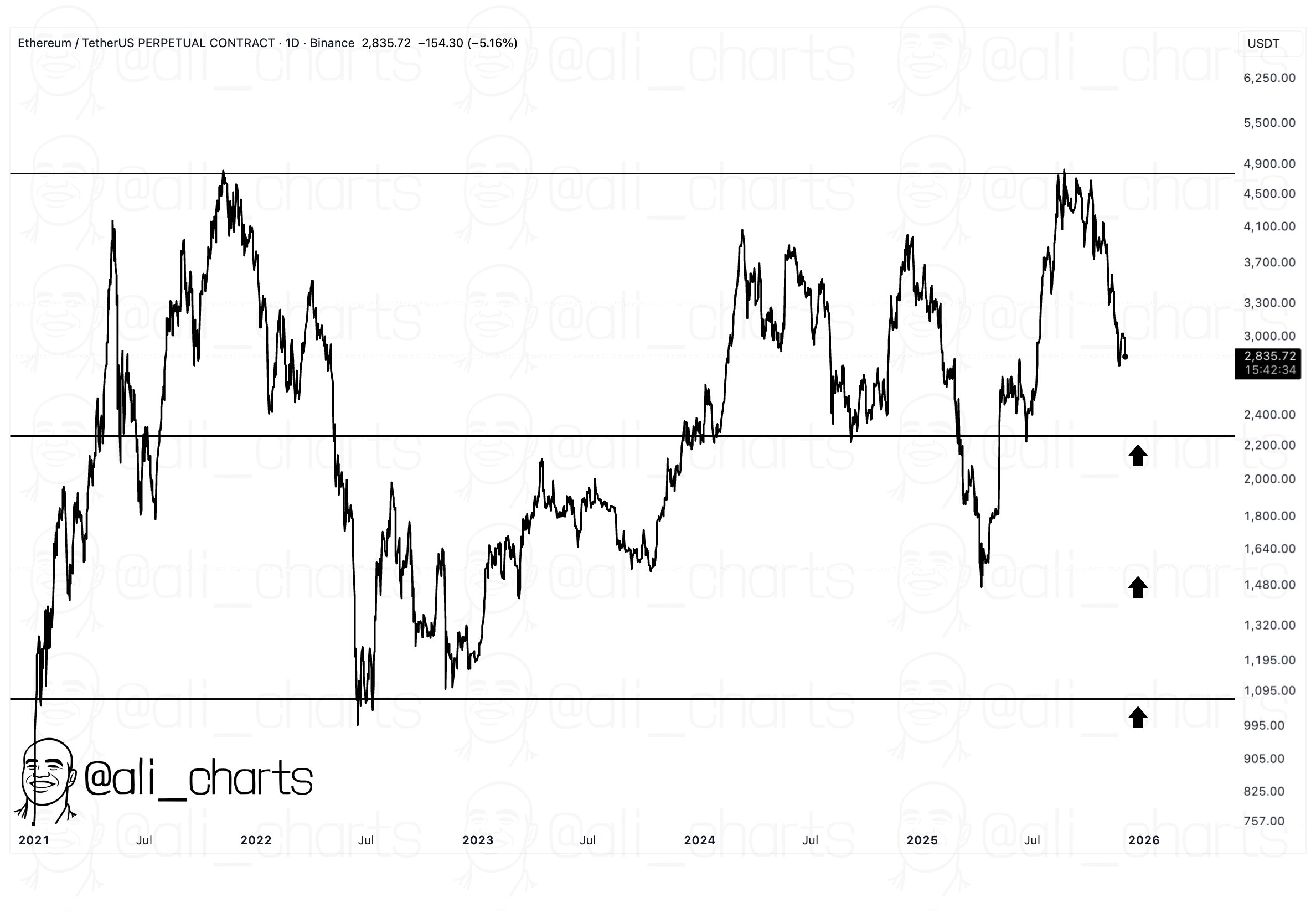
XRP isn’t the only cryptocurrency that has been following a Parallel Channel recently. As Martinez has pointed out in another X post, Ethereum‘s daily price has seemingly been trading inside such a pattern for a few years now.
Ethereum Parallel Channel

XRP Price

XRP has shot up alongside the rest of the cryptocurrency sector as its price has recovered to $2.17.

XRP Price Chart
Disclaimer: The articles reposted on this site are sourced from public platforms and are provided for informational purposes only. They do not necessarily reflect the views of MEXC. All rights remain with the original authors. If you believe any content infringes on third-party rights, please contact [email protected] for removal. MEXC makes no guarantees regarding the accuracy, completeness, or timeliness of the content and is not responsible for any actions taken based on the information provided. The content does not constitute financial, legal, or other professional advice, nor should it be considered a recommendation or endorsement by MEXC.

You May Also Like

OCC Confirms Banks Can Facilitate No-Risk Crypto Transactions

OCC Confirms Banks Can Facilitate No-Risk Crypto Transactions

The post OCC Confirms Banks Can Facilitate No-Risk Crypto Transactions appeared on BitcoinEthereumNews.com. U.S. national banks have been passed by the Office of the Comptroller of the Currency (OCC) to enable their customers perform instant crypto trades with no risk. This decision has cleared a significant obstacle in the way of banks that desire to be part of the expanding digital assets market. Banks Receive Clarity on Crypto Trading Authority  Interpretive Letter 1188 states that a bank can be an intermediary in crypto transactions without having digital assets in its possession. The OCC clarified that one client may sell a crypto asset to one bank and that bank will sell the asset to the other client at the same time. Since the two trades take place virtually at the same time the bank does not have an exposure to the market. The license provides banks with a regulated structure to provide crypto trading services. This is in line with preceding actions like enabling banks to hold major crypto assets. Another explanation that OCC provides is that the role of the bank is not to trade digital assets. Instead, the only responsibility of the bank is linking the sellers and the buyers. OCC Reinforces Bank’s Crypto Oversight The regulator mentioned that such transactions carry a limited amount of settlement risk. The decision is an update of a previous guidance that permitted crypto custody and some stablecoin transactions. The latest clarification strengthens the same allowances but indicates continued regulation of responsible crypto services in the banking space. With this, the banks are now enabled to provide customers with a secure means of accessing digital assets in compliance with federal regulations. The OCC stressed that institutions need to continue having robust risk controls, such as cybersecurity controls and compliance programs. Hence, all their operations can be safe and in line with current rules. How Institutions Might…
Share
BitcoinEthereumNews2025/12/10 07:46
Taiko Makes Chainlink Data Streams Its Official Oracle

Taiko Makes Chainlink Data Streams Its Official Oracle

The post Taiko Makes Chainlink Data Streams Its Official Oracle appeared on BitcoinEthereumNews.com. Key Notes Taiko has officially integrated Chainlink Data Streams for its Layer 2 network. The integration provides developers with high-speed market data to build advanced DeFi applications. The move aims to improve security and attract institutional adoption by using Chainlink’s established infrastructure. Taiko, an Ethereum-based ETH $4 514 24h volatility: 0.4% Market cap: $545.57 B Vol. 24h: $28.23 B Layer 2 rollup, has announced the integration of Chainlink LINK $23.26 24h volatility: 1.7% Market cap: $15.75 B Vol. 24h: $787.15 M Data Streams. The development comes as the underlying Ethereum network continues to see significant on-chain activity, including large sales from ETH whales. The partnership establishes Chainlink as the official oracle infrastructure for the network. It is designed to provide developers on the Taiko platform with reliable and high-speed market data, essential for building a wide range of decentralized finance (DeFi) applications, from complex derivatives platforms to more niche projects involving unique token governance models. According to the project’s official announcement on Sept. 17, the integration enables the creation of more advanced on-chain products that require high-quality, tamper-proof data to function securely. Taiko operates as a “based rollup,” which means it leverages Ethereum validators for transaction sequencing for strong decentralization. Boosting DeFi and Institutional Interest Oracles are fundamental services in the blockchain industry. They act as secure bridges that feed external, off-chain information to on-chain smart contracts. DeFi protocols, in particular, rely on oracles for accurate, real-time price feeds. Taiko leadership stated that using Chainlink’s infrastructure aligns with its goals. The team hopes the partnership will help attract institutional crypto investment and support the development of real-world applications, a goal that aligns with Chainlink’s broader mission to bring global data on-chain. Integrating real-world economic information is part of a broader industry trend. Just last week, Chainlink partnered with the Sei…
Share
BitcoinEthereumNews2025/09/18 03:34