NEAR Foundation launched NEAR AI Cloud and Private Chat to bring verifiable, hardware-backed privacy to AI applications. Brave, OpenMind AGI, and Phala Network integrated the tools, expanding NEAR’s confidential AI reach to more than 100 million users. NEAR Foundation has launched NEAR AI Cloud and Private Chat, two linked products designed to bring verifiable privacy [...]]]>NEAR Foundation launched NEAR AI Cloud and Private Chat to bring verifiable, hardware-backed privacy to AI applications. Brave, OpenMind AGI, and Phala Network integrated the tools, expanding NEAR’s confidential AI reach to more than 100 million users. NEAR Foundation has launched NEAR AI Cloud and Private Chat, two linked products designed to bring verifiable privacy [...]]]>

NEAR Protocol Launches NEAR AI Cloud and Private Chat With Verifiable Privacy

2025/12/04 17:28
  • NEAR Foundation launched NEAR AI Cloud and Private Chat to bring verifiable, hardware-backed privacy to AI applications.
  • Brave, OpenMind AGI, and Phala Network integrated the tools, expanding NEAR’s confidential AI reach to more than 100 million users.

NEAR Foundation has launched NEAR AI Cloud and Private Chat, two linked products designed to bring verifiable privacy to AI usage. The tools are already active within Brave Nightly, OpenMind AGI, and Phala Network suites, placing the technology in front of more than 100 million users. 

According to NEAR Foundation, both products operate on the principle that users should own their interactions with AI. They rely on hardware-backed protections and cryptographic verification, offering privacy assurances that differ from mainstream AI systems that run on centralized data models.

NEAR AI Expands User-Controlled Intelligence

Additionally, Near noted that its AI Cloud processes every request through Intel TDX and NVIDIA Confidential Computing chips, which act as trusted execution environments to isolate sensitive inputs. Every interaction can be verified by a cryptographic attestation confirming that the model executed in a protected environment. As a result, users gain transparency into how their data is handled during AI queries.

Private Chat builds on the same infrastructure. It functions like a major AI assistant but removes the data-harvesting component typically tied to centralized providers. According to the announcement, the application is designed to facilitate daily research and ensure that user data is not disclosed to operators or third parties.

Brave’s integration on Nov. 20 marked one of the most visible implementations, and additional adoption from OpenMind AGI and Phala Network broadened the reach of the technology. The foundation argues that the early partnerships demonstrate the system’s readiness, given that the workloads involved sensitive queries and large-scale traffic.

Market Conditions Challenge Short-Term Momentum

The technical progress arrives as its token trades near multi-month lows. The token broke under the $1.80 range after a long time of decline and heavy selling volume. The price had previously held at the level for several months before slipping further. The resistance in the $3.00-$3.60 range has served as a constant ceiling for analysts, redirecting many attempts at recovery in 2024 and 2025.
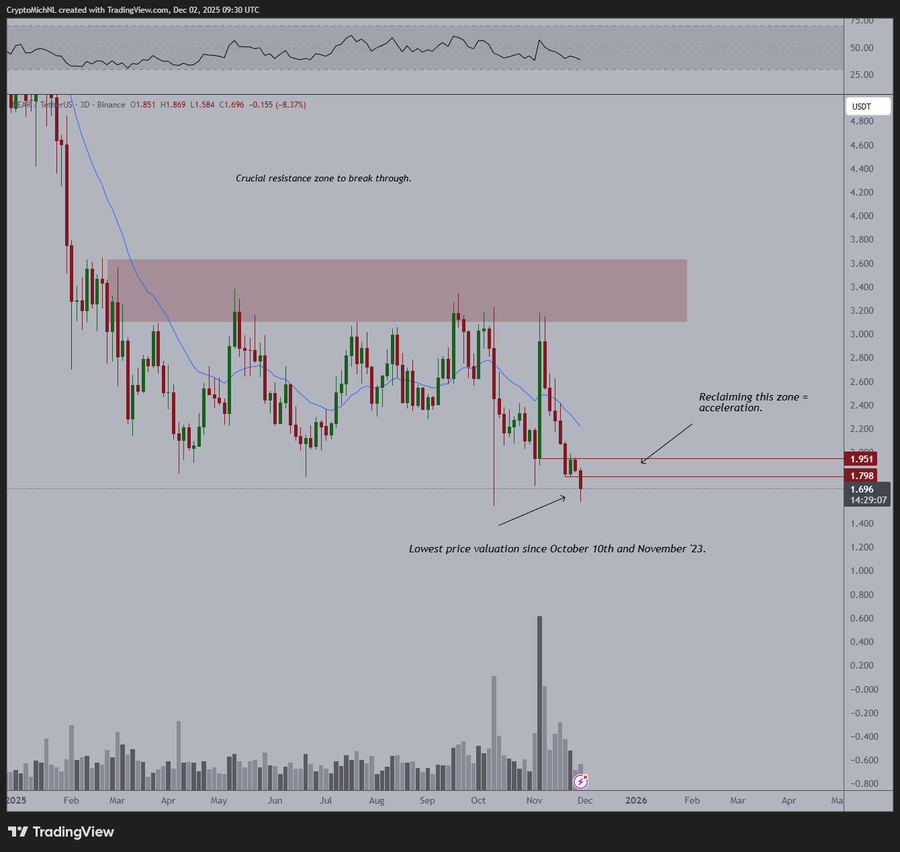
Image3-day NEAR/USDT Chart | Source: @CryptoMichNL on X

Momentum now depends on whether the token can reclaim $1.80 and advance toward $1.95, a zone that historically supported continuation during prior rebounds. According to the analyst, ‘Break through $1.80 & $1.95 and then we should be good to go upwards from here.” The breakdown from the $2.20 to $2.40 range in November intensified the decline, and large-volume sessions around the $2.00 breach suggested heavy supply pressure.

Network Activity Builds Under the Surface

The fundamentals continue to advance despite near-term market weakness. NEAR Intents, the project’s cross-chain automation system, has generated over $7 billion in lifetime volume with more than 12 million swaps and $11.68 million in fees. Unique addresses surged past 800,000 in the past 30 days, according to Dune Analytics data.

Interest also increased after the U.S. prediction market Kalshi added NEAR support on November 25. Additionally, validators voted to reduce inflation on October 28, lowering the tail emission rate from 5% to 2.5%.

]]>
Disclaimer: The articles reposted on this site are sourced from public platforms and are provided for informational purposes only. They do not necessarily reflect the views of MEXC. All rights remain with the original authors. If you believe any content infringes on third-party rights, please contact [email protected] for removal. MEXC makes no guarantees regarding the accuracy, completeness, or timeliness of the content and is not responsible for any actions taken based on the information provided. The content does not constitute financial, legal, or other professional advice, nor should it be considered a recommendation or endorsement by MEXC.

You May Also Like

Best Crypto to Buy as Saylor & Crypto Execs Meet in US Treasury Council

Best Crypto to Buy as Saylor & Crypto Execs Meet in US Treasury Council

The post Best Crypto to Buy as Saylor & Crypto Execs Meet in US Treasury Council appeared on BitcoinEthereumNews.com. Michael Saylor and a group of crypto executives met in Washington, D.C. yesterday to push for the Strategic Bitcoin Reserve Bill (the BITCOIN Act), which would see the U.S. acquire up to 1M $BTC over five years. With Bitcoin being positioned yet again as a cornerstone of national monetary policy, many investors are turning their eyes to projects that lean into this narrative – altcoins, meme coins, and presales that could ride on the same wave. Read on for three of the best crypto projects that seem especially well‐suited to benefit from this macro shift:  Bitcoin Hyper, Best Wallet Token, and Remittix. These projects stand out for having a strong use case and high adoption potential, especially given the push for a U.S. Bitcoin reserve.   Why the Bitcoin Reserve Bill Matters for Crypto Markets The strategic Bitcoin Reserve Bill could mark a turning point for the U.S. approach to digital assets. The proposal would see America build a long-term Bitcoin reserve by acquiring up to one million $BTC over five years. To make this happen, lawmakers are exploring creative funding methods such as revaluing old gold certificates. The plan also leans on confiscated Bitcoin already held by the government, worth an estimated $15–20B. This isn’t just a headline for policy wonks. It signals that Bitcoin is moving from the margins into the core of financial strategy. Industry figures like Michael Saylor, Senator Cynthia Lummis, and Marathon Digital’s Fred Thiel are all backing the bill. They see Bitcoin not just as an investment, but as a hedge against systemic risks. For the wider crypto market, this opens the door for projects tied to Bitcoin and the infrastructure that supports it. 1. Bitcoin Hyper ($HYPER) – Turning Bitcoin Into More Than Just Digital Gold The U.S. may soon treat Bitcoin as…
Share
BitcoinEthereumNews2025/09/18 00:27
The Future of Secure Messaging: Why Decentralization Matters

The Future of Secure Messaging: Why Decentralization Matters

The post The Future of Secure Messaging: Why Decentralization Matters appeared on BitcoinEthereumNews.com. From encrypted chats to decentralized messaging Encrypted messengers are having a second wave. Apps like WhatsApp, iMessage and Signal made end-to-end encryption (E2EE) a default expectation. But most still hinge on phone numbers, centralized servers and a lot of metadata, such as who you talk to, when, from which IP and on which device. That is what Vitalik Buterin is aiming at in his recent X post and donation. He argues the next steps for secure messaging are permissionless account creation with no phone numbers or Know Your Customer (KYC) and much stronger metadata privacy. In that context he highlighted Session and SimpleX and sent 128 Ether (ETH) to each to keep pushing in that direction. Session is a good case study because it tries to combine E2E encryption with decentralization. There is no central message server, traffic is routed through onion paths, and user IDs are keys instead of phone numbers. Did you know? Forty-three percent of people who use public WiFi report experiencing a data breach, with man-in-the-middle attacks and packet sniffing against unencrypted traffic among the most common causes. How Session stores your messages Session is built around public key identities. When you sign up, the app generates a keypair locally and derives a Session ID from it with no phone number or email required. Messages travel through a network of service nodes using onion routing so that no single node can see both the sender and the recipient. (You can see your message’s node path in the settings.) For asynchronous delivery when you are offline, messages are stored in small groups of nodes called “swarms.” Each Session ID is mapped to a specific swarm, and your messages are stored there encrypted until your client fetches them. Historically, messages had a default time-to-live of about two weeks…
Share
BitcoinEthereumNews2025/12/08 14:40