The post Why Mark Cuban’s Drug Cost Message Resonates: It’s Simple appeared on BitcoinEthereumNews.com. Mark Cuban (center), co-founder of Cost Plus Drugs explains his company’s discussions with Humana to develop “direct-to-employer” prescription drug programs that bypass traditional pharmacy benefit companies. Humana CEO Jim Rechtin (right) also spoke with Cuban on a special panel on improving pharmacy experience moderated by Forbes Senior Contributor Bruce Japsen (L) at the Forbes Healthcare Summit on December 4, 2025 at NYU Lagone Health in Manhattan. Jamel Toppin When the billionaire entrepreneur Mark Cuban talks about what his Cost Plus Drugs company can do to reduce prescription costs, his message is simple. In contrast, established pharmacy benefit management (PBM) companies and their health insurer owners say they have the ability to “treat the whole person” because of their large networks of pharmacy and doctor choices and an added ability to manage diseases thanks to vast databases of claims and patient health histories that they have. So what was Cuban’s response at last week’s Forbes Healthcare Summit? “I would say we’re treating the whole person plus their wallet,” Cuban told attendees at the 14th annual Forbes Healthcare Summit at NYU Langone Health in Manhattan. “And do you really want your PBM to be doing all your disease management and all that, or do you want to hire the best provider of that service?” Simplicity, transparency and reducing hurdles are key parts to why Humana, one of the nation’s largest health insurers for older adults, is working on partnering with Cost Plus Drugs in a potentially unique arrangement between an established provider of health benefits to millions of Americans and a smaller disrupter co-funded by Cuban. Cuban says Cost Plus Drugs is a “very simple business.” “You go to costplusdrugs.com, you put in the name of the medication, if it’s one of the thousands … that we carry, it comes up [and]… The post Why Mark Cuban’s Drug Cost Message Resonates: It’s Simple appeared on BitcoinEthereumNews.com. Mark Cuban (center), co-founder of Cost Plus Drugs explains his company’s discussions with Humana to develop “direct-to-employer” prescription drug programs that bypass traditional pharmacy benefit companies. Humana CEO Jim Rechtin (right) also spoke with Cuban on a special panel on improving pharmacy experience moderated by Forbes Senior Contributor Bruce Japsen (L) at the Forbes Healthcare Summit on December 4, 2025 at NYU Lagone Health in Manhattan. Jamel Toppin When the billionaire entrepreneur Mark Cuban talks about what his Cost Plus Drugs company can do to reduce prescription costs, his message is simple. In contrast, established pharmacy benefit management (PBM) companies and their health insurer owners say they have the ability to “treat the whole person” because of their large networks of pharmacy and doctor choices and an added ability to manage diseases thanks to vast databases of claims and patient health histories that they have. So what was Cuban’s response at last week’s Forbes Healthcare Summit? “I would say we’re treating the whole person plus their wallet,” Cuban told attendees at the 14th annual Forbes Healthcare Summit at NYU Langone Health in Manhattan. “And do you really want your PBM to be doing all your disease management and all that, or do you want to hire the best provider of that service?” Simplicity, transparency and reducing hurdles are key parts to why Humana, one of the nation’s largest health insurers for older adults, is working on partnering with Cost Plus Drugs in a potentially unique arrangement between an established provider of health benefits to millions of Americans and a smaller disrupter co-funded by Cuban. Cuban says Cost Plus Drugs is a “very simple business.” “You go to costplusdrugs.com, you put in the name of the medication, if it’s one of the thousands … that we carry, it comes up [and]…

Why Mark Cuban’s Drug Cost Message Resonates: It’s Simple

2025/12/07 21:22

Mark Cuban (center), co-founder of Cost Plus Drugs explains his company’s discussions with Humana to develop “direct-to-employer” prescription drug programs that bypass traditional pharmacy benefit companies. Humana CEO Jim Rechtin (right) also spoke with Cuban on a special panel on improving pharmacy experience moderated by Forbes Senior Contributor Bruce Japsen (L) at the Forbes Healthcare Summit on December 4, 2025 at NYU Lagone Health in Manhattan.

Jamel Toppin

When the billionaire entrepreneur Mark Cuban talks about what his Cost Plus Drugs company can do to reduce prescription costs, his message is simple.

In contrast, established pharmacy benefit management (PBM) companies and their health insurer owners say they have the ability to “treat the whole person” because of their large networks of pharmacy and doctor choices and an added ability to manage diseases thanks to vast databases of claims and patient health histories that they have.

So what was Cuban’s response at last week’s Forbes Healthcare Summit?

“I would say we’re treating the whole person plus their wallet,” Cuban told attendees at the 14th annual Forbes Healthcare Summit at NYU Langone Health in Manhattan. “And do you really want your PBM to be doing all your disease management and all that, or do you want to hire the best provider of that service?”

Simplicity, transparency and reducing hurdles are key parts to why Humana, one of the nation’s largest health insurers for older adults, is working on partnering with Cost Plus Drugs in a potentially unique arrangement between an established provider of health benefits to millions of Americans and a smaller disrupter co-funded by Cuban.

Cuban says Cost Plus Drugs is a “very simple business.”

“You go to costplusdrugs.com, you put in the name of the medication, if it’s one of the thousands … that we carry, it comes up [and] it shows you our actual cost, actually what we pay for,” Cuban said at the healthcare summit last week. “Then we show a 15% markup because we thought that was fair and then, because we’re primarily mail order, it’s $5 to ship it to you. And that’s it. And because of that, it’s simple, easy to understand and it’s dramatically cheaper, in most cases.”

At a time when health insurance costs are rising and could see record spikes next year thanks to a flood of new and popular drugs like GLP-1 prescriptions for obesity, Cuban and Humana’s CenterWell pharmacy business see an opportunity. Health insurers and pharmacy benefit management companies are also under fire for a lack of transparency in how they make money with many of them eliminating controversial rebates they are paid by drugmakers or working to scale them back to give their clients a bigger discount on prescription drugs.

“We are known as an insurance company, but if we’re going to deliver against consumer needs, we need to be in spots in the delivery system that can really impact the access, quality, and ultimately the cost of healthcare,” Rechtin said of Humana, a health insurer best known for providing Medicare Advantage plans to more than 5 million older adults.

“And that’s what CenterWell is all about,” Rechtin said of the pharmacy unit of Humana’s CenterWell health services business. “We basically looked at the traditional (pharmacy benefit) model and we said we are not getting the cost efficiency [and] the affordability that we need to make sure that our members are getting access to medications the way they need to get access to medications. So, we built a pharmacy to try to correct that, and then along the way, what we realized is we’ve actually got a pretty good asset here that is really good at getting medications from the manufacturer – from the plant – to the consumer quickly, efficiently and effectively. That’s good for healthcare [and] it’s good for cost.”

Cuban and Humana’s Rechtin say they want to make the model simpler and more transparent from the drug manufacturer to the patient.

“If you look at how the system operates end to end and you think about all the different players and all the different systems; we have the manufacturer, we have a hub, we have a PBM, we have a distributor, we have a pharmacy – and that doesn’t even name everybody that’s in the system, end to end,” Rechtin said. “The question is, how much value is being added in each of those at each of those steps? And then, how much does it cost? Do you really need all of that cost? And is it really all adding value?”

The initial effort for Humana and Cost Plus Drugs will be in the area of direct-to-employer programs that bypass traditional pharmacy benefit management companies. Though Humana is best known for its Medicare business, Rechtin is working to transform the health insurer into a consumer healthcare company.

Details of the partnership weren’t disclosed, and it’s and still in early stages but both executives acknowledged they see a great opportunity with employers who pick up a big tab for U.S. prescription costs, according to sources close to both companies.

But Cuban and Humana’s CenterWell pharmacy business are working together because they see an opportunity with employers who are tired of paying more for prescription drugs with few alternatives.

“We need more CEOs of large employers to basically say ‘Hey, we’re going to demand a different model. One that is transparent, one that bypasses the system that’s been in place now for decades,’” Rechtin told the Forbes Healthcare Summit audience. “And look, there are alternatives, but those alternatives can’t be fully built without the demand that we need from employers, and that really is going to require CEOs to step into the benefit process.”

Source: https://www.forbes.com/sites/brucejapsen/2025/12/07/why-mark-cubans-drug-cost-message-resonates-its-simple/

Disclaimer: The articles reposted on this site are sourced from public platforms and are provided for informational purposes only. They do not necessarily reflect the views of MEXC. All rights remain with the original authors. If you believe any content infringes on third-party rights, please contact [email protected] for removal. MEXC makes no guarantees regarding the accuracy, completeness, or timeliness of the content and is not responsible for any actions taken based on the information provided. The content does not constitute financial, legal, or other professional advice, nor should it be considered a recommendation or endorsement by MEXC.

You May Also Like

XRP Whales Sell $780 Million, Will Price Fall Below $2?

XRP Whales Sell $780 Million, Will Price Fall Below $2?

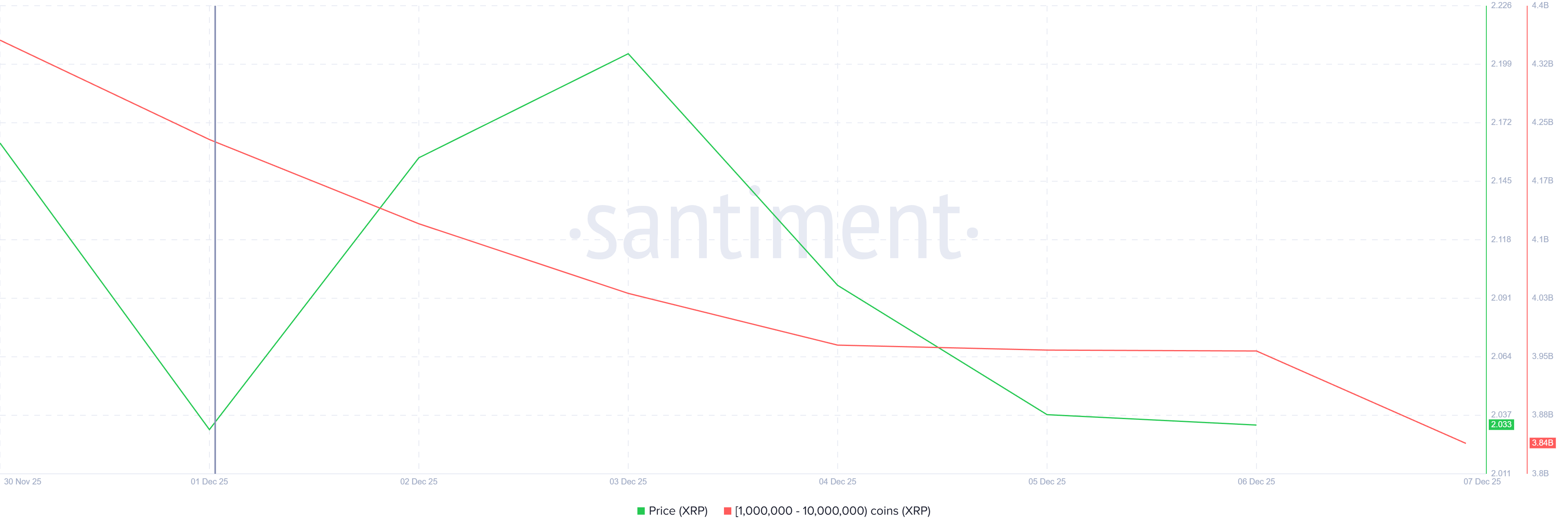
XRP price has returned to the critical $2 level after repeated failed breakout attempts, reflecting uncertainty across the market.  Each attempt to rally above near-term resistance has been met with selling pressure, pulling the altcoin back toward this psychological floor. XRP Holders Are In A Tug Of War Whales have begun offloading substantial portions of their holdings. Over the past seven days, wallets holding between 1 million and 10 million XRP have sold more than 390 million XRP, worth over $783 million at current prices.  This level of distribution shows clear frustration among high-value holders who expected a stronger recovery. Such selling typically weighs heavily on market sentiment, especially when driven by a cohort that can significantly influence liquidity. Want more token insights like this? Sign up for Editor Harsh Notariya’s Daily Crypto Newsletter here. XRP Whale Holding. Source: Santiment Despite whale distribution, long-term holders are counteracting downward pressure. HODL Waves data shows that the share of XRP supply held by the 1-year to 2-year cohort increased from 8.58 percent to 9.81 percent in the past week.  This signals growing conviction among maturing holders who acquired XRP less than a year ago and are now opting to retain their tokens through volatility. This steadiness is helping stabilize XRP at $2, softening the impact of whale selling. XRP HODL Waves. Source: Glassnode XRP Price Notes A Dip XRP is trading at $2.00 at the time of writing, a crucial psychological and technical support level. In recent days, price movements have repeatedly gravitated back to this point, confirming its importance in maintaining market structure. Given the opposing pressure from whale selling and long-term holder accumulation, XRP will likely remain rangebound between $2.00 and $2.20 until a clear directional catalyst emerges. A shift in sentiment or improved market conditions would be needed to break this consolidation pattern. XRP Price Analysis. Source: TradingView However, if bearish momentum strengthens and whale selling accelerates, XRP could fall through the $1.94 support. Such a breakdown would expose the price to a deeper decline toward $1.85, invalidating any near-term bullish expectations.
Share
Coinstats2025/12/08 06:30