In 2008, the World Bank published a piece titled “PayPal (not) in Africa“. The intention was to call…In 2008, the World Bank published a piece titled “PayPal (not) in Africa“. The intention was to call…

PayPal accepts defeat: now the fintech giant finally wants to play in Africa

In 2008, the World Bank published a piece titled “PayPal (not) in Africa“. The intention was to call out the fintech platform for sidelining the continent, where millions of entrepreneurs, freelancers, and small business owners desperately needed access to global payment infrastructure.

The piece highlighted a glaring absence: while anyone could set up a PayPal account in Africa, there was no way to transfer money out. No withdrawal. No receiving funds from overseas clients. Just a one-way street that left countless African professionals locked out of the global digital economy.

Sixteen years later, the frustration endures. Yet something has shifted. The company is finally talking about Africa, not as a conqueror, but as a partner that has finally accepted its limits.

The payments giant recently announced plans to launch its PayPal World platform across Africa in 2026.

Otto Williams, PayPal’s Senior Vice President, Regional Head for the Middle East and Africa, confirmed at Abu Dhabi Finance Week that the company is actively pursuing partnerships with African fintech players. This signals a dramatic reversal of decades of reluctance.

But this raises the question: why now? And perhaps more importantly, what took so long?

Why the PayPal model struggled in Africa

To understand PayPal’s long absence, you need to understand its core imperative: trust. In the early 2000s, Africa represented a high-risk proposition. The company cited disproportionately high rates of chargebacks and fraudulent transactions.

In 2004, the fintech restricted users in Ghana, Nigeria, and several other countries from receiving funds, claiming stolen credit cards from the West were being used to syphon money. Without robust national ID systems at the time, PayPal viewed the continent as an existential threat to its network integrity.

Also, its traditional model was built for Western banking, where it required users to link credit cards or bank accounts, which were not readily available to most Africans.

Compliance with anti-money laundering laws was expensive in regions where regulatory infrastructure was weak. For years, the math simply didn’t add up as the cost of building compliance outweighed the potential revenue.
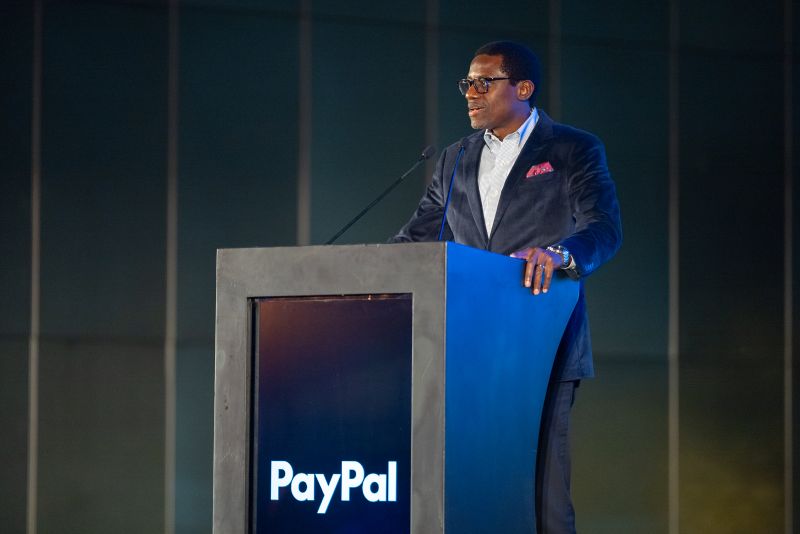
Otto Williams, PayPal’s Senior Vice President, Regional Head for the Middle East and AfricaOtto Williams, PayPal’s Senior Vice President, Regional Head for the Middle East and Africa

Scepticism about this new 2026 promise is high, and for good reason. The company has tried to enter Africa before with “half-measures” that often felt like PR wins rather than actual solutions.

In 2014, a partnership with First Bank of Nigeria was restricted to bank customers and was “send-only.” First Bank had said in one document: In 2021, a partnership with Flutterwave helped businesses but did little for the average person. These attempts failed because they tried to force Africans into a restricted Western banking box.

Meanwhile, since PayPal’s exit, Africa built its own world. Kenya’s M-Pesa revolutionised finance, processing KSh 39.39 trillion (around $300 billion) in Kenya alone. Today, Africa accounts for 70% of global mobile money transaction value.

Homegrown giants like Flutterwave and Paystack filled the void, solving the “last-mile” problems PayPal once deemed impossible.

The new strategy for PayPal World

The 2026 strategy for PayPal World is a quiet admission that the company cannot win the “wallet war” in Africa. Instead of trying to get you to open a PayPal account, the company is now trying to be the “bridge” for the wallet you already use.

Three fundamental shifts made this viable. First, regulatory maturity has improved with systems like Nigeria’s Bank Verification Number (BVN). Second, PayPal no longer has to build from scratch, they can partner with established giants like Safaricom and MTN.

Finally, there is economic pressure. As Western markets slow down, Africa’s young, urban population represents the last major frontier for growth.

For the average user, this is a major shift. In the past, you had to move into PayPal’s “house” and follow its strict rules. If they didn’t like your activity, they locked you out. With PayPal World, they are simply building a door between your house (like M-Pesa or MTN MoMo) and the rest of the world.

Market Opportunity
Nowchain Logo
Nowchain Price(NOW)
$0.00242
$0.00242$0.00242
0.00%
USD
Nowchain (NOW) Live Price Chart
Disclaimer: The articles reposted on this site are sourced from public platforms and are provided for informational purposes only. They do not necessarily reflect the views of MEXC. All rights remain with the original authors. If you believe any content infringes on third-party rights, please contact [email protected] for removal. MEXC makes no guarantees regarding the accuracy, completeness, or timeliness of the content and is not responsible for any actions taken based on the information provided. The content does not constitute financial, legal, or other professional advice, nor should it be considered a recommendation or endorsement by MEXC.

You May Also Like

IP Hits $11.75, HYPE Climbs to $55, BlockDAG Surpasses Both with $407M Presale Surge!

IP Hits $11.75, HYPE Climbs to $55, BlockDAG Surpasses Both with $407M Presale Surge!

The post IP Hits $11.75, HYPE Climbs to $55, BlockDAG Surpasses Both with $407M Presale Surge! appeared on BitcoinEthereumNews.com. Crypto News 17 September 2025 | 18:00 Discover why BlockDAG’s upcoming Awakening Testnet launch makes it the best crypto to buy today as Story (IP) price jumps to $11.75 and Hyperliquid hits new highs. Recent crypto market numbers show strength but also some limits. The Story (IP) price jump has been sharp, fueled by big buybacks and speculation, yet critics point out that revenue still lags far behind its valuation. The Hyperliquid (HYPE) price looks solid around the mid-$50s after a new all-time high, but questions remain about sustainability once the hype around USDH proposals cools down. So the obvious question is: why chase coins that are either stretched thin or at risk of retracing when you could back a network that’s already proving itself on the ground? That’s where BlockDAG comes in. While other chains are stuck dealing with validator congestion or outages, BlockDAG’s upcoming Awakening Testnet will be stress-testing its EVM-compatible smart chain with real miners before listing. For anyone looking for the best crypto coin to buy, the choice between waiting on fixes or joining live progress feels like an easy one. BlockDAG: Smart Chain Running Before Launch Ethereum continues to wrestle with gas congestion, and Solana is still known for network freezes, yet BlockDAG is already showing a different picture. Its upcoming Awakening Testnet, set to launch on September 25, isn’t just a demo; it’s a live rollout where the chain’s base protocols are being stress-tested with miners connected globally. EVM compatibility is active, account abstraction is built in, and tools like updated vesting contracts and Stratum integration are already functional. Instead of waiting for fixes like other networks, BlockDAG is proving its infrastructure in real time. What makes this even more important is that the technology is operational before the coin even hits exchanges. That…
Share
BitcoinEthereumNews2025/09/18 00:32
Why IPO Genie ($IPO) Is Being Called a Top Crypto Presale by Analysts

Why IPO Genie ($IPO) Is Being Called a Top Crypto Presale by Analysts

IPO Genie ($IPO) is being called a top crypto presale by analysts, offering AI-driven market insights, robust tokenomics, and data-backed investor growth.
Share
Blockchainreporter2025/12/18 22:00
Headwind Helps Best Wallet Token

Headwind Helps Best Wallet Token

The post Headwind Helps Best Wallet Token appeared on BitcoinEthereumNews.com. Google has announced the launch of a new open-source protocol called Agent Payments Protocol (AP2) in partnership with Coinbase, the Ethereum Foundation, and 60 other organizations. This allows AI agents to make payments on behalf of users using various methods such as real-time bank transfers, credit and debit cards, and, most importantly, stablecoins. Let’s explore in detail what this could mean for the broader cryptocurrency markets, and also highlight a presale crypto (Best Wallet Token) that could explode as a result of this development. Google’s Push for Stablecoins Agent Payments Protocol (AP2) uses digital contracts known as ‘Intent Mandates’ and ‘Verifiable Credentials’ to ensure that AI agents undertake only those payments authorized by the user. Mandates, by the way, are cryptographically signed, tamper-proof digital contracts that act as verifiable proof of a user’s instruction. For example, let’s say you instruct an AI agent to never spend more than $200 in a single transaction. This instruction is written into an Intent Mandate, which serves as a digital contract. Now, whenever the AI agent tries to make a payment, it must present this mandate as proof of authorization, which will then be verified via the AP2 protocol. Alongside this, Google has also launched the A2A x402 extension to accelerate support for the Web3 ecosystem. This production-ready solution enables agent-based crypto payments and will help reshape the growth of cryptocurrency integration within the AP2 protocol. Google’s inclusion of stablecoins in AP2 is a massive vote of confidence in dollar-pegged cryptocurrencies and a huge step toward making them a mainstream payment option. This widens stablecoin usage beyond trading and speculation, positioning them at the center of the consumption economy. The recent enactment of the GENIUS Act in the U.S. gives stablecoins more structure and legal support. Imagine paying for things like data crawls, per-task…
Share
BitcoinEthereumNews2025/09/18 01:27