👨🏿🚀TechCabal Daily – Zenith goes Shilling
TGIF. 
Over the last seven years, African startups have raised $20.16 billion, proving the ecosystem has matured from “potential” into a high-stakes asset class. The State of Tech in Africa 2025 report reveals that last year was a major turning point, with $3.42 billion raised across 502 deals, including seven $100M+ mega-deals and a record 67 M&A transactions.
As the industry shifts toward consolidation and capital discipline, marked by over 70 strategic partnerships and 50 market expansions, understanding these signals is no longer optional for anyone building or investing on the continent. Be the first to see the data that will define 2026; join the waitlist now to get early access to the definitive year-in-review report.
- Quick Fire
 with Yvonne Ige
 - Flutterwave to launch stablecoin wallets
- Zenith gets Paramount acquisition approval
- Funding Tracker
- World Wide Web 3
- Opportunities
features
Quick Fire with Yvonne Ige
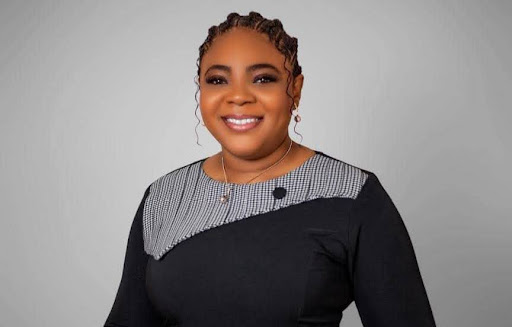 Yvonne Ige, Head of Partnerships, NIBSS
Yvonne Ige has over 15 years of experience in the African fintech and technology space, scaling high-impact solutions. Currently the Head of Partnerships at NIBSS, she sits at the heart of Nigeria’s national payments infrastructure, driving collaboration between banks and fintechs. Her track record includes leading pan-African expansion as the Chief Commercial Officer at Appzone (Qore) and delivering massive digital identity and payment projects for the public sector during her time as VP at Softcom.
- Explain what you do to a 5-year-old.
I help people use computers and phones to make life easier. I work with banks and other big companies to help them send money safely and quickly. I also help the government use technology to keep good records of people. My job is to help people work together so everyone can use technology better.
- At NIBSS, what’s one part of Nigeria’s payments infrastructure most people misunderstand or overlook?
We are an enabler, not a consumer brand, and that’s what most people miss. People think payments are about the apps they see: their bank app, a fintech wallet, a PoS terminal, but none of those work on their own. What makes them work is the shared national infrastructure underneath, which allows all these different institutions to connect, trust each other, and move money safely.
At NIBSS, our role is to make sure that banks, fintechs, switches, and payment providers can plug into one reliable system and compete and innovate on top of it. We don’t try to own the customer; rather, we enable everyone else to serve them. When that foundation is strong, the entire ecosystem grows faster, safer, and more inclusive.
- What’s the biggest trade-off you’ve had to manage when building fintech products versus running national payments systems?
In fintech, you are rewarded for moving fast by testing ideas, launching quickly, and iterating based on what users want. You can afford to fail small and fix things as you go.
In the national payments infrastructure, you are responsible for everyone. A single change can affect millions of people, thousands of businesses, and the entire financial system. So the priority shifts to resilience, trust, and predictability. You don’t get to “move fast and break things” when you are the backbone of the economy.
Having worked on both sides, I’ve learned that neither approach is better as they need each other. Fintech brings speed and creativity, while infrastructure provides the stable rails that make that innovation safe at scale. My role has been learning how to bridge those two worlds so innovation can happen without putting the system at risk.
- If you were starting your career today, what part of Africa’s tech ecosystem would you bet your money on, and why?
Most of the ideas I have had or businesses I created were around technology, whether in payments, beauty, or health. If I had to pick an area right now, it’s exactly where I am, which is payments and financial infrastructure, because that is where technology touches the most people in the most meaningful way. Payments are not just about moving money; it is about whether someone can participate in the economy at all. If you can get paid, save, send money, or accept payments, you can work, trade, build a business, and plan for the future. If you can’t, you are effectively invisible.
What draws me to this space is that it sits right at the intersection of people and systems. Every transaction represents a real human story, a salary being paid, a market trader buying stock, a family sending money home or paying a medical bill, or a small business collecting revenue. When the infrastructure works, those everyday moments become easier, safer, and more reliable. When it doesn’t, it creates friction, exclusion, and real hardship.
For someone like me who cares deeply about people, payments is one of the highest-impact places to work. You’re not just building technology; you’re building access, trust, and economic dignity at scale. And when you combine that with national infrastructure, you’re not helping a few users; you’re helping entire communities, industries, and countries move forward.
- Five years from now, what would success look like for Nigeria’s payments ecosystem, and how do you hope to contribute?
Five years from now, success for Nigeria’s payments ecosystem would mean that payments are no longer something people think about; they just work. Whether you are a market trader, a fintech startup, a large corporation, or a government agency, moving money should be instant, affordable, reliable, and fully interoperable. Cash should no longer be the default, not because it was banned, but because digital payments are simply better: safer, easier, and more trusted.
It would also mean that payments are deeply linked to identity, data, and credit, so that once someone is part of the system, they can do much more than just send money. They can access loans, receive government support, run a formal business, and build a financial history. That is how payments stop being just transactions and start becoming real economic inclusion.
I hope to contribute by helping build and steward the national rails that make all of that possible, ensuring they are neutral, open, resilient, and designed for the long term. I want to keep being a bridge between banks, fintechs, regulators, and innovators, so that Nigeria’s payments infrastructure doesn’t just grow, but grows in a way that serves people, competition, and the future of the economy.
Your 2026 demands disciplined financial operations
Fincra powers the payments infrastructure businesses rely on to collect, pay, and settle across local and major African currencies with confidence. Get started.
fintech
Flutterwave partners with Turnkey to launch stablecoin wallets
 Image source: Flutterwave
Flutterwave, Africa’s largest payments infrastructure startup, has added stablecoin balances to its platform. In partnership with blockchain infrastructure provider Turnkey and artificial intelligence-powered global banking platform Nuvion, merchants can now hold and move money in USDC, USDT, the US Dollar, and Naira inside Flutterwave wallets without touching traditional banks.
Why is Flutterwave leaning hard into stablecoins? In 2025, Flutterwave partnered with Polygon Labs, a blockchain software firm, to make Polygon its default network for cross-border stablecoin settlements. As cross-border payments in Africa remain slow and expensive, stablecoins cut through that by settling faster and moving globally. For Flutterwave, this is about control. By routing more transactions through crypto rails and pairing that with its Mono acquisition, Flutterwave is stitching more of the payments stack in-house.
This isn’t just a Flutterwave thing: Payments companies are increasingly treating stablecoins as infrastructure. In 2024, Stripe partnered with Coinbase Global Inc. to enable USDC stablecoin transfers for its users. In 2025, Ripple, a US-based crypto infrastructure company, partnered with Nigerian fintech startups, VALR, Yellow Card, and Chipper Cash, to roll out its dollar-backed stablecoin, Ripple USD (RLUSD).
Zoom out: What changes for merchants is that they have faster settlements and more predictable FX. For Africa’s ecosystem, this partnership lowers the cost of doing business across African markets, thereby nudging cross-border trade toward digital rails. If it becomes widely adopted, stablecoins become a shared financial infrastructure that plugs Africa directly into global commerce.
Get access to logistics providers across Africa
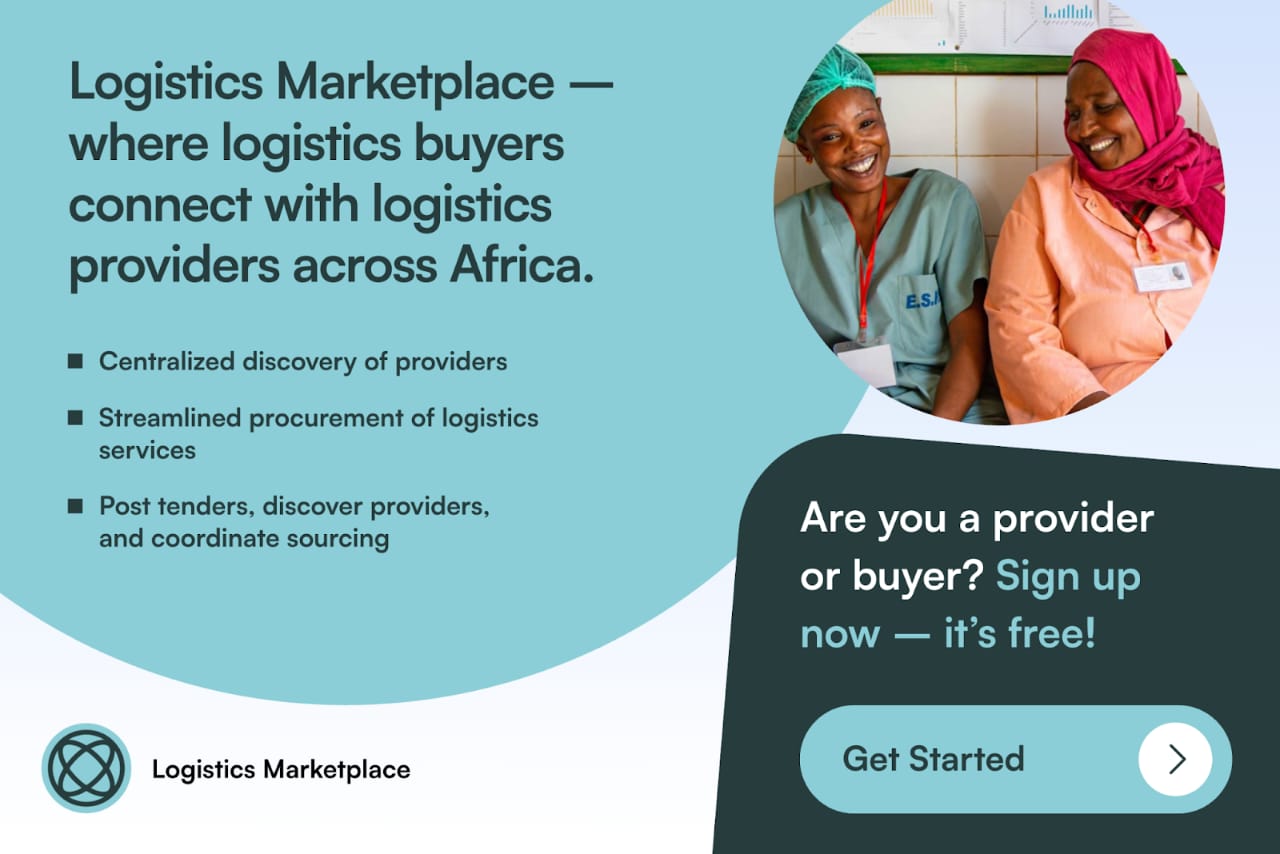
The Logistics Marketplace connects health buyers – governments, partners, humanitarian organisations & manufacturers with logistics providers across Africa. Backed by Global Fund & Gates Foundation, join for free with Access Code WELCOME2026!
banking
Zenith gets Paramount acquisition approval from Kenya’s competition regulator
 Image Source: Google
Zenith Bank, one of Nigeria’s biggest banks, has long been in talks to enter Kenya, and for good reason. Kenya is hard to crack organically, especially the Business Laws (Amendment) Act, 2024, which mandates an increase in minimum core capital from KES 1 billion (7.7 million) to KES 10 billion ($77 million). Acquisitions offer a shortcut, giving banks licences, staff, customers, and regulatory muscle.
Zenith Bank has gotten the nod of the Competition Authority of Kenya, the country’s competition regulator, over its proposed acquisition of Paramount Bank Limited, a mid-tier lender. It’s not a full green light yet, but it puts Zenith firmly inside the door of East Africa’s banking market.
But there are conditions attached: The approval comes with the key caveat that Zenith must retain all 78 Paramount Bank employees for at least 12 months after the deal closes.
Zenith won’t be alone in East Africa: The bank will be joining its fellow Tier I banks, Access Bank, which acquired the National Bank of Kenya, UBA, and GTBank through its acquisition of Fina Bank, which are already active in Kenya. Although the competition regulator has given its green light, approval from the Central Bank of Kenya and Nigerian authorities is still pending.
insights
Funding Tracker
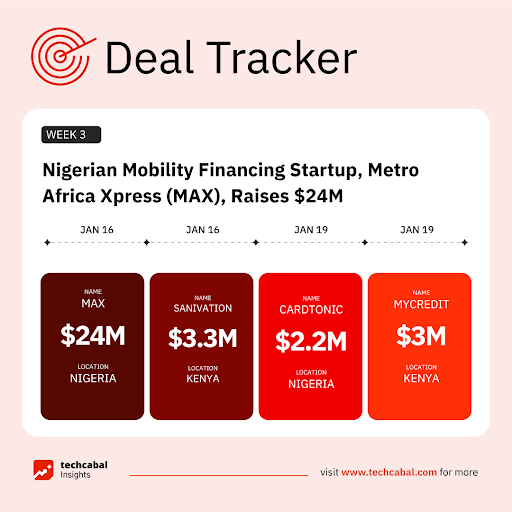 Image Source: TechCabal Insights
Metro Africa Xpress (MAX), a Nigerian mobility financing startup, secured $24 million in equity and debt funding. The equity round saw participation from Equitane DMCC, Novastar, Endeavor Catalyst, and other global investors, while the debt round was from the Energy Entrepreneurs Growth Fund (EEGF) and additional development finance partners. (Jan 16)
Here are the other deals for the week:
- Sanivation, a Kenyan cleantech startup, raised $3.3 million in equity investment from PIDG’s project development arm InfraCo. (Jan 16)
- Cardtonic, a Nigerian fintech startup, raised $2.1 million in seed funding from angel investors. (Jan 19)
- MyCredit, a Kenyan fintech startup, raised $3 million in debt funding from an international microfinance lender. (Jan 19)
Follow us on Twitter, Instagram, and LinkedIn for more funding announcements. Before you go,why are African fintechs choosing profit and security over growth? Find out here.
CRYPTO TRACKER
The World Wide Web3
Source:

|
Coin Name |
Current Value |
Day |
Month |
|---|---|---|---|
| Bitcoin | $89,571 |
– 0.36% |
+ 2.98% |
| Ether | $2,967 |
– 1.63% |
+ 1.41% |
| BNB | $890 |
– 0.03% |
+ 6.20% |
| Solana | $128.54 |
– 1.13% |
+ 5.83% |
* Data as of 06.39 AM WAT, January 23, 2026.
Events
 Africa Tech Summit Nairobi is returning for its eighth edition in February 2026, and this time, payments infrastructure is getting top billing. Fincra, a pan-African fintech company, has been announced as the headline supporter of the event, which will be held on February 11–12, 2026, at the Sarit Expo Centre, Nairobi, Kenya. The summit will bring together over 2,000 delegates across fintech, AI, climate tech, and startups to discuss how Africa builds interoperable payment rails for cross-border trade and digital commerce. Get your early bird tickets.
- Delve into AI: Before the VCs arrive, FirstFounders wants African AI startups built to last
- Andela acquires Woven to build AI-fluent engineering talent at scale Kariuki Ngari, Standard Chartered Kenya’s marathon-loving CEO, to retire in April
Written by: Kenn Abuya, Zia Yusuf, and Opeyemi Kareem
Edited by: Ganiu Oloruntade
Want more of TechCabal?
Sign up for our insightful newsletters on the business and economy of tech in Africa.
- The Next Wave: futuristic analysis of the business of tech in Africa.
- Francophone Weekly by TechCabal: insider insights and analysis of Francophone’s tech ecosystem
P:S If you’re often missing TC Daily in your inbox, check your Promotions folder and move any edition of TC Daily from “Promotions” to your “Main” or “Primary” folder and TC Daily will always come to you.

You May Also Like

Vance roasted over stunning comparison: 'Does he know what happened to the Titanic?'

Trump's 'bulldozing' will cost his party in November: WSJ editors