As the Sui staking market is ready to take off, Haedal’s innovative products and strong data make it one of the preferred investment targets for DeFi.As the Sui staking market is ready to take off, Haedal’s innovative products and strong data make it one of the preferred investment targets for DeFi.

Haedal Protocol Analysis: The No. 1 player in Sui’s liquidity staking track, with TVL crushing competitors

2025/04/28 20:00

Author: nicoleliu.eth

Compiled by: Tim, PANews

PANews Editor's Note: Sui Ecosystem Liquidity Staking Protocol Haedal will conduct TGE on April 29, and users can receive airdrops. The author of this article is a founding partner of Comma3 Ventures, which has participated in the seed round investment of Haedal Protocol. Haedal Protocol is a hidden gem project in the field of liquidity staking in the Sui ecosystem. As the Sui staking market is ready to take off, Haedal's innovative products and strong data make it one of the preferred investment targets for DeFi.

Here’s why it’s worth investing and what you need to pay attention to 👇 (all data as of April 15)

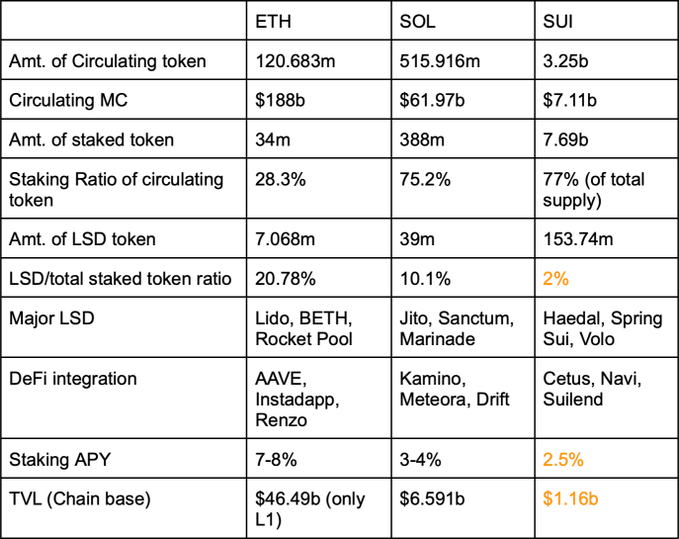
The liquid staking market of the Sui network is not yet prosperous, with the total value of staked SUI being $307.48 million, of which only 2% is liquid. In comparison: 10.1% of the total value of staked SOL in the Solana network is liquid, while 30.5% of the total value of staked ETH in the Ethereum network is liquid, out of a total value of $10.25 billion. As the Sui ecosystem develops, the Haedal staking protocol, which currently has a TVL of $120 million, is expected to become the leader in liquid staking in the ecosystem.
Haedal Protocol Analysis: The No. 1 player in Sui’s liquidity staking track, with TVL crushing competitors

A major problem with Sui’s liquid staking derivatives market is that its staking annualized yield is low, around 2.5%, compared to Solana’s 7-8% APY and Ethereum’s 3-4%.

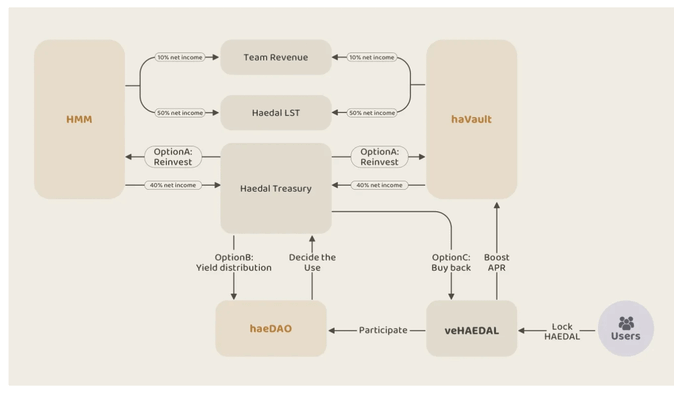
Haedal significantly improves the staking performance of the Sui network by adopting a dynamic validator selection mechanism and an innovative Hae3 framework: including three major components: HMM, HaeVault and HaeDAO, and its performance surpasses other LSD protocols.

Haedal monitors the status of all network verification nodes and selects the node with the highest APR when staking. When canceling the pledge, Haedal will give priority to withdrawing funds from the verification nodes with lower APR. This strategy can continuously ensure that the liquidity staked tokens maintain a high annualized rate of return.

HMM (Haedal Market Maker) optimizes the liquidity of various DEXs on the Sui blockchain by combining oracle pricing and real-time market data, and charges a transaction fee of 0.04%.

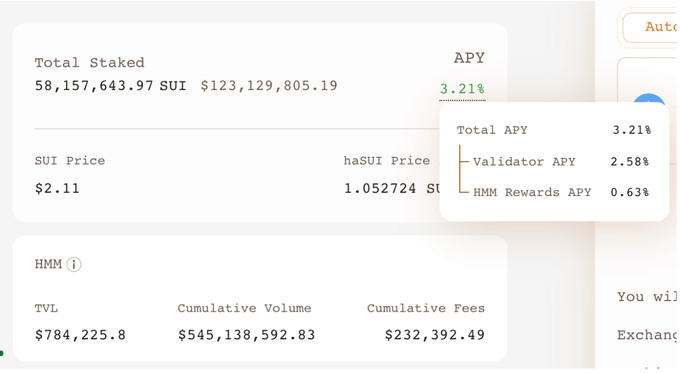
From February to March, trading volume increased from $59.13 million to $284.15 million, generating $236,000 in fees, with an average TVL of $800,000 during the period. After using 50% of the revenue for incentives, haSUI's annualized rate of return increased by 24.4%, from 2.58% to 3.21%.
Haedal Protocol Analysis: The No. 1 player in Sui’s liquidity staking track, with TVL crushing competitors

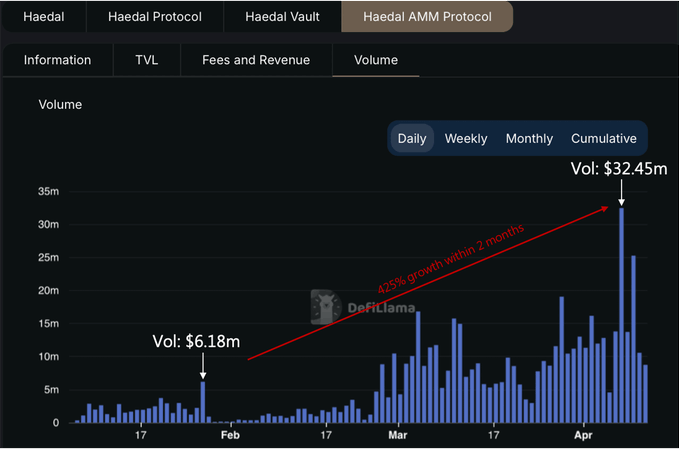
Cetus Protocol is the largest DEX in the Sui ecosystem, with a daily trading volume of $92 million. Haedal was launched on January 6, 2025, and currently has a daily trading volume of $5.69 million, equivalent to 6.12% of Cetus's trading volume. By adopting an oracle pricing mechanism, HMM is poised to achieve rapid revenue growth by capturing arbitrage trading volume.
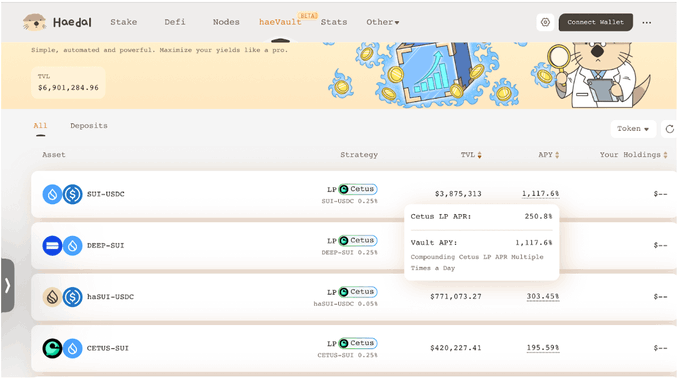
Haedal Protocol Analysis: The No. 1 player in Sui’s liquidity staking track, with TVL crushing competitors Haedal Vault simplifies the liquidity provision process for users with idle funds, eliminating the tedious operations of managing LP positions, allowing users to easily deposit funds and obtain higher returns.

HaeVault improves returns through ultra-narrow rebalancing strategies. Taking the SUI-USDC trading pair as an example, the annualized rate of return provided by the Cetus platform is 250.8% (based on Cetus data), while HaeVault achieves an annualized rate of return of 1117%. After deducting 16% of the fee, the net rate of return is still as high as 938%.
Haedal Protocol Analysis: The No. 1 player in Sui’s liquidity staking track, with TVL crushing competitors

Hae3 is deeply integrated into the Sui DeFi ecosystem (TVL exceeds $1 billion). Among them, the HMM protocol captures DEX fee income, the Haedal vault optimizes the income of liquidity providers, and HaeDAO grants governance decision-making power.

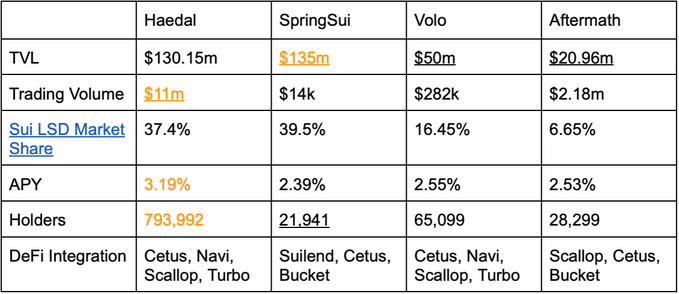
Volo and Suilend, which focus on basic staking and lending operations, lack this synergy, making Haedal a superior yield optimizer.
Haedal Protocol analysis: No. 1 player in Sui’s liquidity staking track, TVL crushes competitors

The use cases of HAEDAL tokens further solidify their value. Locking them into veTokens can be used to participate in HaeDAO governance or to increase the annualized rate of return of the treasury. In addition, potential airdrop opportunities (which are very common in the Sui ecosystem) also add additional advantages.

Haedal's core indicators are strong: TVL reached $117.36 million (compared to Suilend's $117.4 million and Volo's $50 million), the number of daily active wallets exceeded 44,000, and the number of holders reached 794,000. Currently, Haedal is temporarily in the leading position in the three key indicators of transaction volume, annualized rate of return and holder size.

Support from VC institutions such as Hashed, Comma3, OKX Ventures and Animoca Brands further illustrates its potential.
Haedal Protocol analysis: No. 1 player in Sui’s liquidity staking track, TVL crushes competitors

Haedal stands out with its high-growth market (LSD penetration is only 2%, with a 10-fold growth potential), innovative products and solid fundamentals. As the Sui ecosystem expands, the protocol is in a favorable position in the field of liquidity staking and is expected to become an industry leader.

Disclaimer: The articles reposted on this site are sourced from public platforms and are provided for informational purposes only. They do not necessarily reflect the views of MEXC. All rights remain with the original authors. If you believe any content infringes on third-party rights, please contact [email protected] for removal. MEXC makes no guarantees regarding the accuracy, completeness, or timeliness of the content and is not responsible for any actions taken based on the information provided. The content does not constitute financial, legal, or other professional advice, nor should it be considered a recommendation or endorsement by MEXC.

You May Also Like

BDACS Launches KRW1, South Korean Won-Backed Stablecoin, Marking Key Digital Asset Milestone

BDACS Launches KRW1, South Korean Won-Backed Stablecoin, Marking Key Digital Asset Milestone

BDACS launches KRW1, a won-backed stablecoin with strong institutional backing. Avalanche blockchain powers KRW1, ensuring high performance and security. KRW1 aims for diverse use cases in payments and remittances. BDACS has officially launched KRW1, a stablecoin fully backed by the South Korean won, after completing a proof of concept (PoC) that validated its technical infrastructure. This launch is a big move towards BDACS the company has incorporated fiat deposits and issuing of stablecoins as well as blockchain verification into an ever functioning and operational ecosystem. KRW1 will become an important participant in the market of digital assets, where the priority will be compliance with the regulation, openness, and scalability. The stablecoin is fully backed by South Korean won kept in escrow at the Woori Bank, which is the key participant in this project. It also allows for the verification of reserves in real time by means of an integrated banking API, which supports the stability and reliability of KRW1. This is what makes BDACS a unique solution to the problem of breaking the barrier between the old financial system and the digital economy due to its integration of conventional banking and blockchain technology. Also Read: Bitcoin’s Next Move Depends on $115,440: Here’s What Happens Next! Leveraging Avalanche Blockchain for Enhanced Security and Scalability For its blockchain infrastructure, BDACS has chosen the Avalanche network, which is known for its high-performance capabilities and security. Avalanche’s speed and reliability make it an ideal choice for supporting KRW1’s stablecoin operations, ensuring that they can scale effectively while maintaining the highest levels of security. The collaboration between BDACS and Avalanche underscores the company’s belief in utilizing cutting-edge blockchain technology to provide a safe and scalable solution to the digital asset exchange. Looking ahead, BDACS envisions KRW1 as a versatile stablecoin that can be used for various purposes, including remittances, payments, investments, and deposits. The company also intends to incorporate the use case of KRW1 into the public sector, as the company will be able to provide low-cost payment options in emergency relief disbursements and other basic services. This growth will assist in decreasing transaction charges and increasing accessibility to digital financial solutions. BDACS aims to make KRW1 a key component of South Korea’s burgeoning digital economy by making strategic commitments with Woori Bank and using the latest blockchain technology. The company is determined to play a pivotal role in shaping the future of stablecoins in the region. Also Read: Top Investor Issues Advance Warning to XRP Holders – Beware of this Risk The post BDACS Launches KRW1, South Korean Won-Backed Stablecoin, Marking Key Digital Asset Milestone appeared first on 36Crypto.
Share
Coinstats2025/09/18 21:39
What Every Platform Eventually Learns About Handling User Payments Across Borders

What Every Platform Eventually Learns About Handling User Payments Across Borders

There is a moment almost every global platform hits. It rarely shows up in dashboards or board meetings. It reveals itself quietly, one payout del
Share
Medium2025/12/10 21:54
Kalshi debuts ecosystem hub with Solana and Base

Kalshi debuts ecosystem hub with Solana and Base

The post Kalshi debuts ecosystem hub with Solana and Base appeared on BitcoinEthereumNews.com. Kalshi, the US-regulated prediction market exchange, rolled out a new program on Wednesday called KalshiEco Hub. The initiative, developed in partnership with Solana and Coinbase-backed Base, is designed to attract builders, traders, and content creators to a growing ecosystem around prediction markets. By combining its regulatory footing with crypto-native infrastructure, Kalshi said it is aiming to become a bridge between traditional finance and onchain innovation. The hub offers grants, technical assistance, and marketing support to selected projects. Kalshi also announced that it will support native deposits of Solana’s SOL token and USDC stablecoin, making it easier for users already active in crypto to participate directly. Early collaborators include Kalshinomics, a dashboard for market analytics, and Verso, which is building professional-grade tools for market discovery and execution. Other partners, such as Caddy, are exploring ways to expand retail-facing trading experiences. Kalshi’s move to embrace blockchain partnerships comes at a time when prediction markets are drawing fresh attention for their ability to capture sentiment around elections, economic policy, and cultural events. Competitor Polymarket recently acquired QCEX — a derivatives exchange with a CFTC license — to pave its way back into US operations under regulatory compliance. At the same time, platforms like PredictIt continue to push for a clearer regulatory footing. The legal terrain remains complex, with some states issuing cease-and-desist orders over whether these event contracts count as gambling, not finance. This is a developing story. This article was generated with the assistance of AI and reviewed by editor Jeffrey Albus before publication. Get the news in your inbox. Explore Blockworks newsletters: Source: https://blockworks.co/news/kalshi-ecosystem-hub-solana-base
Share
BitcoinEthereumNews2025/09/18 04:40