Top 4 Reasons NVIDIA Stock Has Gone Nowhere Despite Revenue Surge
Key Insights
- NVIDIA stock price has moved horizontally since late last year.
- Analysts have criticized it for circular investments, including in Nebius and CoreWeave.
- Its much-anticipated return to selling chips to Chinese customers has stalled.
NVIDIA stock is flat this year, even as the technology giant faces numerous tailwinds. This includes its strong revenue and profitability growth. It has slumped by over 10% from its record high, with its valuation falling by over $500 billion.
NVIDIA Stock Dropped Amid Circular Investment Concerns
In a major statement this week, NVIDIA said that it was investing $2 billion in Nebius. That’s a top neocloud company that counts Microsoft and Meta Platforms as clients.
This investment came a month after the company invested a similar amount in CoreWeave. It’s a similar firm that provides services to OpenAI and Microsoft.
In addition to this, NVIDIA recently said that it would invest $30 billion in OpenAI, the creator of ChatGPT.
These investments, while good, have raised substantial concerns about circular allocation of cash. This is a situation where the company invests in its customers, who then use these funds to buy its chips.
As a result, Nvidia benefits from having higher revenues. This, in theory, leads to a higher stock price.
Critics argue that the circular investment approach serves as a market signal. They claim the company uses it to project an image of accelerating growth.
China Woes Have Continued
Meanwhile, one of the recent bullish catalysts for the NVIDIA stock price is taking time to materialize. Investors have been waiting for the company to start selling its chips to Chinese companies like Alibaba, Baidu, and Tencent.
This crisis started last year when President Trump ordered NVIDIA, AMD, and others to stop selling to Chinese firms. This order came amid the trade war.
After much lobbying by Jensen Huang and others, Trump relented and allowed it to sell the chips. His condition was that the Commerce Department should assess the potential buyers and their relationship with the military.
China, on the other hand, developed cold feet and announced a review on whether it should allow these chips in the country. Beijing argued that local companies were okay using those made by local companies.
NVIDIA has yet to start selling its GPUs to China because of the ongoing review. On the positive side, this issue will likely be handled in Trump’s trip to China later this month.
Rotation From Growth to Value
Additionally, the ongoing NVIDIA stock price consolidation is due to the broader rotation from growth to value.
This is a situation where investors move from companies demonstrating strong growth to those with slow and consistent growth. This rotation is often due to valuation or industry concerns.
Most growth companies have retreated this year. For example, stocks like Atlassian, Palantir, and AppLovin have all dropped by double digits.
In contrast, top value ETFs like the Schwab US Dividend Equity ETF (SCHD) and the Vanguard Value ETF are doing better. They are performing greatly compared to the tech-heavy Nasdaq 100.
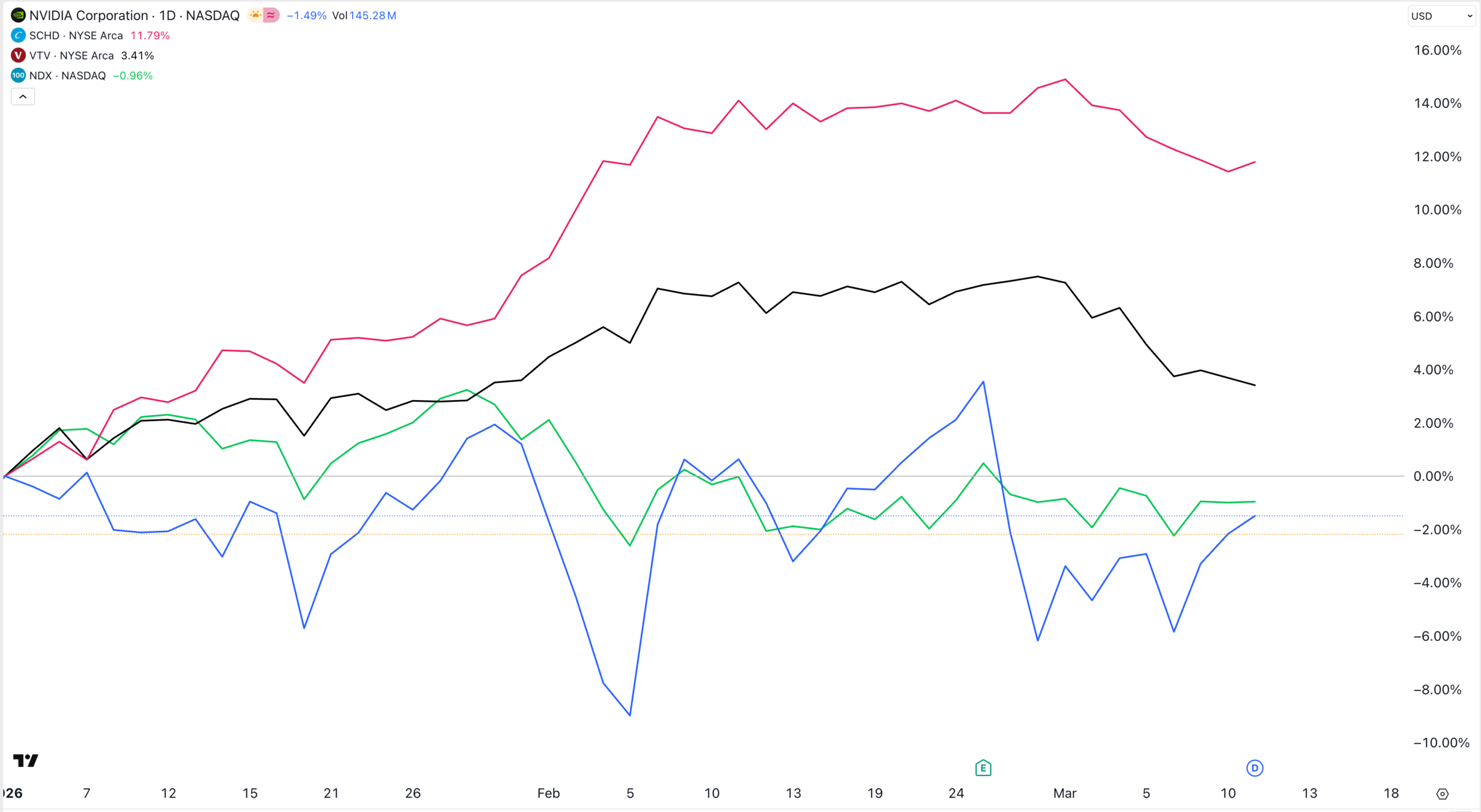 Nasdaq 100 vs SCHD and VTV | Source: TradingView
This rotation to value is happening because of the fear that most technology companies became highly overvalued. As we wrote recently, most valuation metrics show that NVIDIA has now become a bargain.
It also happened amid the ongoing concerns about the potential AI bubble. This explains why top software companies like Adobe, ServiceNow, and Intuit have slumped.
ASIC Chips Development to Fuel Competition
There are concerns that NVIDIA is facing substantial competition, especially from its biggest clients. In a statement this week, Meta Platforms said that it was building its own ASIC chips. It has already rolled out MTIA 300 and is working on MTIA 400, MTIA 450, and MTIA 500.
Other companies like Microsoft and Amazon are also working on their chips. These developments are notable because NVIDIA’s top five customers account for over 50% of its sales.
Still, despite all these challenges, there are reasons why the NVIDIA stock price may rebound soon. Its revenue and profit growth are soaring, and it has a large market share in the GPU industry. The firm is aiming to launch its first CPU soon and has become highly undervalued.
The post Top 4 Reasons NVIDIA Stock Has Gone Nowhere Despite Revenue Surge appeared first on The Market Periodical.
You May Also Like

Here’s How Consumers May Benefit From Lower Interest Rates

Two Tokens Control 86% of the Stablecoin Market and the Gap Is Not Closing