

- Quick Buy/SellBuy & sell with cards and mobile payments
- P2PTrade with local payments at best prices
- Fiat DepositDeposit in BRL, COP, EUR, and more
- Global Bank TransferBuy and sell via local banks
- MEXC CardSpend your crypto worldwide
- SpotBuy and sell crypto with ease
- RealStocksTrade top US equities directly with crypto
- ConvertSwap hot tokens instantly with 0 fees
- Pre-MarketGet in early before official listings
- MX ZoneUnlock exclusive perks with MX
- Spot DCASteady growth through ups and downs
- Spot GridBuy low and sell high 24/7
- Meme+Discover on-chain gems early
- On-ChainYour unified hub for discovering, trading, and managing on-chain assets
- USDT-MPerpetual Futures settled in USDT
- USDC-MPerpetual Futures settled in USDC
- USD1-MPerpetual Futures settled in USD1
- Coin-MPerpetual Futures settled in other cryptos
- Futures EarnEarn up to 20% APR on your Futures funds
- AI StrategyConvert ideas into strategic action
- Grid TradingCapture volatility with automated trading
- Copy Trade × AIFollow seasoned traders or strategize with AI
- Demo TradingSimulate Futures trading risk-free
- Futures OverviewExplore Futures tools, products, and features
- GOLD Futures24/7 access to top liquidity & leveraged power
- OIL Futures24/7 access to top liquidity & leveraged trading
- SILVER FuturesTrade with 0 fees, top liquidity, and flexible leverage.
- BTC FuturesMarket's lowest fees and high leverage
- ETH FuturesMarket's lowest fees and high leverage
- ZEC Futures SurgeEnjoy 0 fees, up to 150× leverage, and top position capacity at 21×+ leverage
- MEXC EarnEarn high APR on your crypto
- Hold and EarnHold assets and earn interest daily
- Futures EarnEarn on balance and unlock higher APR as you trade
- On-Chain EarnEasy staking. Real on-chain yield
- MEXC LoansBorrow instantly at competitive rates
- Rewards HubGet started with $10,000 in bonuses
- Event CenterHigher rewards, 0 fees
- Invite and EarnInvite friends and earn 140 USDT each
- LaunchpadAccess top tokens early or at a discount
- $500K TSLA FeverWin TSLAX, TSLAON & more!
- Airdrop+Deposit and trade to claim new airdrops
- KickstarterHold MX to earn new tokens
- RealStocks PNL Rate LeaderboardTrade $100 to win up to $10,000 in stock rewards
- 0 FeesTrade hot futures, enjoy limited 0 fees
- Futures M-DayTrade Futures and claim daily rewards
- Futures Loss Coverage PlanGet triple protection and win $5,000 in XAUT
- Referral ProgramInvite friends and unlock commissions from 40%
- Affiliate ProgramTop-tier affiliate commissions up to 70%
- MEXC VVIPM-Score into Wealth, 10+ Elite Benefits Upgrading
- MEXC × TradingViewConnect MEXC to trade directly on TradingView
- Crypto NewsFollow the latest crypto headlines
- AnnouncementsStay on top of every happening on MEXC
- LearnStrong crypto fundamentals for every beginner
- MEXC InstitutionalTailored solutions for institutional clients
JPM Coin Ethereum: Are Bank Deposits Moving Onchain?
J.P. Morgan has brought JPM Coin, ticker JPMD, to the Ethereum mainnet, extending its USD-denominated deposit token to a second public blockchain after launching it on Base. The October 19, 2026 expansion matters because JPMD is not a conventional stablecoin. It represents a U.S. dollar deposit at J.P. Morgan and remains available to eligible institutional clients rather than the general public.
That distinction changes how the move should be interpreted. Ethereum already hosts tokenized funds, real-world assets, collateral and a deep pool of onchain liquidity. Bringing a bank deposit token into the same execution environment gives institutions another way to settle payments and move cash without leaving the public-chain ecosystem for every transaction. The shift is therefore less about Ethereum gaining another token and more about bank money beginning to sit directly beside tokenized financial assets.
The JPM Coin Ethereum expansion also shows how the boundary between public blockchain infrastructure and regulated banking is becoming less rigid. J.P. Morgan still controls access to JPMD, and the token remains part of a regulated banking relationship. What changes is where that bank liability can be used. If more institutional assets move onto public chains, the availability of bank-issued onchain cash could become increasingly important for payments, collateral and settlement.
Key Takeaways
- J.P. Morgan launched JPM Coin on Ethereum mainnet on October 19, 2026.
- JPMD is a USD deposit token for institutional clients, not a public retail stablecoin.
- Ethereum becomes the second public blockchain for JPMD after Base.
- The expansion places bank-issued onchain cash closer to tokenized assets and institutional liquidity.
- The strategic value lies in reducing the need to move between public-chain assets and offchain bank settlement.
What Changes With JPM Coin Ethereum?
The JPM Coin Ethereum launch expands where J.P. Morgan's institutional clients can use tokenized bank deposits. JPMD had already moved beyond private-bank blockchain infrastructure through its Base deployment. Adding Ethereum brings the token directly onto the Layer 1 network where many tokenized assets, DeFi protocols and institutional blockchain projects already operate.
The product itself does not suddenly become permissionless. JPMD remains tied to a J.P. Morgan banking relationship and is intended for eligible institutional clients. What changes is that institutions can potentially keep both the asset side and the cash side of certain transactions in the same public-chain environment.
MEXC's earlier coverage of JPM Coin's multichain expansion provides useful background on J.P. Morgan's broader effort to make tokenized bank money interoperable across public and institutional blockchain networks.
Is JPM Coin Ethereum the Same as a Stablecoin?
No. JPMD is a tokenized bank deposit rather than a conventional public stablecoin.
That difference starts with the claim represented by the token. A deposit token represents a claim on a deposit held with the issuing bank. A typical fiat-backed stablecoin represents a claim structured around reserves held by a non-bank or specialized issuer, subject to that issuer's legal and regulatory framework.
Access is also different. JPMD is designed for institutional clients and operates inside J.P. Morgan's controlled compliance environment. A public stablecoin such as USDC can generally circulate much more broadly across exchanges, wallets and applications.
This distinction matters because JPMD brings a regulated bank liability onto a public blockchain without turning that liability into an unrestricted retail asset.
Why Ethereum Became the Next Network
Ethereum already hosts a large concentration of tokenized assets and onchain liquidity. That makes it useful not simply as another blockchain distribution channel, but as a place where institutional assets and payment instruments can coexist.
A simplified transaction can now look like this:
Tokenized asset
→ institutional trade
→ JPMD payment
→ Ethereum settlement
→ bank deposit claim
The advantage is not that every financial process becomes decentralized. JPMD remains bank-issued and access-controlled. The advantage is that institutions may be able to reduce the number of times they move between blockchain-based assets and conventional banking rails during the lifecycle of a transaction.
For example, an institution holding a tokenized fund on Ethereum may otherwise need to sell, withdraw or bridge value before returning to bank money. A deposit token can potentially keep the cash leg closer to the asset leg, making settlement, collateral management or treasury movement more programmable.
That helps explain why Ethereum's role matters. The network already acts as a venue for tokenized assets; JPMD adds a form of bank money that can operate alongside them.
Deposit Token, Stablecoin, or Traditional Deposit?
The three instruments can all represent dollar-denominated value, but they are not interchangeable.
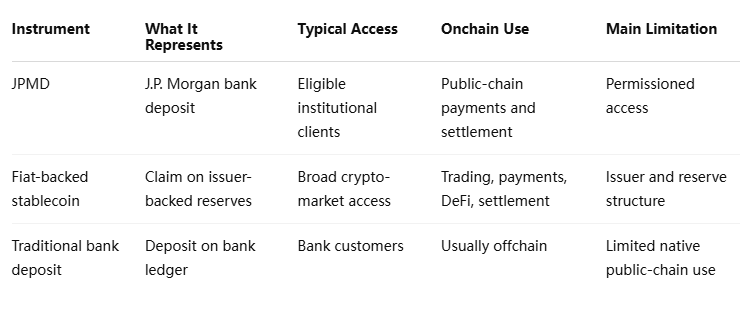
The practical difference is not only technical. It concerns legal claim, issuer structure, access rules and where the instrument can move.
JPM Coin Ethereum does not replace stablecoins because the two products serve different users and operating models. Stablecoins remain useful where open circulation and broad interoperability matter. Deposit tokens are more naturally suited to institutions that want onchain functionality while preserving a direct banking relationship.
The Bigger Shift Is Public-Chain Bank Money
The more important development is that public blockchains are no longer being used only for tokenized assets. They are increasingly becoming environments where different forms of money and financial claims can interact.
J.P. Morgan has already moved parts of its tokenized-finance strategy onto public networks, including JPMD on Base and tokenized money-market activity on Ethereum. Adding JPMD to Ethereum brings another piece of the institutional stack onto the same infrastructure.
This matters because tokenization has long had an asymmetry problem. Assets could be placed onchain, but the cash side of settlement often remained dependent on traditional banking windows or separate stablecoin infrastructure. That creates operational friction precisely at the point where institutions need certainty of payment.
A bank deposit token does not eliminate that problem entirely, but it gives institutions another native settlement asset that remains connected to a bank balance.
The transition is therefore moving from tokenized assets alone toward tokenized assets plus tokenized cash.
MEXC View: Onchain Finance Needs Native Cash, Not Just Assets
Institutional tokenization cannot scale efficiently if only the asset side moves onchain. A tokenized bond, fund or collateral position still needs a reliable cash leg for settlement, margin and redemption.
JPM Coin Ethereum addresses that missing layer from the perspective of regulated bank money. It allows institutions to use a deposit claim issued by a major bank in the same environment where tokenized financial assets already exist.
That does not make JPMD a universal settlement asset, and it does not reduce the role of stablecoins or traditional bank rails. But it shows that public-chain finance is becoming less dependent on moving back and forth between fundamentally different systems.
If more banks follow the same model, the institutional blockchain market may evolve into an environment where tokenized deposits, stablecoins and central-bank money all compete or coexist as different forms of settlement liquidity.
Risks and Limitations
- Access remains institutional. JPMD is not an unrestricted retail token and continues to depend on J.P. Morgan eligibility and compliance requirements.
- JPMD is not a public stablecoin. It represents a bank deposit and should not be analyzed using the same legal or distribution assumptions as USDC or similar assets.
- Kinexys volume is not JPMD Ethereum volume. Broader Kinexys transaction statistics should not be used as a proxy for adoption of the new Ethereum deployment.
- Ethereum deployment does not replace banking rails. Traditional payment systems and J.P. Morgan's other settlement infrastructure remain part of the broader architecture.
- Public-chain presence does not mean permissionless finance. Access controls and institutional requirements remain central to the product.
- Adoption still needs to be demonstrated. Technical availability does not guarantee large payment or settlement flows
Ethereum Is Becoming a Venue for Both Assets and Cash
The JPM Coin Ethereum expansion matters because institutional blockchain markets need more than tokenized assets. They need credible forms of cash that can settle against those assets without forcing every transaction back through separate offchain workflows.
JPMD adds one such instrument. It remains a regulated J.P. Morgan deposit token with restricted institutional access, but it can now operate directly on Ethereum, where tokenized funds, collateral and other financial assets already exist. That creates a more complete settlement environment than an asset-only blockchain market.
The development should not be interpreted as a replacement for stablecoins or traditional banking. Deposit tokens solve a different problem. They give bank clients a way to preserve the legal and operational relationship of a commercial-bank deposit while gaining some of the programmability and interoperability of public blockchain infrastructure.
The larger question is whether other major banks will follow. If tokenized assets continue moving onto Ethereum and other public networks, institutional users will increasingly need native cash instruments with sufficient regulatory certainty and liquidity. JPM Coin Ethereum suggests that banks are beginning to compete for that role directly. The next indicators to watch are transaction adoption, integration with tokenized assets, additional supported networks and whether other banks introduce comparable deposit-token products.
Sources
J.P. Morgan — JPM Coin goes live on Ethereum:
https://www.jpmorgan.com/payments/newsroom/jpm-coin-live-on-ethereum
MEXC News — JPMorgan’s Kinexys to Issue JPM Coin Natively on Canton Network:
https://www.mexc.com/news/426075
Risk Disclaimer: This article is for reference only and does not constitute investment advice. The cryptocurrency market is highly volatile. Please make decisions cautiously based on your individual circumstances.
News Related to PUBLIC

ARK Venture Fund tokenization: What Do Investors Own?

How Ave’s Arc Chain Integration Supports Stablecoin Finance

Comments
Only preset comments and emojis can be selected