Learn how Moment-Sum-of-Squares relaxation improves optimization for machine learning models when standard SDP methods fail to find global optima.Learn how Moment-Sum-of-Squares relaxation improves optimization for machine learning models when standard SDP methods fail to find global optima.

Improving Global Optimization in HSVM and SDP Problems

2026/01/14 23:30
3 min read
For feedback or concerns regarding this content, please contact us at [email protected]

Abstract and 1. Introduction

  1. Related Works

  2. Convex Relaxation Techniques for Hyperbolic SVMs

    3.1 Preliminaries

    3.2 Original Formulation of the HSVM

    3.3 Semidefinite Formulation

    3.4 Moment-Sum-of-Squares Relaxation

  3. Experiments

    4.1 Synthetic Dataset

    4.2 Real Dataset

  4. Discussions, Acknowledgements, and References

    \

A. Proofs

B. Solution Extraction in Relaxed Formulation

C. On Moment Sum-of-Squares Relaxation Hierarchy

D. Platt Scaling [31]

E. Detailed Experimental Results

F. Robust Hyperbolic Support Vector Machine

3.4 Moment-Sum-of-Squares Relaxation

The SDP relaxation in Equation (8) may not be tight, particularly when the resulting W has a rank much larger than 1. Indeed, we often find W to be full-rank empirically. In such cases, moment-sum-of-squares relaxation may be beneficial. Specifically, it can certifiably find the global optima, provided that the solution exhibits a special structure, known as the flat-extension property [30, 32].

\
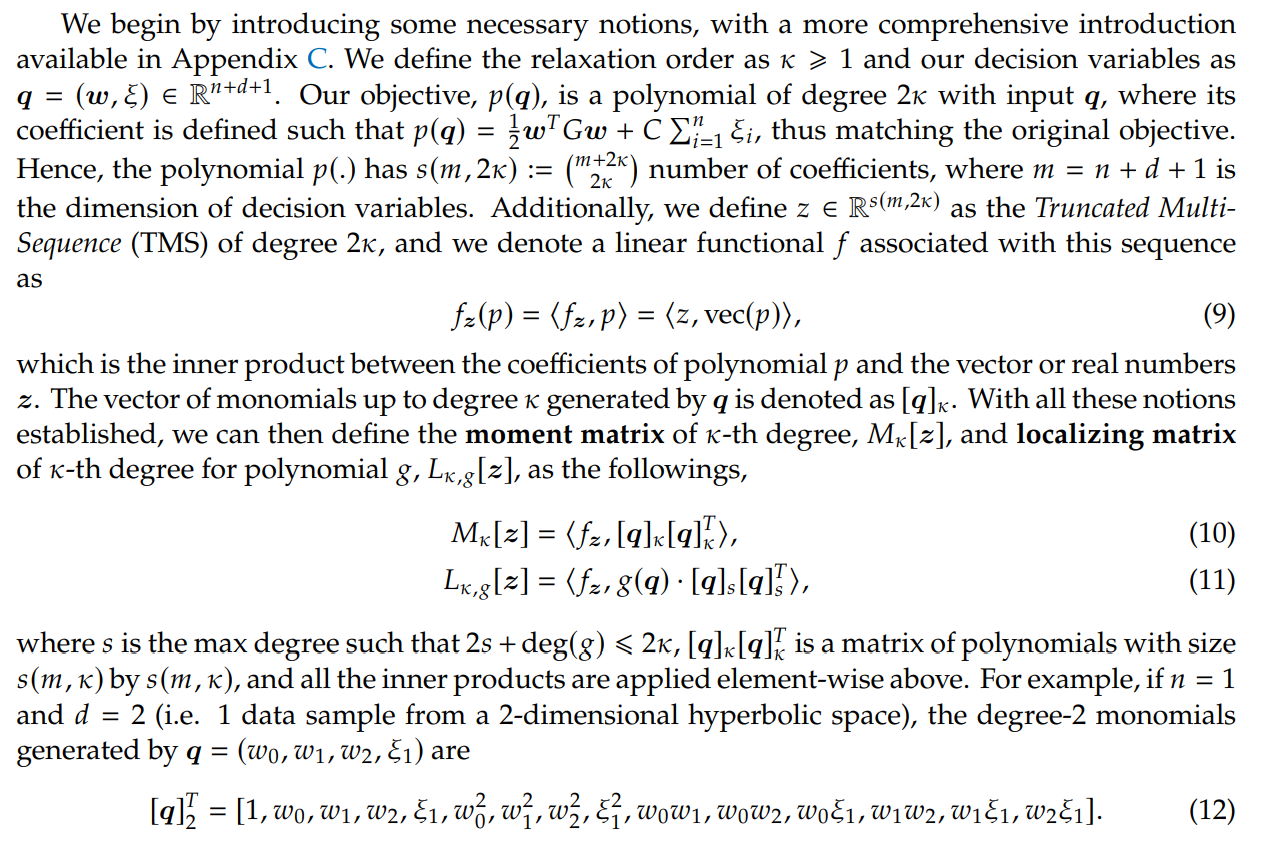
\ With all these definitions established, we can present the moment-sum-of-squares relaxation [9] to the HSVM problem, outlined in Equation (7), as

\
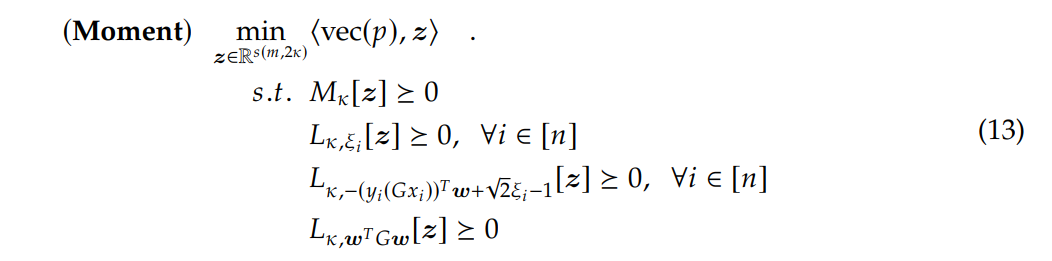
\ Note that 𝑔(q) ⩟ 0, as previously defined, serves as constraints in the original formulation. Additionally, when forming the moment matrix, the degree of generated monomials is 𝑠 = 𝜅 − 1, since all constraints in Equation (7) has maximum degree 1. Consequently, Equation (13) is a convex programming and can be implemented as a standard SDP problem using mainstream solvers. We further emphasize that by progressively increasing the relaxation order 𝜅, we can find increasingly better solutions theoretically, as suggested by Lasserre [33]

\
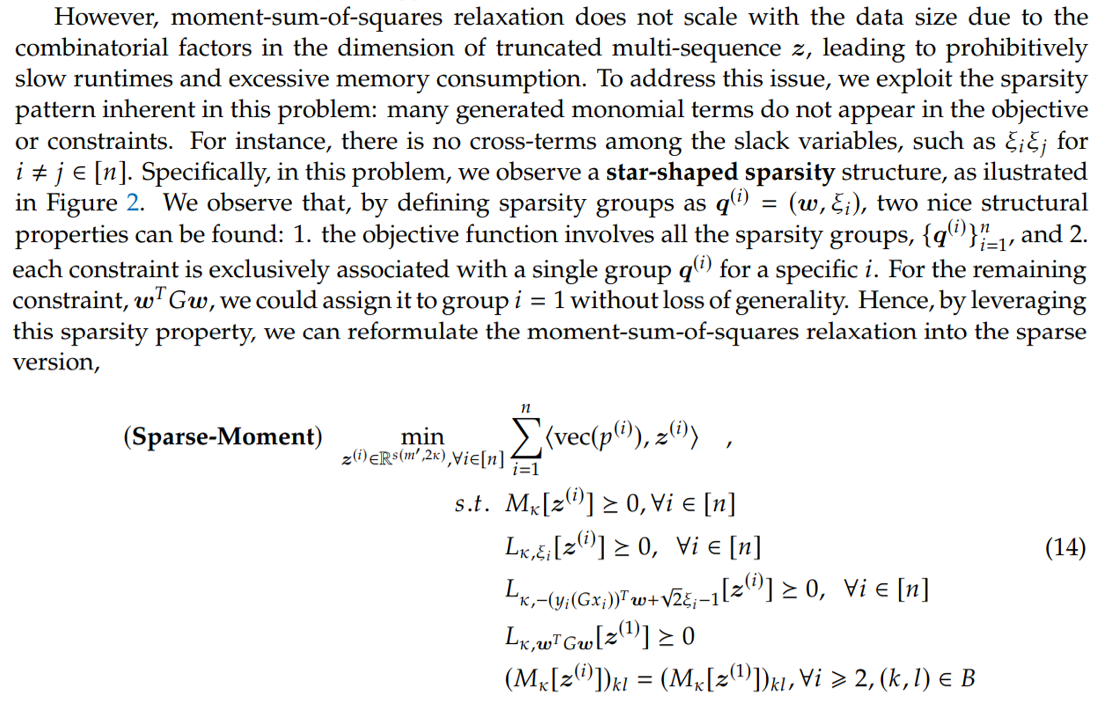
\ where đ” is an index set of the moment matrix to entries generated by w along, ensuring that each moment matrix with overlapping regions share the same values as required. We refer the last constraint as the sparse-binding constraint.

\ Unfortunately, our solution empirically does not satisfy the flat-extension property and we cannot not certify global optimality. Nonetheless, in practice, it achieves significant performance improvements in selected datasets over both projected gradient descent and the SDP-relaxed formulation. Similarly, this formulation does not directly yield decision boundaries and we defer discussions on the extraction methods to Appendix B.2.

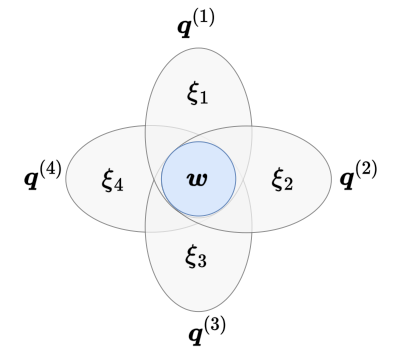
\ Figure 2: Star-shaped Sparsity pattern in Equation (13) visualized with 𝑛 = 4
\

:::info Authors:

(1) Sheng Yang, John A. Paulson School of Engineering and Applied Sciences, Harvard University, Cambridge, MA ([email protected]);

(2) Peihan Liu, John A. Paulson School of Engineering and Applied Sciences, Harvard University, Cambridge, MA ([email protected]);

(3) Cengiz Pehlevan, John A. Paulson School of Engineering and Applied Sciences, Harvard University, Cambridge, MA, Center for Brain Science, Harvard University, Cambridge, MA, and Kempner Institute for the Study of Natural and Artificial Intelligence, Harvard University, Cambridge, MA ([email protected]).

:::


:::info This paper is available on arxiv under CC by-SA 4.0 Deed (Attribution-Sharealike 4.0 International) license.

:::

\

Market Opportunity
Brainedge Logo
Brainedge Price(LEARN)
$0.006822
$0.006822$0.006822
-2.91%
USD
Brainedge (LEARN) Live Price Chart
Disclaimer: The articles reposted on this site are sourced from public platforms and are provided for informational purposes only. They do not necessarily reflect the views of MEXC. All rights remain with the original authors. If you believe any content infringes on third-party rights, please contact [email protected] for removal. MEXC makes no guarantees regarding the accuracy, completeness, or timeliness of the content and is not responsible for any actions taken based on the information provided. The content does not constitute financial, legal, or other professional advice, nor should it be considered a recommendation or endorsement by MEXC.

You May Also Like

Provenance Blockchain (HASH) Jumps 23.8% as Trading Volume Reveals Supply Squeeze

Provenance Blockchain (HASH) Jumps 23.8% as Trading Volume Reveals Supply Squeeze

Provenance Blockchain's HASH token posted a surprising 23.8% gain in 24 hours, but the modest $114,406 trading volume tells a more complex story. Our analysis of
Share
Blockchainmagazine2026/03/19 21:03
Cryptos Signal Divergence Ahead of Fed Rate Decision

Cryptos Signal Divergence Ahead of Fed Rate Decision

The post Cryptos Signal Divergence Ahead of Fed Rate Decision appeared on BitcoinEthereumNews.com. Crypto assets send conflicting signals ahead of the Federal Reserve’s September rate decision. On-chain data reveals a clear decrease in Bitcoin and Ethereum flowing into centralized exchanges, but a sharp increase in altcoin inflows. The findings come from a Tuesday report by CryptoQuant, an on-chain data platform. The firm’s data shows a stark divergence in coin volume, which has been observed in movements onto centralized exchanges over the past few weeks. Bitcoin and Ethereum Inflows Drop to Multi-Month Lows Sponsored Sponsored Bitcoin has seen a dramatic drop in exchange inflows, with the 7-day moving average plummeting to 25,000 BTC, its lowest level in over a year. The average deposit per transaction has fallen to 0.57 BTC as of September. This suggests that smaller retail investors, rather than large-scale whales, are responsible for the recent cash-outs. Ethereum is showing a similar trend, with its daily exchange inflows decreasing to a two-month low. CryptoQuant reported that the 7-day moving average for ETH deposits on exchanges is around 783,000 ETH, the lowest in two months. Other Altcoins See Renewed Selling Pressure In contrast, other altcoin deposit activity on exchanges has surged. The number of altcoin deposit transactions on centralized exchanges was quite steady in May and June of this year, maintaining a 7-day moving average of about 20,000 to 30,000. Recently, however, that figure has jumped to 55,000 transactions. Altcoins: Exchange Inflow Transaction Count. Source: CryptoQuant CryptoQuant projects that altcoins, given their increased inflow activity, could face relatively higher selling pressure compared to BTC and ETH. Meanwhile, the balance of stablecoins on exchanges—a key indicator of potential buying pressure—has increased significantly. The report notes that the exchange USDT balance, around $273 million in April, grew to $379 million by August 31, marking a new yearly high. CryptoQuant interprets this surge as a reflection of

Share
BitcoinEthereumNews2025/09/18 01:01
XRP and Chainlink Clash Again as Social Media Feud Returns

XRP and Chainlink Clash Again as Social Media Feud Returns

The post XRP and Chainlink Clash Again as Social Media Feud Returns appeared on BitcoinEthereumNews.com. Chainlink liaison Zach Rynes faced pushback after he labeled
Share
BitcoinEthereumNews2026/03/19 20:52