Koko Networks, a Kenyan climate tech startup once touted as a major solution to clean cooking in Africa,… The post Kenyan climate startup Koko shuts down after $Koko Networks, a Kenyan climate tech startup once touted as a major solution to clean cooking in Africa,… The post Kenyan climate startup Koko shuts down after $

Kenyan climate startup Koko shuts down after $60m debt crisis

Koko Networks, a Kenyan climate tech startup once touted as a major solution to clean cooking in Africa, has shut down operations after accumulating more than $60 million in debt. The company confirmed the closure to staff on Friday, laying off about 700 employees with immediate effect.

Founded in 2014, Koko established a fuel distribution network that enabled low-income households to transition from charcoal to bioethanol, a cleaner and more sustainable alternative. Over the years, it rolled out thousands of automated fuel dispensers across Kenya and served more than one million households.

But the business collapsed after regulatory delays cut off its main source of funding, carbon credits, leaving the company unable to cover operating costs or repay lenders.

Kenyan climate startup Koko shuts down after $60m debt crisis
When carbon money stopped flowing

Koko made money by selling carbon credits from households using cleaner fuel. That money helped lower stove and fuel prices. But the government never approved international credit trading, so the system failed.

Approval was never granted. As delays continued, Koko faced increasing difficulty covering the gap between customer payments and supply chain costs. With cash flow diminishing, lenders secured their loans and tightened control over company assets well before the shutdown.

Also read: Nigeria’s clean cooking challenge goes beyond stoves – BURN

Koko’s collapse is significant because it was one of Africa’s most recognised clean cooking startups, having raised substantial funding and received support from global climate funds. Its failure raises concerns about the viability of climate startups that rely heavily on government-supported carbon markets.

Kenyan climate startup Koko shuts down after $60m debt crisis

It also highlights the practical fragility of carbon financing. Despite growing demand for cleaner energy, regulatory uncertainty can still derail large-scale projects intended to benefit low-income communities.

What Koko’s shutdown leaves behind

Koko’s collapse is significant because it was one of Africa’s most recognised clean cooking startups, having raised substantial funding and received support from global climate funds. Its failure raises concerns about the viability of climate startups that rely heavily on government-supported carbon markets.

For households, the immediate impact is practical: over one million Kenyan families now face uncertainty around access to affordable cooking fuel, with many likely forced back to charcoal, which is dirtier and more expensive over time.

For investors and lenders, the focus has shifted to recovering losses. Koko owes more than $60 million, and although its backers hold insurance guarantees, any payout could take years due to legal and regulatory processes.

Kenyan climate startup Koko shuts down after $60m debt crisis

The shutdown in Kenya serves as a warning to African climate tech founders that even well-funded solutions can fail without aligned government policy, financing, and infrastructure.

Koko’s rise and fall now stand as one of the clearest examples of how hard it remains to turn climate innovation into sustainable business, especially when entire models depend on carbon markets that are still evolving.

The post Kenyan climate startup Koko shuts down after $60m debt crisis first appeared on Technext.

Disclaimer: The articles reposted on this site are sourced from public platforms and are provided for informational purposes only. They do not necessarily reflect the views of MEXC. All rights remain with the original authors. If you believe any content infringes on third-party rights, please contact [email protected] for removal. MEXC makes no guarantees regarding the accuracy, completeness, or timeliness of the content and is not responsible for any actions taken based on the information provided. The content does not constitute financial, legal, or other professional advice, nor should it be considered a recommendation or endorsement by MEXC.

You May Also Like

Telos Advisers Welcomes Stephen Gardner as a Strategic Advisory Board Member

Telos Advisers Welcomes Stephen Gardner as a Strategic Advisory Board Member

Former Amtrak CEO brings more than 25 years of leadership experience in rail, infrastructure delivery, and national transportation policy NEWARK, N.J.–(BUSINESS
Share
AI Journal2026/02/03 02:16
CEO Sandeep Nailwal Shared Highlights About RWA on Polygon
CEO Sandeep Nailwal Shared Highlights About RWA on Polygon

The post CEO Sandeep Nailwal Shared Highlights About RWA on Polygon appeared on BitcoinEthereumNews.com. Polygon CEO Sandeep Nailwal highlighted Polygon’s lead in global bonds, Spiko US T-Bill, and Spiko Euro T-Bill. Polygon published an X post to share that its roadmap to GigaGas was still scaling. Sentiments around POL price were last seen to be bearish. Polygon CEO Sandeep Nailwal shared key pointers from the Dune and RWA.xyz report. These pertain to highlights about RWA on Polygon. Simultaneously, Polygon underlined its roadmap towards GigaGas. Sentiments around POL price were last seen fumbling under bearish emotions. Polygon CEO Sandeep Nailwal on Polygon RWA CEO Sandeep Nailwal highlighted three key points from the Dune and RWA.xyz report. The Chief Executive of Polygon maintained that Polygon PoS was hosting RWA TVL worth $1.13 billion across 269 assets plus 2,900 holders. Nailwal confirmed from the report that RWA was happening on Polygon. The Dune and https://t.co/W6WSFlHoQF report on RWA is out and it shows that RWA is happening on Polygon. Here are a few highlights: – Leading in Global Bonds: Polygon holds 62% share of tokenized global bonds (driven by Spiko’s euro MMF and Cashlink euro issues) – Spiko U.S.… — Sandeep | CEO, Polygon Foundation (※,※) (@sandeepnailwal) September 17, 2025 The X post published by Polygon CEO Sandeep Nailwal underlined that the ecosystem was leading in global bonds by holding a 62% share of tokenized global bonds. He further highlighted that Polygon was leading with Spiko US T-Bill at approximately 29% share of TVL along with Ethereum, adding that the ecosystem had more than 50% share in the number of holders. Finally, Sandeep highlighted from the report that there was a strong adoption for Spiko Euro T-Bill with 38% share of TVL. He added that 68% of returns were on Polygon across all the chains. Polygon Roadmap to GigaGas In a different update from Polygon, the community…
Share
BitcoinEthereumNews2025/09/18 01:10
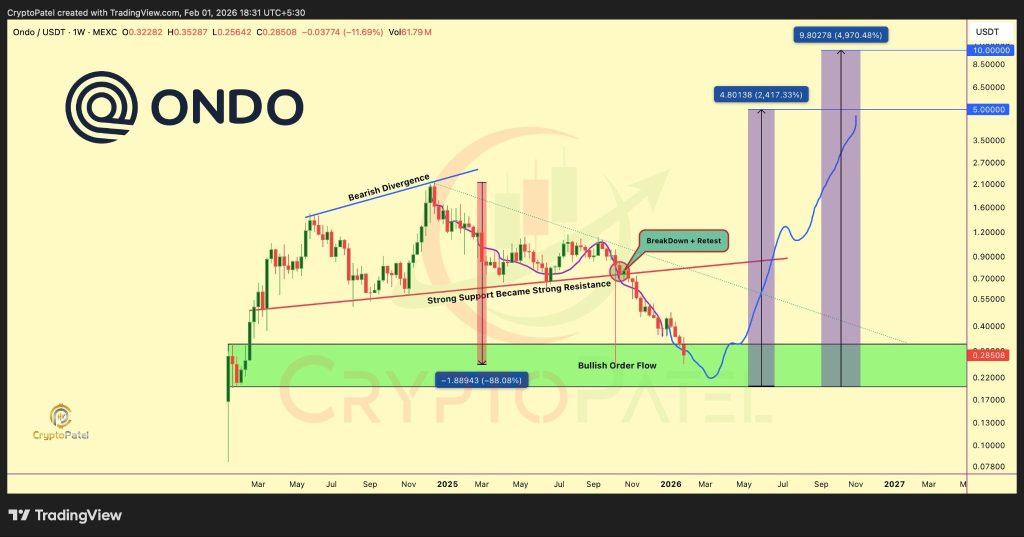
ONDO Price Crashes 88% From All-Time Highs, But Analyst Says ‘Last Hope’ Zone Is Here

ONDO Price Crashes 88% From All-Time Highs, But Analyst Says ‘Last Hope’ Zone Is Here

The ONDO price has drifted into a part of the chart that usually gets traders paying attention. After months of downside, the price is now sitting inside a zone
Share
Captainaltcoin2026/02/03 02:30
