Michael Saylor says Bitcoin could emerge as one of the biggest winners if artificial intelligence compresses corporate “terminal value” and forces markets to stopMichael Saylor says Bitcoin could emerge as one of the biggest winners if artificial intelligence compresses corporate “terminal value” and forces markets to stop

Saylor Says Bitcoin Could Win Big If AI Destroys Traditional Moats

2026/03/18 07:00
4 min read
For feedback or concerns regarding this content, please contact us at [email protected]

Michael Saylor says Bitcoin could emerge as one of the biggest winners if artificial intelligence compresses corporate “terminal value” and forces markets to stop paying up for long-dated growth. His argument came in response to Chamath Palihapitiya’s latest thought experiment, which framed AI not simply as a productivity engine, but as a force that could undermine the basic assumptions behind modern equity valuation.

Palihapitiya’s core thesis was stark. If AI makes disruption faster, cheaper, and more relentless, investors may no longer be willing to underwrite cash flows far into the future. In that world, equities would stop being valued as long-duration assets and instead trade closer to what they generate right now.

“The entire architecture of modern capital markets rests on a single, rarely examined assumption: that competitive advantages compound over time. Moats persist. Brands endure. Network effects defend,” Palihapitiya wrote. “Strip that assumption away, and you aren’t just repricing some stocks, you would be dismantling the philosophical foundation of how capital has been allocated for a century.”

He then pushed that logic through a valuation framework built around disruption risk. Using a US 10-year yield of roughly 4.5% as a starting point and an equity risk premium of 4% to 5%, Palihapitiya argued that a stable, durable business might justify a 10x to 12x free cash flow multiple. But once AI-driven obsolescence becomes a serious annual risk, those multiples fall fast. At a 20% annual disruption probability, he estimated fair value at about 3.9x FCF. At 30%, it drops to 2.8x. Even 10% only gets to roughly 6.5x.

That matters because, in his telling, markets have done this before. He pointed to newspapers after digital advertising, retailers facing Amazon, oil majors during the energy transition, and even New York taxi medallions after Uber. In each case, the market was not denying the existence of current cash flows. It was repricing how long those cash flows could realistically last.

Palihapitiya extended that argument to the broader market. With the S&P 500 valued at around $58 trillion and corporate free cash flow near $2.8 trillion annually, he argued that repricing the index at 5x FCF would imply a market value of about $14 trillion, or a 75% drawdown. Even a less severe compression would radically change how capital gets allocated.

Bitcoin Could Surge as AI Destroys Traditional Moats

Saylor’s response was brief and reiterated his previous public stance. “If AI compresses terminal value and makes every moat temporary, capital will rotate to assets with no disruption risk,” he wrote. “Bitcoin is Digital Capital – scarce, neutral, and impervious to AI disruption. $BTC should be the primary beneficiary of this shift.”

That exchange quickly turned to a familiar fault line in Bitcoin debates: quantum risk. Palihapitiya answered that Bitcoin “would need to be quantum resistant by then,” prompting Saylor to push back. “Your AI thesis assumes the digital world is quantum-resistant. If quantum breaks cryptography, it breaks AI, cloud infrastructure, banks, and the internet—not just Bitcoin. The entire stack upgrades together.”

Palihapitiya was unconvinced. “No. A store of value has to be 100% hacking resistant. It’s an existential feature,” he wrote. “For other industries it will be important but less binary/existential.”

Others in crypto added nuance. BitGo CEO Mike Belshe said both sides were partially right, arguing that Bitcoin is likely the “low-hanging fruit” for quantum attackers even if other systems would also be affected. He added: “It’s just too easy relative to other efforts. Similarly, Bitcoin also has the easiest job to be Quantum Resistant – it’s a clean solve technically, suffering only from lack of governance and decisiveness. The banking solution(s) to Quantum will be much harder with a much longer tail of work, but at least the centralized decision making is easier.”

Helius Labs CEO Mert Mumtaz made a similar distinction from another angle: “Those systems can detect, mitigate, and fix against a quantum threat infinitely faster than bitcoin in a non-messy way. That is the cost of decentralization. An EC2 machine getting hacked (won’t happen anyway) is nowhere near the severity of your entire financial getting drained.”

At press time, Bitcoin traded at $74,140.
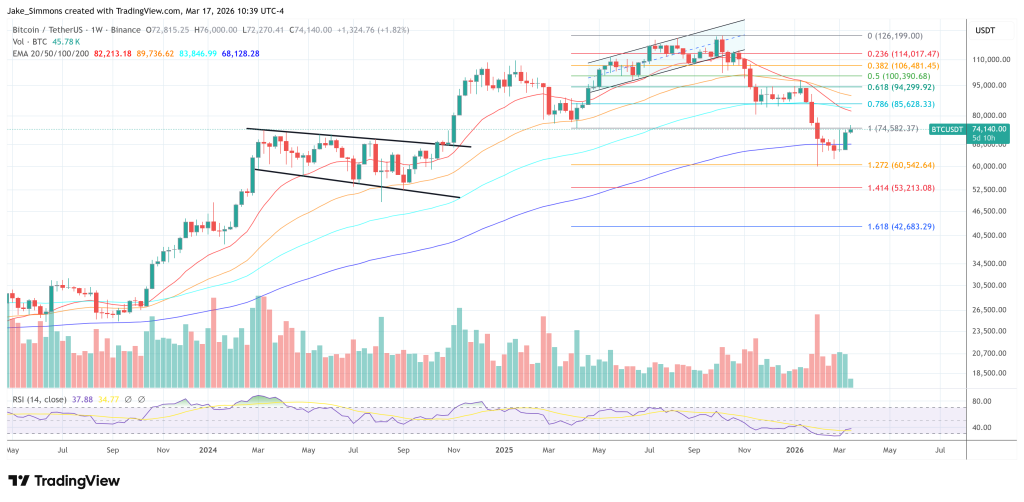
Bitcoin price chart
Market Opportunity
Notcoin Logo
Notcoin Price(NOT)
$0.0004143
$0.0004143$0.0004143
+0.21%
USD
Notcoin (NOT) Live Price Chart
Disclaimer: The articles reposted on this site are sourced from public platforms and are provided for informational purposes only. They do not necessarily reflect the views of MEXC. All rights remain with the original authors. If you believe any content infringes on third-party rights, please contact [email protected] for removal. MEXC makes no guarantees regarding the accuracy, completeness, or timeliness of the content and is not responsible for any actions taken based on the information provided. The content does not constitute financial, legal, or other professional advice, nor should it be considered a recommendation or endorsement by MEXC.

You May Also Like

Neom terminates $1bn tunnel contract at heart of The Line

Neom terminates $1bn tunnel contract at heart of The Line

Saudi Arabia’s Neom has cancelled a roughly $1 billion tunnelling contract at the heart of its flagship “The Line” giga-project, according to public documents.
Share
Agbi2026/03/18 11:28
Gold continues to hit new highs. How to invest in gold in the crypto market?

Gold continues to hit new highs. How to invest in gold in the crypto market?

As Bitcoin encounters a "value winter", real-world gold is recasting the iron curtain of value on the blockchain.
Share
PANews2025/04/14 17:12
These Are The XRP Price Targets You Need To Know Now: Cubic Analytics Founder

These Are The XRP Price Targets You Need To Know Now: Cubic Analytics Founder

Cubic Analytics founder Caleb Franzen says XRP is entering a decisive phase after months of compression, with the price structure implying a path toward the $6–$11 zone so long as the market defends what he calls the key risk line at $2.68. XRP Price Targets In a wide-ranging discussion on the Thinking Crypto podcast with host Tony Edward, Franzen stressed that his conclusions are grounded in “price, structure, and statistical signals” rather than narrative. “It’s the chart itself. It’s the structure itself,” he said. “So long as we stay above $2.68, we’re going much higher.” Franzen’s XRP view comes out of the same template he applies across digital assets: identify trend integrity, map the impulse-consolidation rhythm, and translate it into a ladder of Fibonacci extension targets on a logarithmic scale. In XRP’s case, he argues the market traced higher highs and then “tightened up” into a controlled series of lower highs—what he calls a classic volatility coil that “allows price to reset… for the next leg higher.” Related Reading: Social Media Turns Bearish On XRP: Is This A Buy Signal? He then anchors objective targets to that structure: using the most recent consolidation leg, he cites the 161.8% extension near roughly $4.40 and the 261.8% extension around $6. From the larger Q1 swing—Q1 highs to Q1 lows—he adds a second band of objectives at approximately $5.40 and $11.55. The message, in his words: “Those are the price targets that you have to be aware of if you’re holding and investing in XRP… so long as we stay above $2.68.” Risk management is central to how Franzen frames the trade. Rather than a maximalist forecast, he sets a clear invalidation level and treats it as a mechanical decision point. “If we fall below $2.68, you can get stopped out. You can reduce some of your exposure. You can slow down your DCA,” he said. “It’s okay to be wrong. It’s just not okay to stay wrong.” The Macro Angle Although the podcast also covered Bitcoin, Ethereum and Solana, Franzen’s macro and cross-asset framework is meant to contextualize, not overshadow, the XRP setup. He repeatedly described himself as “time agnostic,” declining to pin outcomes to a specific month or quarter and insisting that the tape, not the calendar, dictates probability. “I’ve been sharing [cycle] targets since the middle of 2023,” he noted, adding that the prudent path is to keep raising targets within an uptrend while letting invalidation handle the rest. That stance is informed by what he characterizes as resilient, supportive macro conditions—good enough for risk assets to trend without demanding a weak US dollar as a crutch. He pointed to strong real activity data and improving earnings assumptions as evidence that risk appetite is not being forced; it’s developing naturally. Related Reading: XRP Ready For $9 Blast — ‘Break $3.10 And It’s Game Over,’ Says Analyst Among the specific markers he flagged: Q2 real GDP growth at 3.8% with expectations of roughly 3.9% for Q3; prime-age unemployment near historic lows at about 3.8%; labor force participation rising; and both real and nominal wage growth, with wages around 4.1% year over year. In credit, he underscored tight spreads and high-yield corporates printing multi-year highs—“and if we adjust them for the dividend yield, they’re trading at all-time highs”—a combination that, in his experience, does not occur when markets are bracing for imminent stress. “As we’re looking at the weight of the evidence here, everything is coming together,” he said. “Higher highs and higher lows, increasing risk appetite, decent macro conditions, the Fed is cutting interest rates… We have to continue to have an upward bias.” That macro lens matters for XRP, he argues, because it reinforces the primacy of structure over story. He criticized a common assumption that crypto rallies must coincide with a falling dollar, highlighting that the US Dollar Index (DXY) has been roughly flat since mid-April while Bitcoin—and, by extension, broader crypto beta—advanced materially. He also described a composite lens that prices Bitcoin against a basket of global currencies (effectively offsetting BTC/USD by DXY) and said that index is making fresh all-time highs too, reflecting “weak global fiat currencies, not necessarily just a weak dollar.” The implication for XRP: if the broader liquidity and risk backdrop continues to reward trend persistence, then the technical coil and extension ladder have a cleaner runway. At press time, XRP traded at $2.8593. Featured image created with DALL.E, chart from TradingView.com
Share
NewsBTC2025/10/08 21:30