Why Gold Plunged More Than 8% This Week Despite Middle East Conflict
Key Takeaways
- Gold experienced an 8% weekly decline, marking its steepest drop since the beginning of 2020
- The late February U.S.-Israel military action against Iran sparked inflation concerns, pressuring precious metals
- Leading central banks worldwide, including the Federal Reserve and European Central Bank, maintained current rates and indicated limited future reductions
- Silver experienced a steeper decline of nearly 10% during the week, with market observers noting its greater vulnerability to currency fluctuations
- Gold prices fell below the $4,800–$5,200 trading corridor established since conflict erupted
Precious metals showed modest gains on Friday, though gold remains poised to close its third consecutive week in negative territory. Spot gold advanced approximately 1.4% to reach $4,715 per ounce, while futures contracts gained roughly 2.4%.
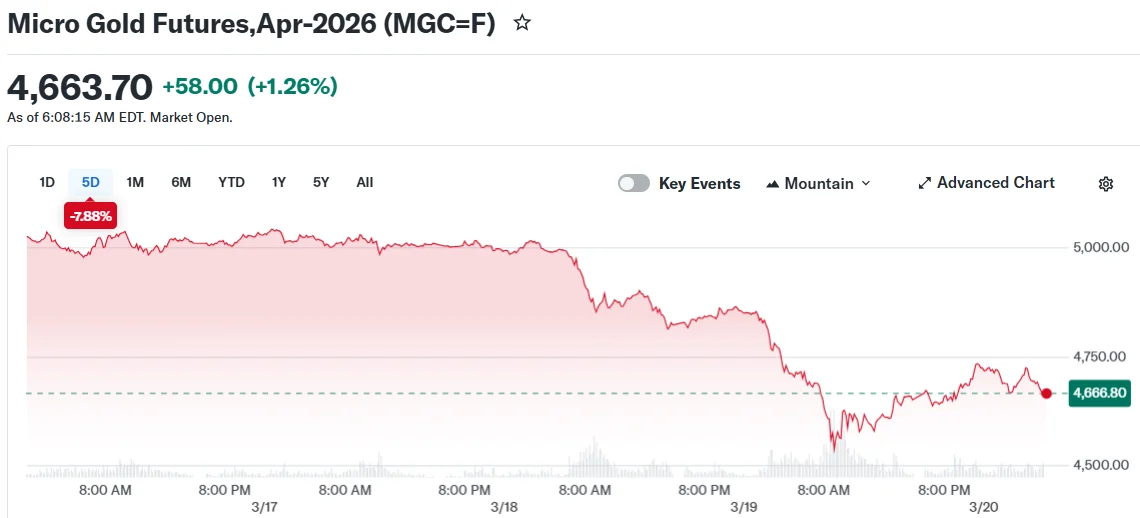 Micro Gold Futures,Apr-2026 (MGC=F)
Friday’s modest rebound couldn’t offset the substantial damage from earlier in the week. Gold has shed more than 8% over the past five trading sessions, representing its poorest weekly showing since the early months of 2020.
Prior to this week’s selloff, gold had maintained a relatively stable trading band between $5,000 and $5,200 following the commencement of U.S.-Israel military operations against Iran in late February. This week’s sharp decline sent prices tumbling well beneath that established range.
The ongoing military conflict has heightened worries about escalating energy costs and broader inflationary pressures. Crude oil prices surged to nearly four-year peaks this week following attacks on critical energy infrastructure across the Middle East region.
Global monetary authorities have reacted to these inflationary warning signs with a notably hawkish stance. Australia’s central bank implemented a rate increase, while the Federal Reserve, European Central Bank, Swiss National Bank, and Bank of Japan all maintained their existing policy rates.
These institutions uniformly communicated that monetary easing remains off the table for the foreseeable future. This messaging proved particularly damaging for gold, as reduced borrowing costs typically provide tailwinds for the non-yielding precious metal.
The Federal Reserve maintained its policy stance on Wednesday while cautioning that inflationary pressures may intensify. Although gold traditionally serves as an inflation protection mechanism, elevated interest rates enhance the relative appeal of yield-generating investments.
Dollar strength created additional headwinds for gold. An appreciating greenback increases the cost of gold for international buyers using alternative currencies, potentially dampening global demand.
The dollar weakened on Friday, providing temporary relief for precious metals. Multiple central banks signaled potential rate increases, which strengthened their respective currencies relative to the U.S. dollar.
Silver Experiences Sharper Decline
Silver sustained steeper losses than gold’s, falling nearly 10% throughout the week. Spot silver climbed 0.5% on Friday to $73.14 per ounce, though this gain only marginally offset the week’s substantial losses.
Market analysts at OCBC noted that silver demonstrates heightened sensitivity to both dollar movements and overall market risk appetite compared to gold. The firm indicated it may adjust its silver price forecasts “modestly lower” in response to current market dynamics.
Silver also confronts challenges from potential global economic deceleration, which could diminish industrial consumption. The metal plays a crucial role in solar energy systems and various electrical applications.
Platinum declined 2.9% for the week, though it recovered 2.1% on Friday to trade around $2,016 per ounce.
Market Expert Perspectives
Nicholas Frappell, who leads institutional markets globally at ABC Refinery, informed Reuters that gold successfully maintained critical technical support thresholds on a weekly timeframe.
He suggested gold could potentially rally back toward the $4,800 level where the breakdown occurred. Frappell also observed that market participants had positioned themselves for further selling rather than accumulation following gold’s disappointing performance throughout the conflict period.
Spot gold has now retreated more than 10% since the February 28 U.S.-Israel strike on Iran commenced.
The post Why Gold Plunged More Than 8% This Week Despite Middle East Conflict appeared first on Blockonomi.
You May Also Like

Bitcoin ETF and Ethereum ETF End Another Positive Week; BTC Price and ETH Price Set Upticks

bluesky funding disclosed: $100M Series B led