

Polymarket 73% odds Hormuz Strait traffic to normalize by May end
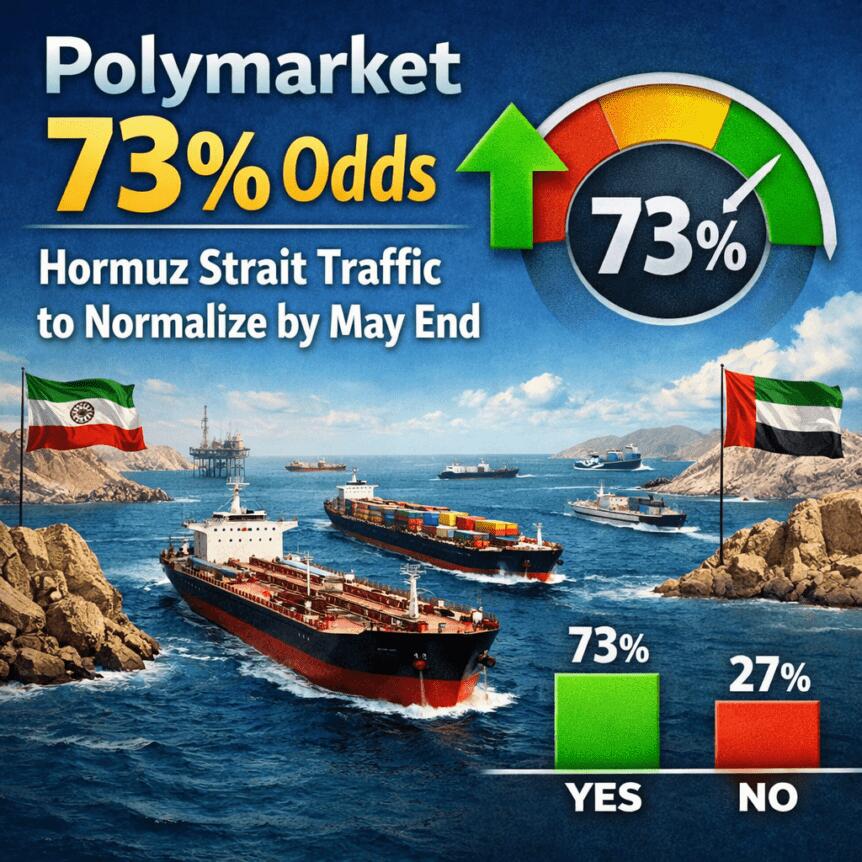
A temporary ceasefire between the United States and Iran sparked a notable, though tentative, market reaction as traders positioned around the Strait of Hormuz. Polymarket’s prediction-market odds on traffic through the strait returning to normal surged, reflecting optimism that the ceasefire could hold long enough to ease regional tensions.
The odds climbed to a high of 82% on Friday after Iranian Foreign Minister Seyed Abbas Araghchi announced that the Strait of Hormuz was open. They later cooled, settling at about 73% as further statements emerged. Araghchi’s message was conveyed in an X post, stating: “The passage for all commercial vessels through the Strait of Hormuz is declared completely open for the remaining period of the ceasefire, on the coordinated route as already announced by the Ports and Maritime Organization of the Islamic Republic of Iran.”
The latest Polymarket odds on Hormuz traffic returning to normal by end-May, mapped against evolving political signals. Source: PolymarketIn the meantime, traders on Polymarket had previously priced in a more cautious outlook, with odds of a return to normal activity by the end of April at around 40%. The divergence between these two points highlights the evolving uncertainty around the durability of the ceasefire and its broader impact on global supply chains.
The news came as the war in Iran reverberated through financial markets, influencing both crypto and energy assets as investors reassessed risk premia and geopolitical risk. That backdrop set the stage for a volatile session across digital assets even as traditional energy proxies moved in response to shifting oil supply expectations.
Bitcoin advances on ceasefire news, but the outlook remains fragile
Bitcoin (BTC) registered a notable, albeit brief, lift in response to the ceasefire developments, briefly tapping around $78,000 before retreating to roughly $77,358 at the time of reporting. The move underscored how geopolitical headlines continue to correlate with crypto sentiment, even as the broader macro picture remains unsettled.
Market observers highlighted that while the immediate reaction was supportive for risk-on assets, the longer-term trajectory was far from assured. Nic Puckrin, a crypto market analyst, described the ceasefire as fragile and fraught with unresolved core issues. He noted that a sustained absence of tensions, a meaningful drop in oil prices toward roughly $80 per barrel, and softer-than-expected economic data would all help BTC regain a higher level, potentially near $90,000.
“A ceasefire that results in the end of geopolitical tensions, a sustained drop in oil prices toward $80, and ideally also softer-than-expected economic data that calms stagflation fears” are all needed for BTC to reclaim the $90,000 level, he said. The market’s sensitivity to oil dynamics underscores how intertwined crypto and energy narratives have become in periods of heightened geopolitical risk.
Beyond the chart dynamics, the political backdrop remains a key driver. U.S. President Donald Trump stated that the naval blockade on Iran would “remain in full force and effect” until the transaction with Iran is 100% complete, a stance that keeps the risk of renewed escalation in focus for traders and policymakers alike.
Analysts emphasize that a durable resolution would likely require more than a short-term pause: it would demand progress on broader regional issues, verification mechanisms, and a credible path to de-escalation that reduces volatility across asset classes, including risk assets tied to geopolitical risk premiums.
What this means for investors and markets going forward
The current cycle illustrates a central truth about crypto markets in times of geopolitical strain: risk-on flows can emerge on partial news, but the sustainability of price moves hinges on the durability of peace signals and the broader macro regime. If the ceasefire endures and oil markets stabilize, appetite for crypto risk could improve further, potentially lifting BTC back toward earlier highs. Conversely, if tensions re-ignite or if the ceasefire proves short-lived, the same assets may retreat as investors gravitate toward safety and risk-off positioning.
Market participants will also be watching how policymakers respond to evolving conditions. The prospect of delayed rate cuts—if economic data softens and inflation remains sticky—could influence BTC’s risk premium and its ability to attract new entrants seeking inflation-hedge or digital-asset diversification benefits. The interplay between geopolitics, energy prices, and crypto demand will likely shape the trajectory of Bitcoin and related assets through the coming weeks and into mid-2026.
In the near term, traders should monitor several cross-currents: the durability of the ceasefire, any new statements from Iran or its interlocutors, and the oil-price path as markets digest the potential implications for supply and global growth. As with prior episodes, the path forward is unlikely to be linear, with volatility flagging opportunities for traders who can adapt quickly to shifting signals about risk appetite and macro stability.
For investors, the episode underscores the importance of a diversified approach to exposure amid geopolitical uncertainty. Crypto markets remain sensitive to policy signals, while traditional energy dynamics continue to color risk sentiment across multiple asset layers. As the situation evolves, market participants will look for clearer, verifiable concessions and longer-lasting guarantees that could translate into steadier price action for both digital assets and energy-linked markets.
Readers should stay tuned for further developments on the ceasefire’s longevity, any changes to Hormuz traffic flow, and the potential shifts in oil and macro indicators that could recalibrate the risk-reward calculus for crypto portfolios in the months ahead.
This article was originally published as Polymarket 73% odds Hormuz Strait traffic to normalize by May end on Crypto Breaking News – your trusted source for crypto news, Bitcoin news, and blockchain updates.


Potrebbe anche piacerti

Less Than 1% of Crypto Projects Disclose Market Maker Deals

US Markets Rise Alongside Crypto After Trump Post, Coincidence?




