SpaceX shares extended their post-IPO pullback after the company disclosed plans to enter the bond market despite reporting more than $100 billion in cash and equivalents. The move highlights a key shift in investor focus. The first week after the IPO was dominated by scarcity, momentum, and index-inclusion speculation. Now the market is beginning to evaluate whether SpaceX's valuation can be supported by future cash flows, Starlink growth, and Starship execution rather than IPO enthusiasm alone.SpaceX shares extended their post-IPO pullback after the company disclosed plans to enter the bond market despite reporting more than $100 billion in cash and equivalents. The move highlights a key shift in investor focus. The first week after the IPO was dominated by scarcity, momentum, and index-inclusion speculation. Now the market is beginning to evaluate whether SpaceX's valuation can be supported by future cash flows, Starlink growth, and Starship execution rather than IPO enthusiasm alone.

SpaceX Slides as Debt Raise Revives the Valuation Debate

2026/06/23 15:40
3 min di lettura
Per feedback o dubbi su questo contenuto, contattateci all'indirizzo [email protected].
Notizie in breve
SpaceX shares extended their post-IPO pullback after the company disclosed plans to enter the bond market despite reporting more than $100 billion in cash and equivalents. The move highlights a key shift in investor focus. The first week after the IPO was dominated by scarcity, momentum, and index-inclusion speculation. Now the market is beginning to evaluate whether SpaceX's valuation can be supported by future cash flows, Starlink growth, and Starship execution rather than IPO enthusiasm alone.

SpaceX's Debt Offering Shows Growth Is Still Being Prioritized Over Profitability

SpaceX recently made waves by disclosing its first bond offering as a public company, with proceeds expected to refinance bridge loans and support long-term expansion initiatives. Interestingly, SpaceX disclosed over $100 billion in cash while launching a new debt offering following its record IPO, suggesting the debt raise is not driven by sudden liquidity concerns but by capital structure management and future investment needs.

This distinction matters heavily to the market because investors are no longer evaluating SpaceX as a newly listed stock benefiting simply from IPO scarcity. Instead, they are beginning to assess how much spending will be required to support massive Starship development, AI infrastructure ambitions, and the ongoing expansion of Starlink.

The market's immediate reaction suggests investors are becoming much more sensitive to valuation and capital allocation questions, especially after SpaceX briefly approached a staggering $3 trillion valuation following its Nasdaq debut.

The Market Is Repricing SpaceX From an IPO Story Into an Execution Story

SpaceX shares surged nearly 20% on their first trading day after pricing at $135 per share, turning the company into one of the largest publicly traded firms in the world. Since then, volatility has increased significantly as investors digest new information about earnings, spending plans, and future growth assumptions.

The emerging debate is no longer whether SpaceX is an exceptional company. The debate is whether investors are paying for today's business or for a future infrastructure platform that combines launch services, satellite connectivity, AI computing capacity, and potentially entirely new orbital industries.

That distinction becomes increasingly important when the company is still reporting net losses despite strong revenue growth. Recent disclosures showed annual revenue of approximately $18.7 billion alongside continued heavy investment spending. As a result, SpaceX's next challenge is proving its valuation after the IPO surge in the public markets.

For traders tracking these rapid price movements and looking to hedge positions, staying updated on SpaceX stock price and futures trading is becoming vital as the asset reprices.

Index Inclusion May Be the Next Major Catalyst

While the stock has pulled back from its post-IPO highs, institutional investors continue to watch potential index inclusion events closely.

Several major index providers have adopted accelerated rules that could allow SpaceX to enter key benchmarks much sooner than traditional IPOs. Investors are watching potential Nasdaq-100 inclusion as the next catalyst because it could generate massive, mechanical buying from passive funds and ETFs.

The next phase of trading may therefore be driven less by retail enthusiasm and more by institutional flows, index demand, and upcoming quarterly earnings disclosures.

The SpaceX Watchlist: 3 Critical Growth Catalysts for Traders

The key question for investors is whether SpaceX can transition from a scarcity-driven IPO winner into a company that consistently justifies its valuation through flawless execution.

Traders should keep a close eye on three specific metrics moving forward:

  • Starlink subscriber growth and profitability: Can the satellite internet arm maintain its growth trajectory and improve profit margins?
  • Starship development milestones and launch cadence: Will regular, successful launches scale up fast enough to meet commercial demand?
  • AI infrastructure spending and monetization: How heavily will SpaceX invest in AI, and what is the timeline for seeing a return on that capital?

The stock's early volatility suggests that investors are beginning to demand hard evidence rather than exciting narratives. The IPO proved there was enormous demand for SpaceX shares. The next challenge is proving that long-term growth can support one of the market's most ambitious valuations.

Gli articoli scritti dal team editoriale di Notizie MEXC hanno esclusivamente scopo informativo generale e non costituiscono consulenza finanziaria, di investimento o di trading. I mercati delle criptovalute sono altamente volatili, ti preghiamo di condurre le tue ricerche e verificare in modo indipendente le informazioni prima di prendere decisioni finanziarie. Redatti in conformità con la nostra Politica editoriale, MEXC non si assume alcuna passività per le perdite subite facendo affidamento su questi contenuti. Per segnalare violazioni del copyright o dei diritti di terzi, contatta [email protected].

Potrebbe anche piacerti

SEC Innovation Exemption: How Tokenized Stocks Can Trade Onchain

SEC Innovation Exemption: How Tokenized Stocks Can Trade Onchain

The U.S. Securities and Exchange Commission introduced a five-year Innovation Exemption on September 17, 2026, creating a temporary regulatory pathway for certain tokenized U.S. stocks to trade onchain. Under the framework, qualifying Tokenized Securities Venues can facilitate trading in tokenized National Market System stocks through permissioned automated market makers and liquidity pools without being treated as registered exchanges under the usual definition, provided they comply with a detailed set of conditions. Liquidity providers participating in those pools can also receive limited conditional relief from the statutory definition of a dealer
Condividi
MEXC NEWS2026/09/18 14:04
U.S. Stock Perps Are Coming: Why Kalshi and Coinbase Want In
U.S. Stock Perps Are Coming: Why Kalshi and Coinbase Want In

The U.S. derivatives market may be approaching an important structural shift as Kalshi and Coinbase Derivatives both move to introduce perpetual futures linked to individual U.S. stocks. The proposals matter because perpetual futures are no longer being treated only as a crypto-native trading product. Instead, two major U.S. platforms are attempting to adapt the format to equities such as Apple, Nvidia and Tesla, potentially bringing continuous leveraged stock-price exposure into a regulated domestic market.
Condividi
MEXC NEWS2026/09/21 13:19
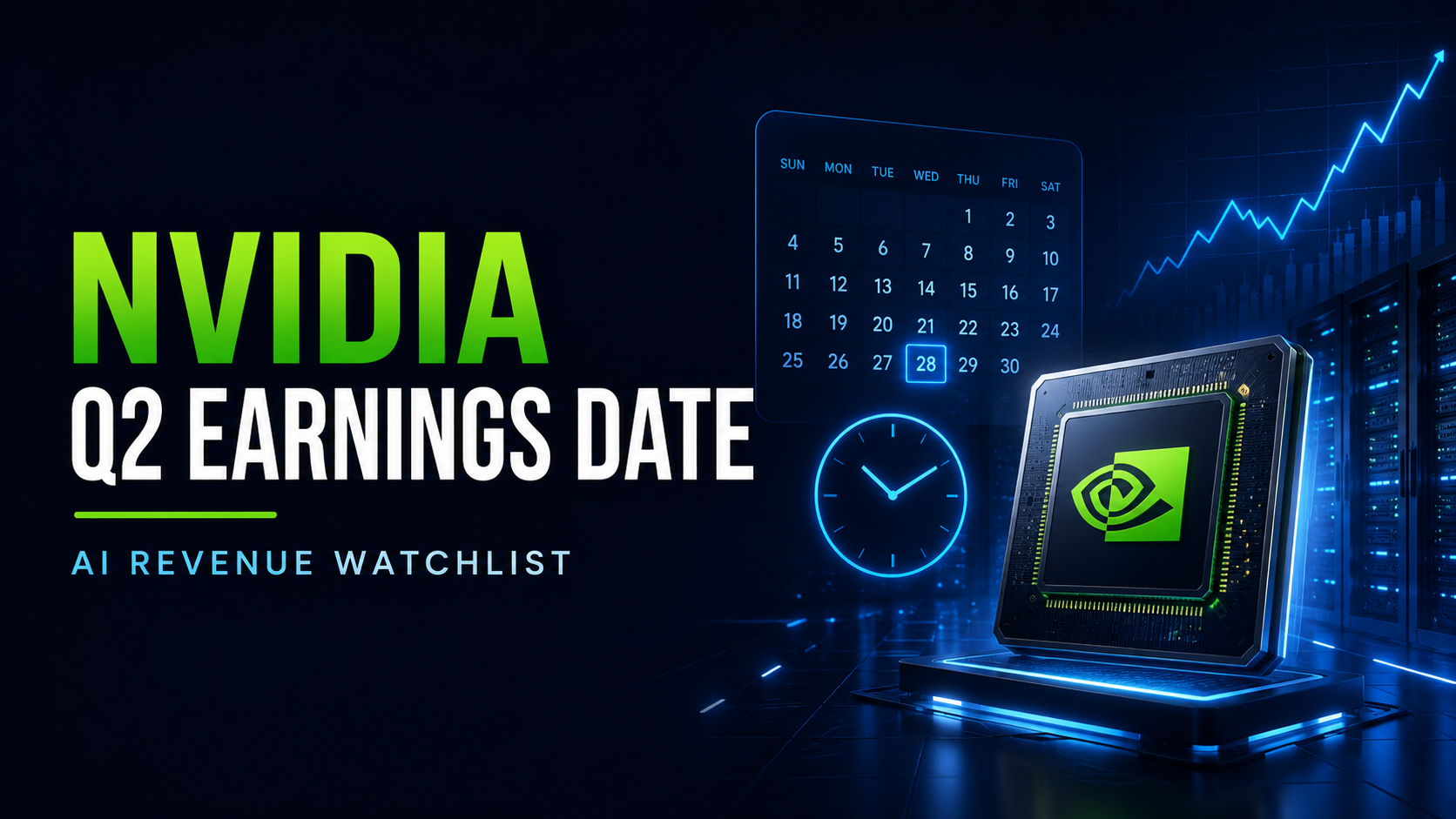
Nvidia FY2027 Q2 Earnings Date: Expected Report Time, Earnings Call, and AI Revenue Watchlist

Nvidia FY2027 Q2 Earnings Date: Expected Report Time, Earnings Call, and AI Revenue Watchlist

Nvidia’s fiscal Q2 2027 earnings are expected to become one of the most important AI market events of the summer. Wall Street Horizon lists Nvidia’s next earnings date as Wednesday, August 26, 2026, after market close, for Q2 fiscal 2027. This is not just another earnings date. Nvidia’s own Q1 FY2027 outlook set the bar extremely high: the company guided for $91.0 billion in Q2 revenue, plus or minus 2%, with a non-GAAP gross margin expected at about 75.0%. Nvidia also explicitly noted that its outlook assumes no Data Center compute revenue from China, making the coming report a much cleaner test of non-China AI infrastructure demand. For traders, the key question is no longer simply whether Nvidia beats expectations. The bigger issue is whether the company can consistently convert AI demand into revenue growth, margin durability, and forward guidance strong enough to defend the market’s AI infrastructure premium.
Condividi
MEXC NEWS2026/07/06 18:17