OpenAI is reportedly leaning toward delaying its IPO until 2027, but the sharper market signal is coming from SpaceX. SpaceX closed down 16.4% at $154.60 on June 22, down 31.5% from its $225.64 intraday high, though still 14.5% above its $135 IPO price. That move turned SpaceX from a clean scarcity-driven IPO success into the first major public-market stress test for the AI-adjacent mega-listing cycle. OpenAI’s issue is not demand, but price. Reuters, citing The New York Times, reported that OpenAI is considering waiting until 2027 to preserve a valuation target of up to $1 trillion, while advisers have framed the choice as either waiting for that valuation or going public sooner at a lower target. Prediction markets are already reflecting that caution. Polymarket’s OpenAI IPO market recently showed roughly one-in-four odds for an OpenAI IPO by Dec. 31, 2026, signaling that traders no longer see a near-term listing as the clear base case. For crypto traders, that makes AI pre-IPO exposure less of a one-way scarcity trade and more of a valuation-discipline trade tied to public-market benchmarks.OpenAI is reportedly leaning toward delaying its IPO until 2027, but the sharper market signal is coming from SpaceX. SpaceX closed down 16.4% at $154.60 on June 22, down 31.5% from its $225.64 intraday high, though still 14.5% above its $135 IPO price. That move turned SpaceX from a clean scarcity-driven IPO success into the first major public-market stress test for the AI-adjacent mega-listing cycle. OpenAI’s issue is not demand, but price. Reuters, citing The New York Times, reported that OpenAI is considering waiting until 2027 to preserve a valuation target of up to $1 trillion, while advisers have framed the choice as either waiting for that valuation or going public sooner at a lower target. Prediction markets are already reflecting that caution. Polymarket’s OpenAI IPO market recently showed roughly one-in-four odds for an OpenAI IPO by Dec. 31, 2026, signaling that traders no longer see a near-term listing as the clear base case. For crypto traders, that makes AI pre-IPO exposure less of a one-way scarcity trade and more of a valuation-discipline trade tied to public-market benchmarks.

From Scarcity Trade to Valuation Discipline: SpaceX’s Pullback Tests OpenAI’s IPO Ambition

2026/06/29 16:38
4 min di lettura
Per feedback o dubbi su questo contenuto, contattateci all'indirizzo [email protected].
Notizie in breve
OpenAI is reportedly leaning toward delaying its IPO until 2027, but the sharper market signal is coming from SpaceX. SpaceX closed down 16.4% at $154.60 on June 22, down 31.5% from its $225.64 intraday high, though still 14.5% above its $135 IPO price. That move turned SpaceX from a clean scarcity-driven IPO success into the first major public-market stress test for the AI-adjacent mega-listing cycle. OpenAI’s issue is not demand, but price. Reuters, citing The New York Times, reported that OpenAI is considering waiting until 2027 to preserve a valuation target of up to $1 trillion, while advisers have framed the choice as either waiting for that valuation or going public sooner at a lower target. Prediction markets are already reflecting that caution. Polymarket’s OpenAI IPO market recently showed roughly one-in-four odds for an OpenAI IPO by Dec. 31, 2026, signaling that traders no longer see a near-term listing as the clear base case. For crypto traders, that makes AI pre-IPO exposure less of a one-way scarcity trade and more of a valuation-discipline trade tied to public-market benchmarks.

SpaceX Shows How Scarcity Pricing Changes After Listing


SpaceX’s IPO initially looked like a definitive validation of the AI and space-infrastructure trade. The company priced its IPO at $135 per share, rallied sharply after listing, and quickly became one of the most closely watched public-market symbols tied to the next generation of technology infrastructure.


However, the recent post-listing price action highlights what changes when a scarce private-market asset transitions to public trading. As highlighted by MarketWatch, SpaceX closed down 16.4% at $154.60, retreating 31.5% from its intraday high of $225.64, though it still remains 14.5% above its initial IPO price.


Before a listing, a company's valuation is heavily shaped by limited access, strategic demand, and long-term narrative value. After listing, the asset is forced to face the harsh realities of daily liquidity, short interest, options activity, strict valuation models, and shifting macro risk appetite.


That difference is critical for OpenAI. Private markets can easily support a premium for scarce AI assets because access is highly restricted. Public markets are far less patient. Once a company trades openly, investors begin comparing growth metrics, cash burn, infrastructure spending, and profitability timelines in real time. SpaceX did not break the AI IPO window—but it has fundamentally changed the price of admission.

What the Market Is Repricing

The market is not rejecting artificial intelligence. Instead, it is actively repricing the terms under which AI companies can command extreme valuations. This structural shift is happening across three key fronts:

  • Public vs. Private Premium Transfer: A company may deserve a scarcity premium while it is private, but that premium often shrinks once retail and institutional investors can actively trade, hedge, or short the stock.
  • Capital Intensity & Profitability: OpenAI undoubtedly possesses one of the strongest demand narratives in the world. However, as Reuters reported, OpenAI is leaning toward waiting until next year for its IPO to preserve a towering $1 trillion valuation target. Achieving that target requires clearing tough questions about compute costs, data center infrastructure spending, and the timeline to durable profitability.
  • Risk-Capital Competition: If OpenAI, Anthropic, SpaceX, and other infrastructure giants all move toward public markets in the same cycle, they will aggressively compete for the exact same pool of growth capital.

The strongest takeaway for investors is simple: AI pre-IPO exposure is officially moving from a scarcity trade to a valuation-discipline trade.


Why Crypto Traders Should Care


For cryptocurrency markets, the OpenAI and SpaceX narratives matter deeply because AI private-company exposure is rapidly merging with the broader Real-World Asset (RWA) and tokenized-equity conversation.


Traders demand access to unicorns like OpenAI, SpaceX, and Anthropic long before traditional public-market participation becomes fully available. This demand fuels prediction markets, pre-IPO derivatives, tokenized stock products, and on-chain RWA narratives. For those looking to monitor real-time price action on these mega-assets, platforms tracking live metrics—such as the MEXC SPCX Stock Page—offer vital visibility.


But SpaceX’s pullback is a stark reminder that early access does not eliminate valuation risk. If the public-market benchmark becomes volatile, any on-chain or synthetic exposure tied to the same theme will reprice just as violently. This is crucial for crypto-native traders, as AI and crypto often compete for the same high-beta risk capital.


What to Validate Next in the AI IPO Cycle


The next question isn't simply whether OpenAI lists in 2026 or 2027. The better framework is to monitor real-time signals indicating the health of the AI IPO window:

  • SpaceX Price Stabilization: Watch whether SpaceX stabilizes above its $135 IPO price. If it holds well above this floor, the market will likely treat the pullback as early post-listing volatility. If it sinks closer to the IPO price, downward pressure on other AI IPO candidates will intensify.
  • OpenAI/Anthropic Messaging: A delayed timeline, a smaller public float, or a lowered valuation target would heavily suggest that public-market discipline is already reshaping deal structures.
  • Prediction-Market Pricing: Keep an eye on live odds. If traders on platforms like Polymarket continue lowering the probability of a 2026 OpenAI IPO, it confirms the market no longer treats a near-term listing as the default outcome.
  • Crypto Market Reaction: If AI tokens, RWA tokens, and tokenized stock narratives weaken alongside traditional AI equities, it suggests public-market volatility is directly bleeding into crypto risk appetite.

Bottom Line


OpenAI’s reported IPO delay and SpaceX’s recent stock pullback are two chapters of the exact same market story: AI mega-assets are entering a much more selective pricing environment.
The AI IPO window is not closed, but it is no longer unconditional. Public investors are now demanding cleaner evidence regarding valuation, spending discipline, liquidity, and paths to profitability. For crypto and traditional traders alike, the takeaway is clear: while AI pre-IPO and tokenized-equity narratives remain undeniably powerful, they can no longer be treated as one-way access trades. Once public-market benchmarks turn volatile, on-chain versions of the same assets will reprice just as quickly.

Gli articoli scritti dal team editoriale di Notizie MEXC hanno esclusivamente scopo informativo generale e non costituiscono consulenza finanziaria, di investimento o di trading. I mercati delle criptovalute sono altamente volatili, ti preghiamo di condurre le tue ricerche e verificare in modo indipendente le informazioni prima di prendere decisioni finanziarie. Redatti in conformità con la nostra Politica editoriale, MEXC non si assume alcuna passività per le perdite subite facendo affidamento su questi contenuti. Per segnalare violazioni del copyright o dei diritti di terzi, contatta [email protected].

Potrebbe anche piacerti

SEC Innovation Exemption: How Tokenized Stocks Can Trade Onchain

SEC Innovation Exemption: How Tokenized Stocks Can Trade Onchain

The U.S. Securities and Exchange Commission introduced a five-year Innovation Exemption on September 17, 2026, creating a temporary regulatory pathway for certain tokenized U.S. stocks to trade onchain. Under the framework, qualifying Tokenized Securities Venues can facilitate trading in tokenized National Market System stocks through permissioned automated market makers and liquidity pools without being treated as registered exchanges under the usual definition, provided they comply with a detailed set of conditions. Liquidity providers participating in those pools can also receive limited conditional relief from the statutory definition of a dealer
Condividi
MEXC NEWS2026/09/18 14:04
U.S. Stock Perps Are Coming: Why Kalshi and Coinbase Want In
U.S. Stock Perps Are Coming: Why Kalshi and Coinbase Want In

The U.S. derivatives market may be approaching an important structural shift as Kalshi and Coinbase Derivatives both move to introduce perpetual futures linked to individual U.S. stocks. The proposals matter because perpetual futures are no longer being treated only as a crypto-native trading product. Instead, two major U.S. platforms are attempting to adapt the format to equities such as Apple, Nvidia and Tesla, potentially bringing continuous leveraged stock-price exposure into a regulated domestic market.
Condividi
MEXC NEWS2026/09/21 13:19
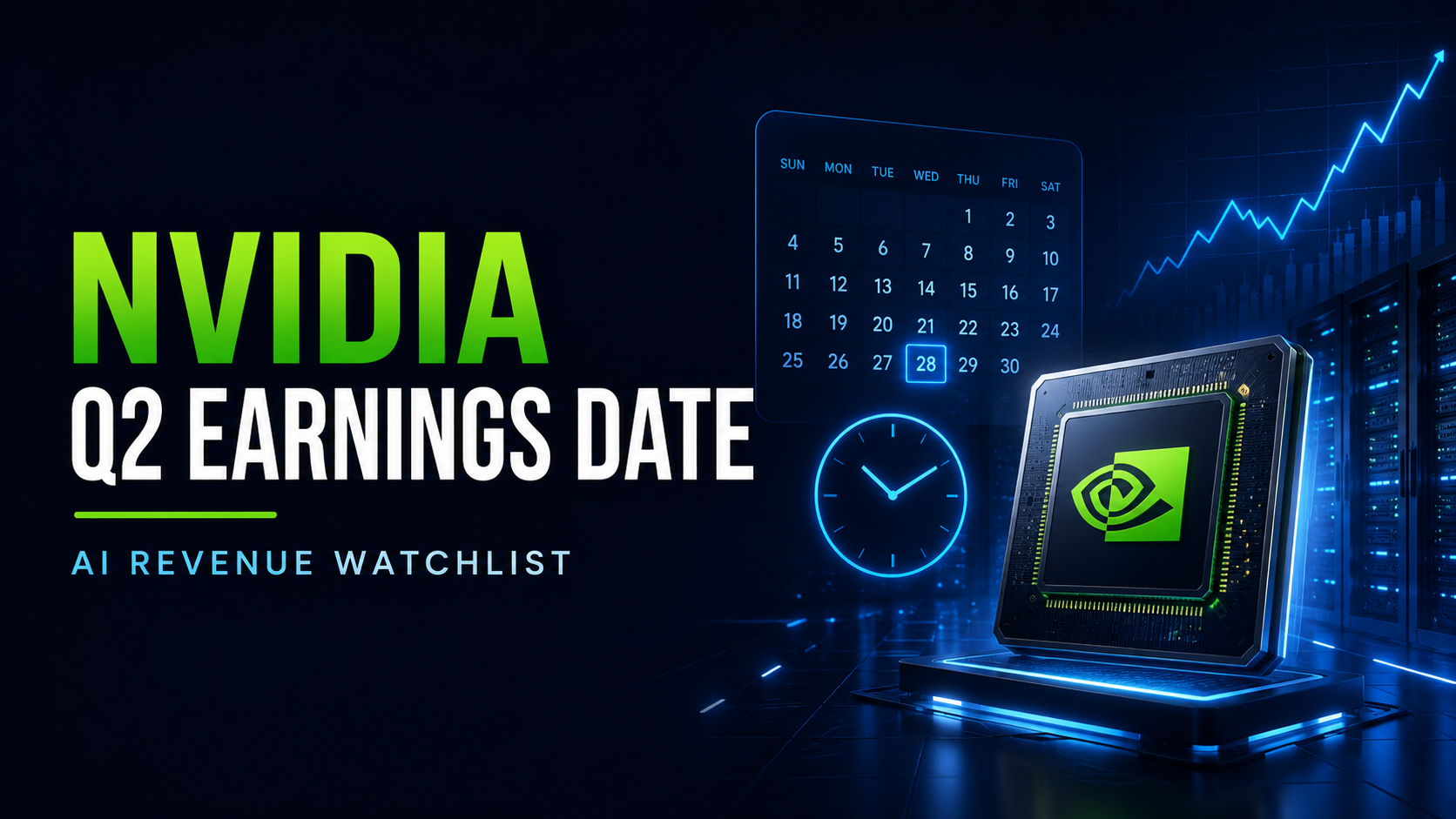
Nvidia FY2027 Q2 Earnings Date: Expected Report Time, Earnings Call, and AI Revenue Watchlist

Nvidia FY2027 Q2 Earnings Date: Expected Report Time, Earnings Call, and AI Revenue Watchlist

Nvidia’s fiscal Q2 2027 earnings are expected to become one of the most important AI market events of the summer. Wall Street Horizon lists Nvidia’s next earnings date as Wednesday, August 26, 2026, after market close, for Q2 fiscal 2027. This is not just another earnings date. Nvidia’s own Q1 FY2027 outlook set the bar extremely high: the company guided for $91.0 billion in Q2 revenue, plus or minus 2%, with a non-GAAP gross margin expected at about 75.0%. Nvidia also explicitly noted that its outlook assumes no Data Center compute revenue from China, making the coming report a much cleaner test of non-China AI infrastructure demand. For traders, the key question is no longer simply whether Nvidia beats expectations. The bigger issue is whether the company can consistently convert AI demand into revenue growth, margin durability, and forward guidance strong enough to defend the market’s AI infrastructure premium.
Condividi
MEXC NEWS2026/07/06 18:17