


MoneySense is an award-winning magazine, helping Canadians navigate money matters since 1999. Our editorial team of trained journalists works closely with leading personal finance experts in Canada. To help you find the best financial products, we compare the offerings from over 12 major institutions, including banks, credit unions and card issuers. Learn more about our advertising and trusted partners.
Vanguard’s VRIF ETF is tilting toward bonds to provide retirees stable income, balancing caution with a 4% annual payout target. The post Why Vanguard’s ETF aimedVanguard’s VRIF ETF is tilting toward bonds to provide retirees stable income, balancing caution with a 4% annual payout target. The post Why Vanguard’s ETF aimed
Why Vanguard’s ETF aimed at retirees is currently cautious in its asset allocation
Per feedback o dubbi su questo contenuto, contattateci all'indirizzo [email protected].
As a semi-retired investor who recently started a registered retirement income fund (RRIF), I regard exchange-traded funds (ETFs) from Vanguard Group as a major part of my core portfolio, along with low-volatility ETFs from BMO ETFs, and income-oriented ETFs from various other vendors.
After the Liberation Day craziness of April 2025, I became increasingly defensive, although my asset allocation is not (yet) to the point that would be recommended by the rule of thumb that your age should equal your fixed income. If that were the case, I should have 28% in equities and 72% fixed income, and I’m not (yet) quite that conservative.
As we indicated in the previous column on the Purpose Longevity Pension Fund, I intend to live a long time (Lord willing); therefore, I also believe that stocks (at least quality dividend-paying stocks or ETFs holding them) should always account for at least half of an investment portfolio—even in retirement.
A core fund for retirees is the Vanguard Retirement Income Fund, or VRIF, trading on the TSX. The ETF name describes exactly what it does and is one of several funds often mentioned by the Retirement Club (see this introductory blog on the Club co-founded by blogger Dale Roberts).
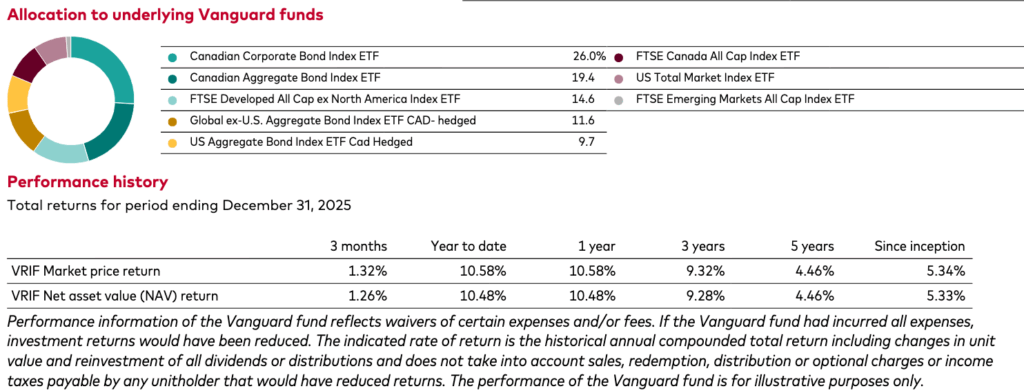
I started a position in VRIF soon after its launch in 2020. At the time, its asset allocation was roughly 50% stocks to 50% fixed income, spread around all geographies in the normal proportions; however, as 2025 proceeded I noticed that VRIF had begun to cut back on its equity exposure and raise its proportion of fixed income, almost to the point of 70% bonds to just 30% stocks.
Semi-retired Globe & Mail financial columnist Rob Carrick mentioned this in his bi-weekly column late in January: “A big believer in bonds is the investing giant Vanguard, which last year took an unusual stance in suggesting a portfolio of 70% bonds and 30% stocks. The underlying thinking here is sound: stocks have soared and bonds are undervalued.”
I’d also noticed various YouTube videos from Vanguard’s U.S. parent evince similar caution—a retrenchment from the big U.S. Growth mega cap stocks in favor of other developed and emerging economies around the world.
On January 21st, Vanguard Canada held a media briefing of two of its top economists at its Toronto headquarters, which allowed me to ask about these perceptions of its rising caution. (You can find at least two news stories on the web filed shortly after the event by Bloomberg News and Investment Executive.)
4% targeted payout in line with Bengen’s famous 4% rule
Our focus here is VRIF. The original news release emphasized the objective is to provide income-seeking investors with a “targeted 4% annual payout.” That happens to be in line with William Bengen’s famous 4% rule, which is “fine with me,” as I quipped at the media briefing.
In response to my query, Vanguard Canada spokesman Matthew Gierasimczuk said VRIF’s asset allocation “varies over time” but the goal is the targeted 4% return: Vanguard sees a “more optimistic outlook on bonds and fixed income.”
Kevin Khang, Vanguard’s head of global economic research reiterated that the ETF seeks to fund a “certain level of payout. Bonds, in our view, can achieve the desired certain level of payout” and “the U.S. stock market is pretty expensive for obvious reasons.” After the Great Financial Crisis, bonds didn’t pay much “but now they are reasonably valued: relative to inflation they are paying a decent real return.”
Rankings
The best ETFs in Canada
read now
For this column I was subsequently referred to Aime Bwakira, Head of Product for Vanguard Canada. In my view, the rationale for VRIF’s high fixed-income exposure appears to be one of not taking more risk than you need to take, an eminently reasonable stance that is apt for the retirees to which VRIF caters.
Bwakira confirmed Vanguard “has been leaning more heavily toward bonds—particularly higher quality and corporate bonds—than in past years while staying within its equity guardrails” of a minimum 30% and maximum 60%. This positioning “reflects the current environment and the results of our capital markets projections.”
Three-fold rationale for raising proportion of Fixed Income
The rationale is three-fold.
First is higher interest rates. Bonds—especially corporate bonds—are paying more than they did for many years following the 2008 Great Financial Crisis (GFC): “This makes them well-suited to support VRIF’s 4% income target without taking on unnecessary stock-market risk.” VRIF includes corporate bond exposure specifically to help enhance yield for investors.
Second, given today’s market outlook, the fund’s model has shifted toward fixed income because bonds “currently provide a more favourable balance of expected return and risk.” I was also referred to Vanguard’s current VCMM 10-year projections (VCMM = Vanguard Capital Markets Model) for various asset classes. It’s also published in the US for US investors Vanguard Capital Markets Model® forecasts.
Dated January 22, 2026, the document states: “Even at current stretched valuations, rising earnings growth could provide momentum for stocks in the near term. However, our conviction is growing stronger that long-term prospects for U.S. equities are subdued. Our model anticipates annualized returns of about 3.9% to 5.9% over the next 10 years.” It adds, “Our muted long-term return projection for U.S. equities is entirely consistent with our more bullish prospects for an AI-led U.S. economic boom.”
The third and most important point raised by Bwakira is that “a higher allocation to bonds helps VRIF deliver reliable cash flows, which is central to its mandate.” Because income needs don’t disappear in periods of market volatility, “VRIF prioritizes stability and sustainability in its payout.” VRIF aims to “maintain the value of an investor’s initial investment over the long term. Tilting toward bonds during periods of elevated equity market uncertainty helps protect investors from large drawdowns while still supporting the payout.”
This common-sense level of caution has not gone unnoticed by Canadian retirees seeking stable income. VRIF is a well-regarded ETF by many members of the Retirement Club, founded by Dale Roberts and partner Brent Schmidt. One of the club’s monthly Zoom presentations in the autumn of 2025 highlighted VRIF among several other income sources for retirees. The Zoom call and newsletter also included a look at BMO’s T Series, which pays out at a rate of 6% from the ZBAL and ZGRO asset allocation models. “Retirees can then combine the ETFs to create monthly income in the range of 4% to 6% based on the portfolio values,” Roberts told me.
One-ticket asset allocation ETFs a gamechanger for both accumulators and retirees
Roberts has long championed VRIF, writing about it on his Cutthecrapinvesting site shortly after its launch and recently updating the post. As Roberts noted, the one-ticket asset allocation ETFs from Vanguard and rivals BMO ETFs, iShares BlackRock, and several others, are proving to be “game changers” for investors still in the wealth-building phases of their financial lives.
In effect, VRIF holds the promise of being a game changer for income-seeking retirees now in the decumulation stage of their lives. As its name implies, VRIF can be held in Canadian RRIFs, but can also be held in RRSPs, TFSAs, RESPs, and similar tax-sheltered accounts, as well as in taxable portfolios.
Featured RRSP Accounts
featured
EQ Bank
Build your retirement savings with 1.50% interest, tax-deferred contributions and zero fees.
go to site
featured
Registered GIC rate
Earn a guaranteed 2.75% in your RRSP when you lock in for 1 year.
go to site
Best RRSP rates
See our ranking of the best RRSP accounts and rates available in Canada.
read now
Roberts observes that VRIF shifted from the basic 50/50 asset allocation at launch to a more conservative 60/40 mix of bonds/stocks by 2025: the precise inverse of Vanguard’s popular VBAL all-in-one ETF, which is usually 60/40 stocks/bonds.
Most years, the 4% can be expected to be generated from some combination of interest income from the fixed-income holdings and dividends and/or capital gains from equities. Roberts noted that, on launch, Vanguard said it’s possible it will have to return some of the investor’s own capital to come up with the 4% annual payout, but that it only expected that to occur once in a decade. Unfortunately, this happened in 2022, when both stocks and fixed income were negative that year.
As it happened, that would have been the proverbial buying opportunity. These days, when there are no more obvious destinations for cash coming from the portfolio, I find myself defaulting to just gradually adding to VRIF.
Newsletter
Get free MoneySense financial tips, news & advice in your inbox.
subscribe now
Read more from Retired Money:
- In planning for retirement, worry about longevity rather than dying young
- Unlocking the Annuity Puzzle
- The 4% rule, revisited: A more flexible approach to retirement income
- Who you gonna trust: Barry Ritholtz or Jim Cramer?
The post Why Vanguard’s ETF aimed at retirees is currently cautious in its asset allocation appeared first on MoneySense.
Disclaimer: gli articoli ripubblicati su questo sito provengono da piattaforme pubbliche e sono forniti esclusivamente a scopo informativo. Non riflettono necessariamente le opinioni di MEXC. Tutti i diritti rimangono agli autori originali. Se ritieni che un contenuto violi i diritti di terze parti, contatta [email protected] per la rimozione. MEXC non fornisce alcuna garanzia in merito all'accuratezza, completezza o tempestività del contenuto e non è responsabile per eventuali azioni intraprese sulla base delle informazioni fornite. Il contenuto non costituisce consulenza finanziaria, legale o professionale di altro tipo, né deve essere considerato una raccomandazione o un'approvazione da parte di MEXC.
Potrebbe anche piacerti

VivoPower To Load Up On XRP At 65% Discount: Here’s How
VivoPower International, a Nasdaq-listed B-Corp now pivoting to an XRP-centric treasury, said on September 16 it has structured its mining and treasury operations so that it can acquire the token “at up to a 65% discount” to prevailing market prices—by mining other proof-of-work assets and swapping those mined tokens. VivoPower Doubles Down On XRP The […]
Condividi
Bitcoinist2025/09/18 10:00

Fed rate decision September 2025
The post Fed rate decision September 2025 appeared on BitcoinEthereumNews.com. WASHINGTON – The Federal Reserve on Wednesday approved a widely anticipated rate cut and signaled that two more are on the way before the end of the year as concerns intensified over the U.S. labor market. In an 11-to-1 vote signaling less dissent than Wall Street had anticipated, the Federal Open Market Committee lowered its benchmark overnight lending rate by a quarter percentage point. The decision puts the overnight funds rate in a range between 4.00%-4.25%. Newly-installed Governor Stephen Miran was the only policymaker voting against the quarter-point move, instead advocating for a half-point cut. Governors Michelle Bowman and Christopher Waller, looked at for possible additional dissents, both voted for the 25-basis point reduction. All were appointed by President Donald Trump, who has badgered the Fed all summer to cut not merely in its traditional quarter-point moves but to lower the fed funds rate quickly and aggressively. In the post-meeting statement, the committee again characterized economic activity as having “moderated” but added language saying that “job gains have slowed” and noted that inflation “has moved up and remains somewhat elevated.” Lower job growth and higher inflation are in conflict with the Fed’s twin goals of stable prices and full employment. “Uncertainty about the economic outlook remains elevated” the Fed statement said. “The Committee is attentive to the risks to both sides of its dual mandate and judges that downside risks to employment have risen.” Markets showed mixed reaction to the developments, with the Dow Jones Industrial Average up more than 300 points but the S&P 500 and Nasdaq Composite posting losses. Treasury yields were modestly lower. At his post-meeting news conference, Fed Chair Jerome Powell echoed the concerns about the labor market. “The marked slowing in both the supply of and demand for workers is unusual in this less dynamic…
Condividi
BitcoinEthereumNews2025/09/18 02:44

Nasdaq Partners With Major US Crypto Exchange to Bring Tokenized Stocks On-Chain
The post Nasdaq Partners With Major US Crypto Exchange to Bring Tokenized Stocks On-Chain appeared on BitcoinEthereumNews.com. Nasdaq to bridge gap between TradFi
Condividi
BitcoinEthereumNews2026/03/10 07:51