SKY rose 10% after the network cut staking emissions and continued buybacks, tightening supply across the market. Sky expanded the USDS credit infrastructure asSKY rose 10% after the network cut staking emissions and continued buybacks, tightening supply across the market. Sky expanded the USDS credit infrastructure as

Sky (SKY) Token Surges After Governance Vote Cuts Emissions and Expands USDS Stablecoin Credit Infrastructure

2026/03/05 22:58
3 min di lettura
Per feedback o dubbi su questo contenuto, contattateci all'indirizzo [email protected].
  • SKY rose 10% after the network cut staking emissions and continued buybacks, tightening supply across the market.
  • Sky expanded the USDS credit infrastructure as lower token issuance and steady buybacks supported bullish market momentum.

SKY, the governance token of the DeFi protocol formerly known as Maker, rose about 10% after a governance vote introduced lower staking emissions and credit infrastructure tied to the USDS stablecoin. The proposal, which combined reduced token issuance with continued buybacks, passed on February 27 and took effect on March 2.

The update changed how SKY enters circulation through staking rewards. Under the new plan, the protocol will distribute about 838.18 million tokens over 180 days. That total is about 161.82 million tokens lower than the earlier schedule, which reduced the pace of new supply entering the market.

Lower emissions spark market movements because they can reduce dilution for existing holders. In this case, the change arrived while the network continued to remove tokens from circulation through its buyback system. This tightened the available supply and supported the token’s upward move.

Sky has already used about $114.5 million in USDS to repurchase nearly 1.83 billion tokens. The program executes purchases in small transactions across the day, with many trades near $10,000 each, removing around 3.6 million tokens from circulation every day.

Additionally, two-thirds of the token supply is staked. That leaves a smaller share of tokens available for active trading, which can add pressure on prices when demand rises.

SKY traded at $0.07819, up 5.13% in the past 24 hours at the time of reporting. The trading volume also rose over 54% in the same period, reaching about $39.97 million.
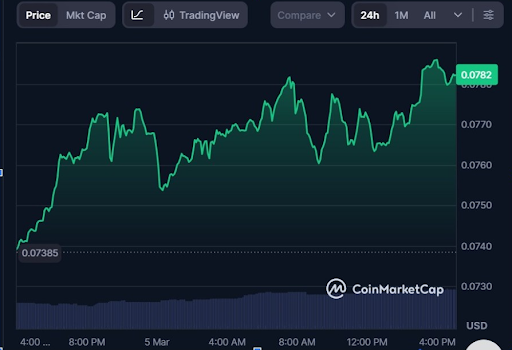
SKYSKYUSD 1-Day Chart | Source: CMC

Meanwhile, we also covered that on March 12, Polkadot will reset its tokenomics under a new monetary framework that will cap DOT supply at 2.1 billion and reduce emissions by 53.6%.

USDS Credit Infrastructure Expansion Adds Momentum to SKY Token

The governance changes also expanded the protocol’s credit structure around USDS. Sky onboarded two new Launch Agents to support credit deployment and liquidity management within the USDS ecosystem. This step gives the protocol more tools to grow stablecoin-related activity while improving its internal market structure.

The credit expansion connects directly to Sky’s effort to strengthen USDS usage across its network. A wider credit base can support borrowing, liquidity provision, and related financial activity tied to the stablecoin. As that infrastructure grows, the protocol can create more on-chain demand around its core products.

The SKY move also fits a wider pattern across DeFi. More protocols now favor lower emissions and market-based buybacks instead of large token distributions. Earlier DeFi models often relied on heavy token incentives, but those systems often increased selling pressure as users sold rewards soon after receiving them.

Recent examples show how this model is changing. Hyperliquid has directed part of its trading-fee revenue toward buying and burning HYPE tokens. Jupiter also voted in February to remove new JUP emissions in 2026, while dYdX approved a plan that sends 75% of protocol revenue toward token buybacks.

]]>
Opportunità di mercato
Logo Sky Protocol
Valore Sky Protocol (SKY)
$0.07143
$0.07143$0.07143
-1.59%
USD
Grafico dei prezzi in tempo reale di Sky Protocol (SKY)
Disclaimer: gli articoli ripubblicati su questo sito provengono da piattaforme pubbliche e sono forniti esclusivamente a scopo informativo. Non riflettono necessariamente le opinioni di MEXC. Tutti i diritti rimangono agli autori originali. Se ritieni che un contenuto violi i diritti di terze parti, contatta [email protected] per la rimozione. MEXC non fornisce alcuna garanzia in merito all'accuratezza, completezza o tempestività del contenuto e non è responsabile per eventuali azioni intraprese sulla base delle informazioni fornite. Il contenuto non costituisce consulenza finanziaria, legale o professionale di altro tipo, né deve essere considerato una raccomandazione o un'approvazione da parte di MEXC.

Potrebbe anche piacerti

U.S. Moves Grip on Crypto Regulation Intensifies

U.S. Moves Grip on Crypto Regulation Intensifies

The post U.S. Moves Grip on Crypto Regulation Intensifies appeared on BitcoinEthereumNews.com. The United States is contending with the intricacies of cryptocurrency regulation as newly enacted legislation stirs debate over centralized versus decentralized finance. The recent passage of the GENIUS Act under Bo Hines’ leadership is perceived to skew favor towards centralized entities, potentially disadvantaging decentralized innovations. Continue Reading:U.S. Moves Grip on Crypto Regulation Intensifies Source: https://en.bitcoinhaber.net/u-s-moves-grip-on-crypto-regulation-intensifies
Condividi
BitcoinEthereumNews2025/09/18 01:09
Rising stablecoins, bullish jobs data, and how crypto is moving past hedge flows

Rising stablecoins, bullish jobs data, and how crypto is moving past hedge flows

The post Rising stablecoins, bullish jobs data, and how crypto is moving past hedge flows appeared on BitcoinEthereumNews.com. The macro setup is gradually tilting
Condividi
BitcoinEthereumNews2026/03/07 02:16
China Blocks Nvidia’s RTX Pro 6000D as Local Chips Rise

China Blocks Nvidia’s RTX Pro 6000D as Local Chips Rise

The post China Blocks Nvidia’s RTX Pro 6000D as Local Chips Rise appeared on BitcoinEthereumNews.com. China Blocks Nvidia’s RTX Pro 6000D as Local Chips Rise China’s internet regulator has ordered the country’s biggest technology firms, including Alibaba and ByteDance, to stop purchasing Nvidia’s RTX Pro 6000D GPUs. According to the Financial Times, the move shuts down the last major channel for mass supplies of American chips to the Chinese market. Why Beijing Halted Nvidia Purchases Chinese companies had planned to buy tens of thousands of RTX Pro 6000D accelerators and had already begun testing them in servers. But regulators intervened, halting the purchases and signaling stricter controls than earlier measures placed on Nvidia’s H20 chip. Image: Nvidia An audit compared Huawei and Cambricon processors, along with chips developed by Alibaba and Baidu, against Nvidia’s export-approved products. Regulators concluded that Chinese chips had reached performance levels comparable to the restricted U.S. models. This assessment pushed authorities to advise firms to rely more heavily on domestic processors, further tightening Nvidia’s already limited position in China. China’s Drive Toward Tech Independence The decision highlights Beijing’s focus on import substitution — developing self-sufficient chip production to reduce reliance on U.S. supplies. “The signal is now clear: all attention is focused on building a domestic ecosystem,” said a representative of a leading Chinese tech company. Nvidia had unveiled the RTX Pro 6000D in July 2025 during CEO Jensen Huang’s visit to Beijing, in an attempt to keep a foothold in China after Washington restricted exports of its most advanced chips. But momentum is shifting. Industry sources told the Financial Times that Chinese manufacturers plan to triple AI chip production next year to meet growing demand. They believe “domestic supply will now be sufficient without Nvidia.” What It Means for the Future With Huawei, Cambricon, Alibaba, and Baidu stepping up, China is positioning itself for long-term technological independence. Nvidia, meanwhile, faces…
Condividi
BitcoinEthereumNews2025/09/18 01:37