

The $73,000 Test: Crowded Shorts And Negative Funding Fueled Bitcoin’s 15% Recovery
Bitcoin is regaining strength after pushing back above the $70,000 level, a move that has helped restore a degree of bullish sentiment following weeks of heightened volatility. The recovery comes after a turbulent period for global markets, during which geopolitical developments and macro uncertainty triggered sharp swings in price action across risk assets.
According to a recent report from CryptoQuant by XWIN Research Japan, Bitcoin experienced notable volatility between late January and early March 2026. During this period, the asset briefly fell into the mid-$60,000 range before staging a sharp rebound in early March that lifted prices back toward the $73,000 area.
The report notes that the initial decline was largely triggered by geopolitical developments. On February 28, reports of a US–Israel military strike on Iran escalated tensions across the Middle East, injecting significant uncertainty into global markets. As risk sentiment deteriorated, Bitcoin quickly dropped to roughly $63,000 on February 29.
However, the sell-off proved short-lived. Market conditions stabilized within days, and by March 2 Bitcoin had already recovered to around the $70,000 level.
Momentum accelerated shortly afterward, as renewed buying pressure between March 4 and March 5 pushed BTC above $73,000, signaling a potential shift in short-term sentiment as investors reassess the broader market environment.
ETF Inflows And Short Covering Fuel Bitcoin’s Rebound
The CryptoQuant report further explains that renewed inflows into US spot Bitcoin ETFs played a major role in driving the recent rebound. In early March, several hundred million dollars flowed into these investment vehicles, providing direct support to spot market demand. On March 4 alone, ETF inflows exceeded $200 million, highlighting a resurgence in institutional participation after a period of weaker activity.
Derivatives markets also contributed significantly to the rally. Open Interest increased sharply while funding rates shifted into negative territory, indicating that many traders had positioned aggressively on the short side. As Bitcoin’s price began to rise, these crowded short positions were forced to unwind, triggering waves of short liquidations that amplified upward momentum through short covering.

On-chain indicators present a more nuanced picture. The report notes that some bearish signals remain, including the 90-day Realized Profit/Loss Ratio staying below 1.0 and a growing share of coins currently held at unrealized losses. At the same time, constructive developments are emerging beneath the surface.
One example is the Coinbase Premium Index, which recently returned to positive territory after an extended period of negative readings. This shift suggests that demand from US-based investors is beginning to recover.
The move toward $73,000 appears to be driven primarily by a combination of ETF inflows and short-covering in derivatives.
Bitcoin Breaks Above Key Resistance As Momentum Strengthens
The chart shows Bitcoin trading near $73,100 after a strong upward move that pushed the price decisively above the $70,000 level. This breakout follows several weeks of consolidation between roughly $64,000 and $69,000, where the market repeatedly tested both support and resistance without establishing a clear direction.
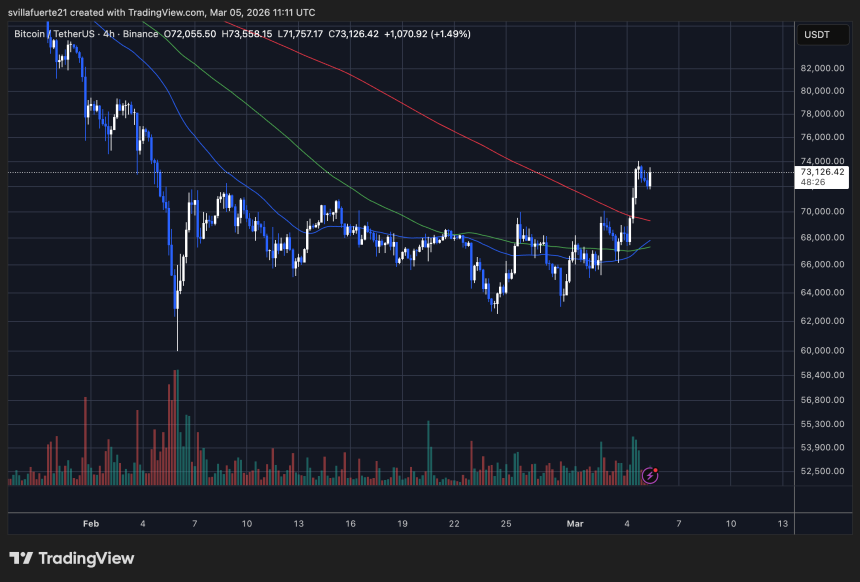
From a technical perspective, the recent rally allowed Bitcoin to reclaim its short-term moving averages, including the 50-period and 100-period lines, which had previously acted as resistance during the consolidation phase. The ability to break above these levels suggests a shift in short-term momentum as buyers regain control of the market.
Price is now approaching the 200-period moving average, which sits slightly above the current level and represents a key technical barrier near the $74,000 region. This level could act as the next resistance zone, as longer-term participants often use it as a reference for trend confirmation.
Volume has also increased during the breakout, indicating stronger participation as the market moves higher. The sharp upward candles reflect aggressive buying pressure, which aligns with the short-covering dynamics observed in derivatives markets.
If Bitcoin manages to consolidate above $70,000, the breakout could establish this level as a new support zone. However, failure to maintain this structure could lead to another retest of the $68,000–$69,000 region before the market attempts a new directional move.
Featured image from ChatGPT, chart from TradingView.com
Potrebbe anche piacerti

XAG/USD Soars Past $84.00 As Safe-Haven Frenzy Meets Crucial NFP Test
Trading Moment: With the non-farm payrolls report imminent, crude oil prices surge, while gold, silver, and Bitcoin face pressure; 80% of analysts are bullish on BTC.
